- What a dormancy period is
- When the clock starts and what restarts it
- The uniform act's periods
- Dormancy periods by state
- Vendor checks and wages: where states differ
- Credits, AR balances and gift cards
- Securities and IRAs
- Recent changes and conflicting sources
- From dormancy date to report
- Questions holders ask
- Sources
Counted from the 51-row table below (each state's statute, or its holder manual where the statute is silent). Maryland excludes ordinary vendor checks altogether.
What a dormancy period is
Unclaimed property laws do not ask a business to hand over money the moment a payee goes quiet. They set a waiting period for each kind of property, and only when it runs out is the property presumed abandoned and reportable. The 2016 uniform act says property “is presumed abandoned if it is unclaimed by the apparent owner during the period specified below”, and then gives a period for each type (section 201). Holders and states call it the dormancy period, the holding period or the abandonment period; they mean the same thing.
The periods have been getting shorter. The Uniform Law Commission explains: “The 1981 Act shortened the general dormancy period from seven years to five years and the 1995 Act then shortened the general dormancy period from five years to three years.” States that never adopted the later acts, or wrote their own, kept longer periods, which is why the same check can be reportable after 3 years in one state and 5 in the next.
When the clock starts and what restarts it
The clock starts when the owner could first claim the property. For a vendor check that is when the debt is due: the model act's period for “a debt of a business association, three years after the obligation to pay arises” (section 201(4)). For wages it is when they are payable; for a customer credit, when the credit arose. Many states count the same way, in their own words.
The clock restarts when the owner shows interest. Under RUUPA the period runs from the later of the dormancy date and “the latest indication of interest by the apparent owner in the property” (section 210(a)). That includes a written message from the owner, a phone call if the holder “contemporaneously makes and preserves a record” of it, and activity the owner directs in the account (section 210(b)).
RUUPA section 210(a) to (d). States without RUUPA have their own lists, often shorter.
The record is what counts. An owner's call that nobody logged does not restart anything an auditor can see, so the date of each owner contact belongs in the same system as the item.
The uniform act's periods
RUUPA is the baseline many states start from, and its periods are the ones most holders meet. Wages wait “one year after the amount becomes payable” (section 201(11)). A customer credit from a retail sale waits “three years after the obligation arose” (section 201(6)). Anything without its own period waits “the earlier of three years after the owner first has a right to demand the property or the obligation to pay or distribute the property arises” (section 201(13)). Gift cards are optional: the act's bracketed section 207 sets 5 years for states that cover them, and the comment says “This Act does not take a position with respect to whether unredeemed balances on gift certificates or gift cards should be covered by the Act.”
RUUPA sections 201, 206, 207 and 208. A state's own statute sets its periods; the table below has each one.
The full act and its comments are on the Uniform Law Commission's page. Each state's own statute decides; the table below is built from those statutes, not from the model.
Dormancy periods by state
One row per state and DC, for the property a business usually holds. Each cell gives the state's period in plain words, from its statute unless the cell says the value comes from the state's manual, rule or office page. "Not listed" means the saved sources give no period for that type. The source column links the statute and gives the citation. The state pages add the rest of each state's list (bank accounts, insurance, safe deposit boxes, money orders) and its own property codes.
| State | Vendor and AP checks | Wages and payroll | Customer credits and refunds | AR credit balances | Gift cards and stored value | Securities and dividends | IRAs and retirement | Catch-all | Statute |
|---|---|---|---|---|---|---|---|---|---|
| Alabama | 3 years (catch-all) | 1 year | 1 year (retail); 3 years (other) | 1 year (retail); 3 years (other) | Exempt (retailers); other certificates 3 years | 3 years | 3 years | 3 years | alison.legislature.state.al.us Code of Ala. 35-12-72(a) |
| Alaska | 3 years | 1 year | 3 years | 3 years | 3 years, at the price paid | 5 years | 3 years after distribution is mandatory | 3 years | akleg.gov AS 34.45.110 to 34.45.260 |
| Arizona | 3 years | 1 year | 3 years | 3 years | Not property (ruling UPR 26-1) | 3 years | 2 years | 3 years | azleg.gov A.R.S. 44-302(A) |
| Arkansas | 3 years | 1 year | 3 years | 3 years | Not property (retailer cards) | 7 years (stock); 3 years (bond interest) | 3 years | 3 years | advance.lexis.com Ark. Code 18-28-202 |
| California | 3 years | 1 year | 3 years | 3 years | Exempt, unless it has an expiration date (then 3 years) | 3 years | 3 years | 3 years | leginfo.legislature.ca.gov Cal. Code Civ. Proc. 1513, 1516, 1520 |
| Colorado | 3 years | 1 year | 3 years | 3 years | 5 years; exempt if gift card sales are $200,000 or less a year | 3 years after returned mail | 3 years after payable (HB 25-1224, June 4, 2025) | 3 years | lexisnexis.com C.R.S. 38-13-201 to 38-13-208 |
| Connecticut | 3 years | 1 year | 3 years | 3 years | Exempt (gift certificates and general-use prepaid cards) | 3 years | 3 years; not before 6 months after required distribution | 3 years | cga.ct.gov Conn. Gen. Stat. 3-57a to 3-64a |
| Delaware | 5 years | 5 years | 5 years | 5 years | 5 years, at the issuer's maximum cost | 3 years | 3 years after required distribution date | 5 years | delcode.delaware.gov 12 Del. C. 1133 |
| District of Columbia | 3 years | 1 year | 3 years | 3 years | 5 years (gift cards); 3 years (other stored value) | 3 years after returned mail | 3 years | 3 years | code.dccouncil.gov D.C. Code 41-152.01 to 41-152.08 |
| Florida | 5 years | 1 year | 5 years; retail credit memos exempt | 5 years | Exempt, except multi-merchant cards from banks or money services | 3 years after returned mail or 5 years without activity | 5 years | 5 years | leg.state.fl.us Fla. Stat. 717.102 to 717.116 (ch. 2026-174) |
| Georgia | 5 years | 1 year | 5 years | 5 years | 5 years, at the price paid | 5 years | 5 years | 5 years | advance.lexis.com O.C.G.A. 44-12-193 to 44-12-211 |
| Hawaii | 5 years (catch-all) | 1 year | 5 years | 5 years | Exempt if no expiration date or fees | 5 years | 3 years | 5 years | capitol.hawaii.gov HRS 523A-3(a) |
| Idaho | 5 years (catch-all) | 1 year | 5 years | 5 years | Not property; other stored value 5 years | 5 years after returned mail | 3 years | 5 years | legislature.idaho.gov Idaho Code 14-5-201 to 14-5-208 |
| Illinois | 3 years | 1 year | 3 years | 3 years | Gift cards not property; open-loop cards 5 years | 3 years after returned mail or 5 years inactive | 3 years | 3 years | ilga.gov 765 ILCS 1026/15-201 to 15-208 |
| Indiana | 3 years | 1 year | 3 years | 3 years; B2B credit memo balances exempt | Not property | 3 years after returned mail | 3 years | 3 years | iga.in.gov IC 32-34-1.5-4 to 32-34-1.5-10 |
| Iowa | 3 years | 1 year | 3 years; B2B credits exempt | 3 years; B2B balances exempt | 5 years; no-fee, no-expiry cards exempt | 3 years | 3 years (rule) | 3 years | legis.iowa.gov Iowa Code 556.2 to 556.9 |
| Kansas | 5 years; checks to businesses exempt | 1 year | 5 years; business customers exempt | 5 years; business customers exempt | Removed from the act in 1999; open-loop cards reportable (office) | 5 years | 3 years | 5 years | ksrevisor.gov K.S.A. 58-3935(a) |
| Kentucky | 3 years | 1 year | 3 years (retail; not in-store credit for returns) | 3 years (catch-all) | Gift cards not property; other stored value 3 years | 3 years after the second returned mailing | 3 years after the later of returned mail and age 70 1/2 | 3 years | apps.legislature.ky.gov KRS 393A.040 |
| Louisiana | 5 years (all other property) | 1 year | 3 years (retail); 5 years (other) | 3 years (retail); 5 years (other) | 3 years after December 31 of the year sold | 3 years | 3 years after the earliest distribution date | 5 years | legis.la.gov La. R.S. 9:154 |
| Maine | 3 years | 1 year | 3 years (retail) | 3 years (catch-all) | 2 years, but 0% reportable if last active in 2022 or later | 3 years after returned mail | 3 years after the later of returned mail and required distribution | 3 years | legislature.maine.gov 33 M.R.S. 2061 to 2068 |
| Maryland | Excluded if issued to vendors in the ordinary course; else 3 years | 3 years | 3 years; credits to commercial customers excluded | Excluded for vendor or commercial accounts; else 3 years | Not property (gift certificates and gift cards) | 3 years after the later of lost address or last contact | 3 years after returned mail, or at age 72 if earlier | 3 years | mgaleg.maryland.gov Md. Code, Com. Law 17-101, 17-308 |
| Massachusetts | 3 years (catch-all; manual code CK13) | 3 years (catch-all) | 3 years; vendor and commercial customer credits exempt | Exempt with commercial customers; else 3 years | Not reportable (manual); expired certificates outside the law | 3 years | 3 years after the earliest distribution date | 3 years | malegislature.gov M.G.L. c. 200A, 5 |
| Michigan | 3 years | 1 year (over $50 only) | 3 years; credits between businesses exempt | Exempt between businesses (since April 1, 2009); else 3 years | 3 years; retail gift certificates outside the act | 3 years | 3 years once distribution is mandatory | 3 years | legislature.mi.gov MCL 567.223, 567.236 |
| Minnesota | 3 years | 1 year | 3 years | 3 years | Exempt (retail sellers) | 3 years | 3 years (holder guide) | 3 years | revisor.mn.gov Minn. Stat. 345.39 |
| Mississippi | 5 years | 5 years (catch-all; the rule repeats it) | 5 years (catch-all) | 5 years (catch-all) | 5 years (statute); office FAQ skips cards with a printed expiry | 5 years and 5 unclaimed distributions | 5 years after payable or distributable (fiduciary) | 5 years | advance.lexis.com Miss. Code 89-12-5, 89-12-11, 89-12-13, 89-12-15 |
| Missouri | 5 years | 3 years (since January 1, 2015) | 5 years; merchandise-only credits at 60% of face | 5 years | 5 years; 60% of face if merchandise only | 5 years | 5 years (fiduciary rule) | 5 years | revisor.mo.gov RSMo 447.535, 447.536 |
| Montana | 5 years (catch-all) | 1 year | 3 years (retail); 5 years (other) | 3 years (retail); 5 years (other) | 3 years; 60% if merchandise only; small sellers exempt | 3 years after the second returned mailing | 3 years after the earliest distribution date | 5 years | mca.legmt.gov MCA 70-9-803 |
| Nebraska | 5 years | 1 year | 3 years (credit memos); 5 years (other) | 5 years (catch-all) | Not abandoned if no fees and no expiry; else 3 years | 5 years | 30 days after the earliest distribution date | 5 years | nebraskalegislature.gov Neb. Rev. Stat. 69-1302, 69-1308 |
| Nevada | 3 years (catch-all) | 1 year | 3 years (retail) | 3 years (catch-all) | 60% reportable on expiry; no expiry date, not reportable | 3 years after last owner interest | 3 years | 3 years | leg.state.nv.us NRS 120A.500 |
| New Hampshire | 5 years | 1 year | 5 years | 5 years | Exempt up to $250, and store credits; over $250, 5 years | 3 years | 5 years once distribution is mandatory (cash) | 5 years | gc.nh.gov RSA 471-C:2, 471-C:17 |
| New Jersey | 3 years | 1 year | 3 years | 3 years | 5 years; 60% of value (100% for reloadable cards) | 3 years | 3 years after the earliest distribution date | 3 years | unclaimedproperty.nj.gov N.J.S.A. 46:30B-7, 46:30B-42, 46:30B-44 |
| New Mexico | 5 years (catch-all) | 1 year | 3 years (retail); 5 years (other) | 5 years (3 if a retail customer credit) | 5 years; 60% of face if merchandise only | 5 years | 3 years after the earliest distribution date | 5 years | nmonesource.com NMSA 7-8A-2 |
| New York | 3 years | 3 years (after a returned notice) | 3 years from the date issued | 3 years | 5 years, even if expired or merchandise only | 3 years | 3 years after the mandatory distribution date | Not listed | nysenate.gov N.Y. Aband. Prop. Law 501, 1315 |
| North Carolina | 5 years | 1 year | 3 years (retail); 5 years (other) | 3 years (retail); 5 years (other) | 3 years at 60%, only if it bears an expiration date | 3 years | 3 years after the earliest distribution date | 5 years | ncleg.gov G.S. 116B-53(c) |
| North Dakota | 2 years | 1 year | 3 years (retail) | 3 years (catch-all) | Gift cards not property; open loop stored value 3 years | 3 years | 3 years | 3 years | ndlegis.gov N.D.C.C. 47-30.2-04 |
| Ohio | 1 year (suppliers); payments to businesses excluded | 1 year | 3 years (retail customers) | 3 years (catch-all) | Excluded (redeemable only for goods or services) | 5 years | 3 years after the final date for distribution | 3 years | codes.ohio.gov R.C. 169.02 |
| Oklahoma | 5 years (catch-all) | 1 year | 5 years (credit memos over $50) | 5 years (catch-all) | 5 years (Form 496-UP) | 3 years | 7 years after age 72 (Form 496-UP) | 5 years | oklegislature.gov 60 O.S. 658 |
| Oregon | 3 years (catch-all) | 1 year | 3 years (credit memos) | 3 years | Not listed | 3 years | 3 years once distribution is mandatory | 3 years | oregonlegislature.gov ORS 98.342 |
| Pennsylvania | 3 years (catch-all) | 2 years | 3 years (catch-all) | 3 years (catch-all) | 3 years from issue if no redemption period; qualified cards exempt | 3 years after lost contact | 3 years after lost contact | 3 years | palegis.us 72 P.S. 1301.10 |
| Rhode Island | 3 years (catch-all) | 1 year | 3 years (credit memos) | 3 years (catch-all) | Not presumed abandoned | 5 years (after 5 unclaimed dividends) | 3 years once distribution is mandatory | 3 years | webserver.rilegislature.gov R.I. Gen. Laws 33-21.1-2 |
| South Carolina | 5 years (catch-all) | 1 year | 5 years (credit memos) | 5 years (office) | Not listed | 3 years | 5 years once distribution is mandatory | 5 years | scstatehouse.gov S.C. Code 27-18-30 |
| South Dakota | 3 years (catch-all) | 1 year | 3 years (credit memos) | 3 years (catch-all) | Exempt if no expiration or fees; otherwise 3 years | 3 years | 3 years once distribution is mandatory | 3 years | sdlegislature.gov SDCL 43-41B-2 |
| Tennessee | 3 years | 1 year | 3 years (retail) | 3 years (catch-all) | Gift cards not property; other stored value 5 years | 3 years | 3 years | 3 years | advance.lexis.com Tenn. Code 66-29-105 |
| Texas | 3 years | 1 year | 3 years | 3 years | 3 years from issue or last use (stored value cards) | 3 years | 3 years from the RMD date (guide) | 3 years | tcss.legis.texas.gov Tex. Prop. Code 72.101 |
| Utah | 3 years | 1 year | 3 years (retail) | 3 years (catch-all) | Gift cards not property; stored value 3 years | 3 years | 3 years | 3 years | le.utah.gov Utah Code 67-4a-201 |
| Vermont | 3 years | 1 year | 3 years (retail) | 3 years (catch-all) | Gift cards not property; other stored value 3 years | 3 years | 3 years | 3 years | legislature.vermont.gov 27 V.S.A. 1461 |
| Virginia | 5 years | 1 year | 5 years (credit balances) | 5 years (credit balances) | Exempt if redeemable in merchandise or services | 5 years | 5 years once distribution is mandatory | 5 years | law.lis.virginia.gov Va. Code 55.1-2501 |
| Washington | 3 years | 1 year | 3 years (retail) | 3 years (catch-all) | Compliant gift certificates not property; stored value 3 years | 3 years | 3 years | 3 years | app.leg.wa.gov RCW 63.30.040 |
| West Virginia | 3 years (office table) | 1 year (office table) | 3 years (retail; office table) | 3 years (office table) | 3 years (office table) | 5 years (office table) | 3 years (office table) | 3 years (office table) | wvunclaimedproperty.gov W. Va. property type codes (2022, updated 2024) |
| Wisconsin | 3 years (debts owed to individuals) | 1 year | 5 years (retail) | 5 years (catch-all) | Not property (gift and stored-value cards) | 3 years | 3 years | 5 years | docs.legis.wisconsin.gov Wis. Stat. 177.0201 |
| Wyoming | 5 years | 1 year | 5 years (credit memos over $100) | 5 years | 5 years if over $100; exempt if no expiration or fees | 3 years | 90 days after the distribution date, absent activity in 5 years | 5 years | wyoleg.gov W.S. 34-24-103 |
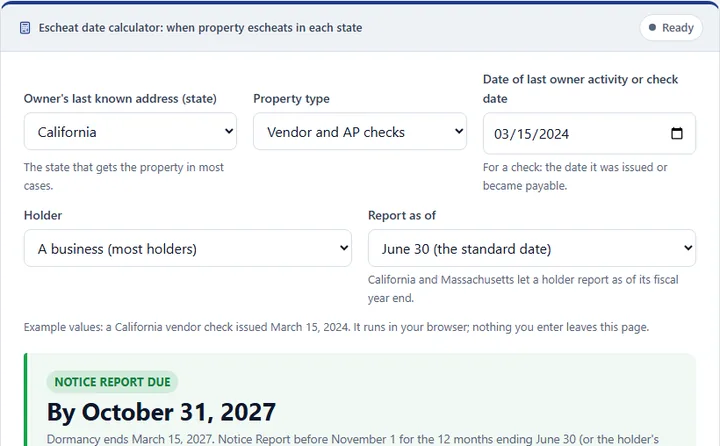
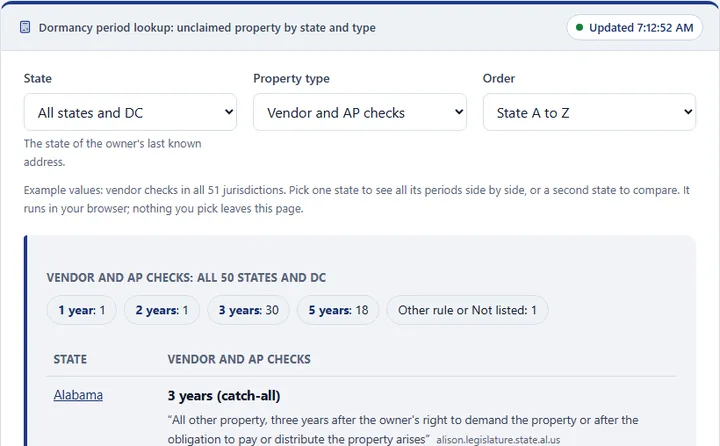
Two cells in a row can rest on the same catch-all section: where a state's law has no line for AR credit balances or vendor checks, the "all other property" period applies, and the cell says "(catch-all)". The dormancy period lookup pulls one state's periods, and the escheat date calculator works out the report date for one item.
Vendor checks and wages: where states differ
For vendor and accounts payable checks, 30 jurisdictions use 3 years and 18 use 5 years: Delaware, Florida, Georgia, Hawaii, Idaho, Kansas, Louisiana, Mississippi, Missouri, Montana, Nebraska, New Hampshire, New Mexico, North Carolina, Oklahoma, South Carolina, Virginia and Wyoming. North Dakota is the shortest: checks “remain uncashed by the owner two years after becoming payable” (N.D.C.C. 47-30.2-04). Ohio counts money owed to suppliers among the sums “held or owed by any holder unclaimed for one year from date payable or distributable” (R.C. 169.02), but it also excludes payments between businesses. Maryland excludes “Outstanding checks or credits issued to vendors or commercial customers in the ordinary course of business” (Md. Code, Com. Law 17-101). Several other states exempt checks to businesses in some form; the uncashed checks guide has each state's business-to-business rule.
Wages are simpler: 44 jurisdictions use 1 year. The exceptions are Maryland, Massachusetts, Missouri and New York at 3 years, Pennsylvania at 2 years, and Delaware and Mississippi at 5 years. Pennsylvania's law covers “Wages or other compensation for personal services that have remained unclaimed by the owner for more than two (2) years” (72 P.S. 1301.10). 3 states also set a dollar floor for wages (Kentucky, Michigan and Ohio); the unclaimed wages guide covers those and payroll cards.
Credits, AR balances and gift cards
Customer credits split by the kind of sale in many states. Alabama, for example, sets “Money or credits owed to a customer as a result of a retail business transaction, one year after the obligation accrued” for retail credits and the 3 year catch-all for the rest (Code of Ala. 35-12-72). Accounts receivable credit balances, customer overpayments and unapplied cash usually have no line of their own and fall under the retail credit rule or the catch-all. Some states exempt credits between businesses; Michigan, Nevada and Iowa exempt the credits but not checks. The customer credits and refunds guide goes deeper.
Gift cards are where states differ most. Some exempt them outright or define them out of "property"; North Dakota's definition says the term does not include “(4) A gift card.” Others report them after a period, often at a percentage of face value: Missouri's law says “Gift certificates, credit memos and credit balances that are redeemable in merchandise only shall be reportable at a rate equal to sixty percent of their respective face value.” (RSMo 447.505). Delaware lists “A stored-value card or gift card, 5 years after the later of the date of purchase” (12 Del. C. 1133). The gift cards guide covers each state's rule and the federal limits on expiration dates.
Securities and IRAs
Securities and dividends are usually measured by lost contact, not time alone. Under RUUPA a security is presumed abandoned three years after “the date a second consecutive communication sent by the holder by first-class United States mail to the apparent owner is returned to the holder undelivered” (section 208). States vary the test: Maine's law says “a security is presumed abandoned 3 years after the later of” a set of dates tied to returned mail (33 M.R.S. ch. 45), while Missouri counts “within seven years or five years as provided in section 447.536 after the date prescribed for payment or delivery” (RSMo 447.520).
Retirement accounts wait for the date distributions must begin. RUUPA ties them to returned mail or the date the owner “becomes 72 years of age, if determinable by the holder” (section 202). Colorado changed its rule in 2025: an account now waits 3 years after it becomes payable or distributable “IF THE OWNER HAS NOT ACCEPTED THE DISTRIBUTION, CORRESPONDED IN WRITING CONCERNING THE DISTRIBUTION, OR OTHERWISE INDICATED AN INTEREST” (HB 25-1224, effective June 4, 2025). Escheated IRA money also has a federal tax side; the securities and retirement guide covers both.
Recent changes and conflicting sources
Several states changed their periods between 2024 and 2026, and some holder manuals have not caught up:
- Florida rewrote chapter 717 in chapter 2026-174 (“Approved by the Governor June 26, 2026.”). The statute now says “Unless otherwise specified by law, the dormancy period is 5 years from the date the property becomes payable or distributable” and sets securities at “Three years after the date a communication” or “Five years after the most recent of any account activity or communication initiated by the apparent owner”. The state's reporting manual still lists “Unclaimed Dividends 3”. The 2026 law governs; see Florida's 2026 changes.
- Arizona struck its business-to-business, de minimis and gift card exclusions from the statute. The Department of Revenue says the change in Laws 2026, ch. 224 (Senate Bill 1336), “was passed on June 22, 2026 and has an effective date of September 12, 2026”. Its ruling UPR 26-1 still says that items such as gift cards “are not ‘property’ for purposes of A.R.S. Title 44, Chapter 3”. The ruling also says it “does not have the force of law”. The table shows the ruling's position, marked as such; the statute is the law.
- Colorado HB 25-1224 (June 4, 2025) changed the retirement account rule above.
- Maine PL 2025 c. 675 changed the retirement account rule; the statute now counts from the later of returned mail and “The date a distribution is required under the United States Internal Revenue Code of 1986”.
Where a state's own office page disagrees with its statute, the table follows the statute. Wisconsin's law says “A debt of a business association owed to an individual, 3 years after the obligation to pay arises” (Wis. Stat. 177.0201(4)), while the Department of Revenue's Publication 82 lists “CK13 VENDOR CHECKS 5”. The statute is the law; ask the office which period it applies before relying on its table.
From dormancy date to report
The dormancy date is not the report date. A state collects once a year, for items that went dormant in its report period. Under the model act the fall report covers “the 12 months preceding July 1 of that year” (section 403(a)). A vendor check issued on March 15, 2023 in a 3 year state with a June 30 cutoff turns dormant on March 15, 2026, falls in the year ending June 30, 2026, and goes on the report due before November 1, 2026, after a due diligence letter in that summer's window. The same check in a 5 year state with the same cutoff waits for the report due in 2028.
Spring and summer states use other cutoffs: Delaware's report “must be filed by all holders and business associations other than banking organizations and insurance companies on or before March 1 of each year to cover the 12 months preceding January 1 of that year”, so its cutoff is December 31. The escheat process page walks through the yearly cycle, and the reporting calendar lists every state's dates.
Tools for this topic
Questions holders ask
What is a dormancy period for unclaimed property?
The time property must go unclaimed before the holder must report it to the state. It is set by state law for each property type, such as 3 years for most vendor checks and 1 year for wages.
What is the dormancy period for uncashed checks?
For vendor and accounts payable checks, 3 years in 30 jurisdictions and 5 years in 18. North Dakota uses 2 years. Payroll checks follow the wage period, 1 year in most states. Check the table for your state.
Does sending a statement restart the dormancy period?
No. Under the 2016 uniform act the period restarts on an indication of interest by the owner: a message, a recorded call, cashing a check or activity in the account. A statement the holder sends is not the owner's action.
Which state's dormancy period applies?
The period of the state that gets the property: usually the state of the owner's last known address in your records, or your state of incorporation if there is no address.
Can I report property before the dormancy period ends?
Only where the state allows it. Under the 2016 uniform act early reporting needs the administrator's consent in a record. Ask the state first.
Sources
- Revised Uniform Unclaimed Property Act (2016, as amended 2022), sections 201, 202, 206 to 210 and 403, and the comments: Uniform Law Commission
- Each state's statute, linked in the table's Statute column; holder manuals and office pages where a cell says so
- Laws of Florida ch. 2026-174: laws.flrules.org; Florida reporting instructions manual: myfloridacfo.com
- Arizona Department of Revenue ruling UPR 26-1: azdor.gov; unclaimed property news: azdor.gov; Colorado HB 25-1224: leg.colorado.gov
- New Hampshire property type code table: findnhmoney.gov