- Stale-dated is a bank rule, not an escheat rule
- When an uncashed check escheats
- Voiding and writing back do not clear it
- Outstanding checks in the bank reconciliation
- Checks to other businesses
- Uncashed vendor checks by state
- Due diligence before you report a check
- Texas v. New Jersey: a case about uncashed checks
- After a check escheats
- Questions holders ask
- Sources
UCC 4-404 and the 51-row table below, from each state's statute or holder manual.
Stale-dated is a bank rule, not an escheat rule
"Stale-dated" comes from banking law. Under the Uniform Commercial Code, “A bank is under no obligation to a customer having a checking account to pay a check, other than a certified check, which is presented more than six months after its date” (UCC 4-404). The same section lets the bank pay it anyway in good faith. So after six months the bank may refuse the check.
None of that changes what the business owes. The check was a way to pay a debt; when it is not cashed, the debt is still there. Missouri's holder guidance puts it plainly: “Stale outstanding checks - checks written represent an attempt to pay a valid obligation.” And: “If a check does not clear the bank, the underlying liability is Unclaimed Property if it cannot be restored to the payee.” North Carolina's guide to uncashed checks says the same of every kind: “An outstanding check is any check that has not cleared your bank for payment. This includes checks that are outstanding, written-off, stale-dated or returned by the post office.”
UCC 4-404; RUUPA sections 201(4), 403 and 501. Periods, windows and thresholds by state are in the table below.
The six months and the three years are separate clocks. The first is the bank's; the second is the state's, and it is the one that decides when the business must report. The stale-dated check policy template sets out how to handle both.
When an uncashed check escheats
The dormancy period depends on what the check paid for, not on the fact that it is a check. A vendor or accounts payable check is a business's debt; the 2016 uniform act sets “a debt of a business association, three years after the obligation to pay arises” (section 201(4)). Of the 50 states and DC, 30 use 3 years for vendor checks and 18 use 5 years (Delaware, Florida, Georgia, Hawaii, Idaho, Kansas, Louisiana, Mississippi, Missouri, Montana, Nebraska, New Hampshire, New Mexico, North Carolina, Oklahoma, South Carolina, Virginia and Wyoming). North Dakota is the shortest: checks “remain uncashed by the owner two years after becoming payable” (N.D.C.C. 47-30.2-04).
Other checks follow their own property type. Payroll checks are wages, usually 1 year (see unclaimed wages and payroll checks). Refund and rebate checks follow the rules for customer credits; North Carolina says “Refund checks are reportable three years from the date issued if associated with a retail transaction and five years from the date issued for all other transactions.” Dividend checks follow securities. In the NAUPA file, vendor checks carry their own code, “CK13 Vendor Checks”, and a check written off to income has one too: “CK14 Checks Written off to Income”.
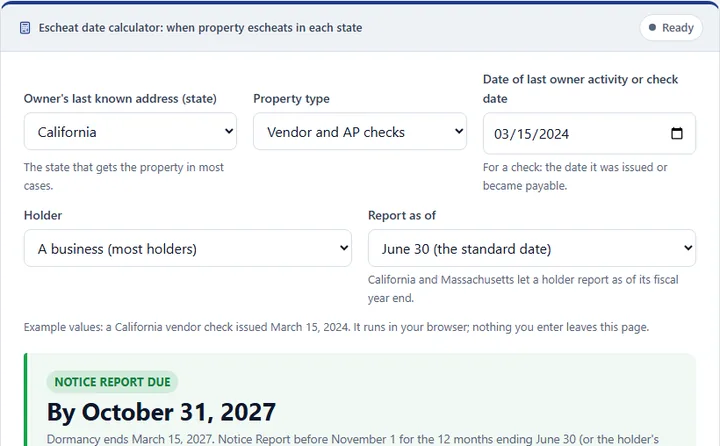
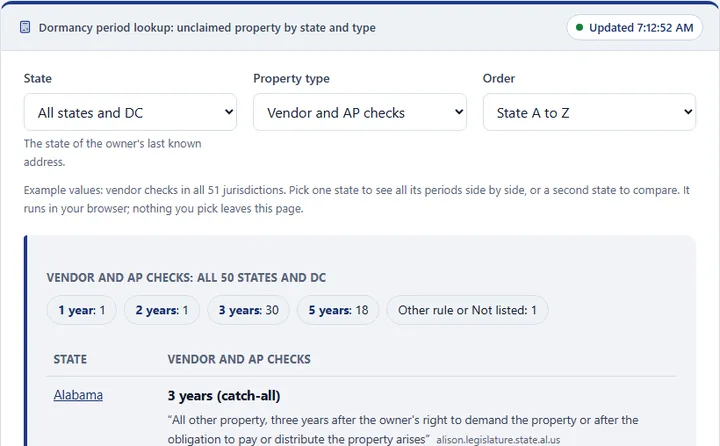
The dormancy periods by state table has every property type, and the escheat date calculator counts the report date for one check.
Voiding and writing back do not clear it
The most common mistake with old checks is to void them, or reverse them to income or miscellaneous revenue, and treat the matter as closed. It is not. The payee is still owed, and the unclaimed property law still reaches the debt. Illinois says so in its rules: a valid business reason to void “does not include a policy of voiding outstanding checks, drafts, or similar instruments after a specified number of days”, and “a policy of automatically voiding would be tantamount to a private escheat law in violation of longstanding public policy in Illinois” (74 Ill. Adm. Code 760.780).
Write-offs get the same treatment. Missouri: “if valid obligations have been written off to an income or expense account in the past, they must be reinstated and reported as Unclaimed Property”. The District of Columbia: “past obligations that have been written off or taken to income are reportable”, because the law “prevents businesses from circumventing the unclaimed property process by making a private escheat”.
RUUPA section 1005(c); 74 Ill. Adm. Code 760.780; Missouri and DC holder guidance.
There are real reasons a check is not owed, and the 2016 uniform act lists them. A holder can show that a check was “issued in error”, “paid, satisfied, or discharged”, replaced with another check, issued without consideration, or “voided [not later than 90 days] [within a reasonable time] after issuance for a valid business reason set forth in a contemporaneous record” (section 1005(c)). Illinois adopted the 90 day version: a check “voided not later than 90 days after issuance” for a recorded business reason. What these share is a record made at the time: a void with a written reason the week the check was cut is a defense; a mass void three years later is not.
On the books, the liability stays open until the check is paid or reported. The escheatment accounting guide shows the journal entries from void to remittance.
Outstanding checks in the bank reconciliation
Most uncashed checks are found in the bank reconciliation, where they sit on the outstanding check list month after month. The list is the starting point for the escheat review, but it hides things. North Carolina's guide warns that checks can be “‘buried’ and easily overlooked”: “It is possible a check number was reused before clearing off a stale-dated check to a liability account. Or, if an outstanding check report sorts by month and day, but not by year, older checks may move from the top of a report to the middle of a report.”
Alaska's self-review guidance tells holders to “review quarterly outstanding lists and void reports” and to “Identify outstanding checks aged 90+ days on each report and voided checks aged 30+ days on each report.” Checks a bank or payment provider issues for you count too: “the company typically remains liable for reporting the unclaimed checks unless otherwise stated in the contract”.
Built from North Carolina's guide to uncashed checks, Alaska's self-review guidance and RUUPA Articles 2, 4 and 5.
Two habits make this work: move each check that will not clear to a liability account with its payee, amount, issue date and last known address, instead of letting it fall off the reconciliation; and age that account by issue year, not by month. Before reissuing to a vendor you cannot reach, check whether the business still exists: goodstandingrules.com links every state's business entity search. A vendor that has dissolved can still be owed money, and its check still goes to the state of its address when the period runs.
Checks to other businesses
Most uncashed checks are owed to vendors, so the business-to-business (B2B) question matters. The 2016 uniform act has no B2B exemption; its drafters note that “Fifteen states have some form of statutory exemption from” property for business-to-business transactions and leave it to each state. Read the state's words closely, because many exemptions cover credits but not checks:
- Checks to businesses exempt, in some form (8): Arizona, Kansas, Maryland, Missouri, Ohio, Tennessee, Virginia and Wisconsin. Kansas: “Any outstanding check, draft, credit balance, customer's overpayment or unidentified remittance issued to a sole proprietorship or business association as part of a commercial transaction in the ordinary course of a holder's business shall not be presumed abandoned” (K.S.A. 58-3935(g)). Missouri and Tennessee exempt them only while there is an ongoing business relationship; Virginia's covers “outstanding checks resulting from or attributable to the sale of goods or services to a business association” (Va. Code 55.1-2501); Arizona's rests on a 2026 ruling after the statutory text was struck.
- Credits exempt, checks still reportable (5): Indiana, Iowa, Michigan, Nevada and North Carolina. Michigan's exemption says “This exemption does not apply to outstanding checks, drafts, or other similar instruments.” Nevada's says “The provisions of this subsection do not apply to outstanding checks, drafts or other similar instruments.”
- Unclear for checks: Massachusetts exempts “any outstanding credit balances to a vendor or commercial customer from a vendor resulting from a transaction occurring in the normal and ordinary course of business shall be exempt” (M.G.L. c. 200A, 5), and its rule says a credit balance includes “the payment to vendors for the purchase of goods and services” (960 CMR 4.03), yet the holder manual still lists vendor checks at 3 years: “CK13 Vendor Checks 3”. Ask the state's unclaimed property office before treating a vendor check as exempt.
- No B2B exemption, said expressly (9): Delaware, Georgia, Idaho, Illinois, New Jersey, New York, North Dakota, South Carolina and West Virginia. Delaware's code: “Nothing in this section shall be construed to create a business-to-business exemption of any kind” (12 Del. C. 1130).
- No exemption found in the statute (28): the rest. Report checks to businesses like any other.
An exemption is not a reason to keep an old vendor check on the books forever. Where it applies, it usually depends on the payee being a business and on the relationship, both of which an auditor will test; keep the records that show them.
Uncashed vendor checks by state
One row per state and DC: the dormancy period for an uncashed vendor or accounts payable check, the state's business-to-business rule as it applies to checks, and the due diligence letter threshold and window. "None found" in the B2B column means the saved statute, rules and manual show no exemption; "Not listed" means no source gave the value.
| State | Vendor check dormancy | Business-to-business rule for checks | Due diligence letter | Statute |
|---|---|---|---|---|
| Alabama | 3 years (catch-all) | None found | $50 or more; at least 60 days before the report | alison.legislature.state.al.us Code of Ala. 35-12-72(a) |
| Alaska | 3 years | None found | $100 or more; within 120 days before the report | akleg.gov AS 34.45.110 to 34.45.260 |
| Arizona | 3 years | Excluded by ruling UPR 26-1: B2B $50 or less, current relationship | $50 or more; mailed at least 120 days before the report Sample due diligence letter (in Publication 651) | azleg.gov A.R.S. 44-302(A) |
| Arkansas | 3 years | None found | $50 or more; 90 to 180 days before the report Sample due diligence letters (Booklet pp. 24 to 25) | advance.lexis.com Ark. Code 18-28-202 |
| California | 3 years | None found | $50 or more; 6 to 12 months before it becomes reportable Guide to Due Diligence (PDF) | leginfo.legislature.ca.gov Cal. Code Civ. Proc. 1513, 1516, 1520 |
| Colorado | 3 years | None found | $25 or more; 60 to 180 days before the report Sample Due Diligence Letter (PDF) | lexisnexis.com C.R.S. 38-13-201 to 38-13-208 |
| Connecticut | 3 years | None found | $50 or more by mail; mailed July 1 to Sept. 30 Sample Due Diligence Letter (PDF) | cga.ct.gov Conn. Gen. Stat. 3-57a to 3-64a |
| Delaware | 5 years | Statute rejects any B2B exemption | $50 or more (securities any value); 60 to 120 days before Due Diligence Sample Letter (Handbook appendix) | delcode.delaware.gov 12 Del. C. 1133 |
| District of Columbia | 3 years | None found | $50 or more; 60 to 180 days before the report Due Diligence Letter (PDF) | code.dccouncil.gov D.C. Code 41-152.01 to 41-152.08 |
| Florida | 5 years | None found | $50 or more; 90 to 180 days; certified mail over $1,000 | leg.state.fl.us Fla. Stat. 717.102 to 717.116 (ch. 2026-174) |
| Georgia | 5 years | No B2B exemption (DOR FAQ) | $50 or more; 60 to 120 days; certified mail over $10,000 Sample owner notification letter (Annual Filing Info) | advance.lexis.com O.C.G.A. 44-12-193 to 44-12-211 |
| Hawaii | 5 years (catch-all) | None found | $50 or more; within 6 months before the report | capitol.hawaii.gov HRS 523A-3(a) |
| Idaho | 5 years (catch-all) | No B2B exemption (manual) | $50 or more; 60 to 180 days before the report Sample due diligence letter (PDF) | legislature.idaho.gov Idaho Code 14-5-201 to 14-5-208 |
| Illinois | 3 years | Ended in 2017; no B2B exemption | $50 or more; 60 days to 1 year before the report | ilga.gov 765 ILCS 1026/15-201 to 15-208 |
| Indiana | 3 years | B2B credit memos only; checks to businesses stay reportable | $50 or more; 60 to 180 days before the report Sample Due Diligence Form Letter (PDF) | iga.in.gov IC 32-34-1.5-4 to 32-34-1.5-10 |
| Iowa | 3 years | Credits only; checks to businesses stay reportable | $50 or more; office: 60 to 120 days before Nov. 1 Due Diligence Notification letter (PDF) | legis.iowa.gov Iowa Code 556.2 to 556.9 |
| Kansas | 5 years; checks to businesses exempt | Checks and credits to businesses exempt (58-3935(g)) | $100 or more (stock and boxes any value); 60 to 120 days Sample due diligence letter (PDF) | ksrevisor.gov K.S.A. 58-3935(a) |
| Kentucky | 3 years | None found | $50 or more; 60 to 180 days before the report Sample Due Diligence Letter (PDF) | apps.legislature.ky.gov KRS 393A.040 |
| Louisiana | 5 years (all other property) | None found | $50 or more; 60 to 120 days before the report Reporting Cheat Sheet with due diligence tips (PDF) | legis.la.gov La. R.S. 9:154 |
| Maine | 3 years | None found | $50 or more per owner; 60 to 180 days before the report Sample Due Diligence Letter (PDF) | legislature.maine.gov 33 M.R.S. 2061 to 2068 |
| Maryland | Excluded if issued to vendors in the ordinary course; else 3 years | Checks and credits to vendors and commercial customers excluded | $100 or more; 30 to 120 days before the report (statute) Sample due diligence letter in the Holder Manual (PDF) | mgaleg.maryland.gov Md. Code, Com. Law 17-101, 17-308 |
| Massachusetts | 3 years (catch-all; manual code CK13) | Vendor credit balances exempt; rule includes payments to vendors | $100 or more (manual); at least 60 days before the report Due diligence dates (Reporting Guidelines) | malegislature.gov M.G.L. c. 200A, 5 |
| Michigan | 3 years | Credits between businesses exempt; checks stay reportable | $50 or more ($100 for big reporters); 60 to 365 days before Sample due diligence letters (manual, Appendix C) | legislature.mi.gov MCL 567.223, 567.236 |
| Minnesota | 3 years | None found | $100 or more; within 120 days before the report Sample due diligence letter (2026 guide, PDF) | revisor.mn.gov Minn. Stat. 345.39 |
| Mississippi | 5 years | None found | Before the report (statute); office suggests $50 or more, 60 days Due diligence guidance (holder reporting FAQ) | advance.lexis.com Miss. Code 89-12-5, 89-12-11, 89-12-13, 89-12-15 |
| Missouri | 5 years | Checks to businesses with an ongoing relationship exempt | $50 or more; first-class letter within 1 year before | revisor.mo.gov RSMo 447.535, 447.536 |
| Montana | 5 years (catch-all) | None found | $50 or more; 60 to 120 days before the report | mca.legmt.gov MCA 70-9-803 |
| Nebraska | 5 years | None found | Over $25; 60 to 120 days before the deadline (handbook) Due diligence letter rules (Report Requirements) | nebraskalegislature.gov Neb. Rev. Stat. 69-1302, 69-1308 |
| Nevada | 3 years (catch-all) | Credits to businesses exempt; checks stay reportable | $50 or more; 60 to 120 days before the report Sample due diligence letter (Holder Manual, Appendix B) | leg.state.nv.us NRS 120A.500 |
| New Hampshire | 5 years | None found | $50 or more; within 120 days before the report Owner notice rules (Form T-1 instructions, PDF) | gc.nh.gov RSA 471-C:2, 471-C:17 |
| New Jersey | 3 years | No B2B exemption (Treasury FAQ) | $50 or more; certified mail 60 to 120 days before the report Holder Reporting Reminder with due diligence (PDF) | unclaimedproperty.nj.gov N.J.S.A. 46:30B-7, 46:30B-42, 46:30B-44 |
| New Mexico | 5 years (catch-all) | None found | $50 or more; 60 to 120 days before the report Holder Due Diligence | nmonesource.com NMSA 7-8A-2 |
| New York | 3 years | No B2B exemption (handbook) | First-class mail; second notice by certified mail over $1,000 Due Diligence Requirements | nysenate.gov N.Y. Aband. Prop. Law 501, 1315 |
| North Carolina | 5 years | Business credit balances exempt; vendor checks not on the list | $25 or more from Dec. 1, 2026 ($50 before); 60 to 120 days Due Diligence guide with sample letter (PDF) | ncleg.gov G.S. 116B-53(c) |
| North Dakota | 2 years | None: the manual says business payees are reported | $25 or more; up to 120 days before the report Sample due diligence letter, uncashed checks (PDF) | ndlegis.gov N.D.C.C. 47-30.2-04 |
| Ohio | 1 year (suppliers); payments to businesses excluded | Checks and credits between businesses excluded | $50 or more; certified mail at $1,000 or more OUF-8 Notice of Unclaimed Funds letter (PDF) | codes.ohio.gov R.C. 169.02 |
| Oklahoma | 5 years (catch-all) | None found | $50 or more; up to 120 days before the report Due diligence sample letter (Word) | oklegislature.gov 60 O.S. 658 |
| Oregon | 3 years (catch-all) | None found | Over $100; at least 60 days before the report (rule) Sample due diligence letter (PDF) | oregonlegislature.gov ORS 98.342 |
| Pennsylvania | 3 years (catch-all) | None found | $50 or more; 60 to 120 days before the report Holder notice rules, section 1301.10a (PDF) | palegis.us 72 P.S. 1301.10 |
| Rhode Island | 3 years (catch-all) | None found | $50 or more; up to 120 days before the report | webserver.rilegislature.gov R.I. Gen. Laws 33-21.1-2 |
| South Carolina | 5 years (catch-all) | None: the Treasurer says property owed to businesses is reported | $50 or more; up to 120 days before the report Sample due diligence letter (PDF) | scstatehouse.gov S.C. Code 27-18-30 |
| South Dakota | 3 years (catch-all) | None found | $50 or more; at least 60 days before the report (office) Due diligence notice and sample letter (PDF) | sdlegislature.gov SDCL 43-41B-2 |
| Tennessee | 3 years | Not presumed abandoned during an ongoing business relationship | $50 or more; 60 to 180 days before the report Sample due diligence letter, in the Reporting Guide (PDF) | advance.lexis.com Tenn. Code 66-29-105 |
| Texas | 3 years | None found | Over $250; at least 60 days before delivery Sample due diligence letter, general purpose (PDF) | tcss.legis.texas.gov Tex. Prop. Code 72.101 |
| Utah | 3 years | None found | $50 or more; 60 to 180 days before the report Sample due diligence letter, in the Reporting Guide (PDF) | le.utah.gov Utah Code 67-4a-201 |
| Vermont | 3 years | None found | $50 or more; 60 to 180 days before the report Sample due diligence letter (PDF) | legislature.vermont.gov 27 V.S.A. 1461 |
| Virginia | 5 years | Checks for goods or services sold to a business exempt | $100 or more; at least 60 days before the report | law.lis.virginia.gov Va. Code 55.1-2501 |
| Washington | 3 years | None found | $50 or more; 60 to 180 days before the report | app.leg.wa.gov RCW 63.30.040 |
| West Virginia | 3 years (office table) | None: the office says business payees are reported | $50 or more; 60 to 120 days before the report (office) Sample due diligence letter, Exhibit A of the Guidelines | wvunclaimedproperty.gov W. Va. property type codes (2022, updated 2024) |
| Wisconsin | 3 years (debts owed to individuals) | Payments or credits owed to another business excluded | $50 or more; 60 to 120 days before the report Sample owner letter, Publication 82, Appendix 3 (PDF) | docs.legis.wisconsin.gov Wis. Stat. 177.0201 |
| Wyoming | 5 years | None found | $50 or more; up to 120 days before the report | wyoleg.gov W.S. 34-24-103 |
Payroll checks are in the unclaimed wages table; refund checks follow customer credits.
Due diligence before you report a check
Before reporting an uncashed check, write to the payee at the last known address. Under the 2016 uniform act the letter goes “not more than 180 days nor less than 60 days before filing the report” for property of $50 or more (section 501(a)). Of the 51 jurisdictions, 38 start at $50. Colorado, Nebraska, North Carolina and North Dakota set $25 (North Dakota: “The value of the property is twenty-five dollars or more.” North Carolina's lower amount starts December 1, 2026 under S.L. 2026-50), and Alaska, Kansas, Maryland, Massachusetts, Minnesota, Oregon and Virginia set $100. In Texas, a holder of property “that is valued at more than $250 shall, not later than the 60th day before the date the property is delivered to the comptroller” mail the notice (Tex. Prop. Code ch. 74).
Larger checks can need more. Florida, Georgia, New Jersey, New York and Ohio call for certified mail in some cases; Georgia's 2026 law (SB 403) adds: “For properties over $10,000.00, mailed letters shall be sent by certified mail”. A letter that brings the payee back ends the matter: reissue the check and take it off the report. The due diligence letters by state page has every state's rules and sample letters.
The letter only works if the address works. A check that went uncashed often went to a bad address in the first place, and the same address decides which state gets the money.
Texas v. New Jersey: a case about uncashed checks
The Supreme Court's leading escheat case is about the uncashed checks of an ordinary business. Sun Oil Company held “various small debts totaling $26,461.65”, owed to “approximately 1,730 small creditors who have never appeared to collect them”, most “resulting from failure of creditors to claim or cash checks”. The list reads like an accounts payable and payroll file: “uncashed checks payable to employees for wages” and expenses, “uncashed checks payable to suppliers for goods and services”, and “unclaimed refunds of payroll deductions owing to former employees”.
Texas, New Jersey (Sun's state of incorporation) and Pennsylvania (its main office) each claimed the money. The Court gave it to the state of the creditor's address: each item “is subject to escheat only by the State of the last known address of the creditor, as shown by the debtor's books and records” (379 U.S. 674). If the records show no address, the holder's state of incorporation takes it, subject to a later claim by the address state. That is still the rule, so for every uncashed check the payee address in your vendor master decides where it goes. The which state gets it guide covers the priority rules in full.
After a check escheats
Once the check is reported and paid to the state, the payee claims it from the state. A holder that reported in good faith after sending the required letter “is relieved of liability arising thereafter with respect to payment or delivery of the property to the administrator” (section 604(a)). If a vendor calls later and the business pays it directly, the business “may file a claim for reimbursement from the administrator of the amount paid” (section 605), using the state's holder reimbursement process. Keep the check copy and the report line together so the claim is easy to prove.
Tools for this topic
Templates
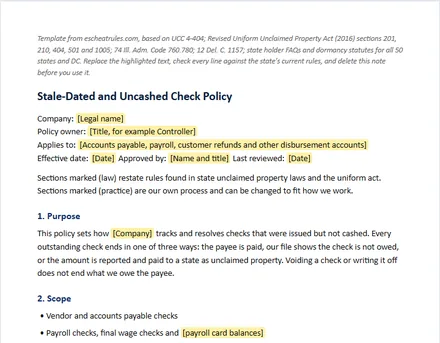
Stale-dated check policy
A policy for AP and payroll teams on uncashed checks: aging, outreach, voiding, write-offs, due diligence and reporting, with the law and the practice marked apart.
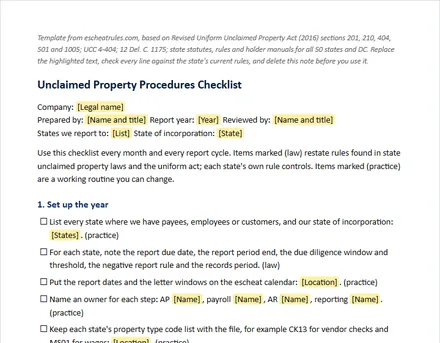
Procedures checklist
A month-by-month checklist for AP, payroll and AR: aging and outreach, voids, credits, wages, due diligence letters, the report and records, with each state's dates.
Questions holders ask
What is a stale-dated check?
A check presented more than six months after its date. Under UCC 4-404 the bank does not have to pay it, though it may. The debt behind the check is still owed to the payee.
Can I void an uncashed check and keep the money?
No. Voiding or writing a check back to income does not end the debt. After the state's dormancy period the money must be reported as unclaimed property. Illinois calls an automatic void policy a private escheat.
How long before an uncashed vendor check must be reported?
Usually 3 years after it was issued (30 jurisdictions) or 5 years (18). North Dakota uses 2 years. Payroll checks are 1 year in most states. The report is due on the state's next report date after that.
Do I report uncashed checks to other businesses?
In most states, yes. 8 states exempt some checks to businesses, often only during an ongoing relationship; several others exempt credits between businesses but not checks.
Which state do I report an uncashed check to?
The state of the payee's last known address in your records, under Texas v. New Jersey. If you have no address, your state of incorporation.
What do I do with outstanding checks on the bank reconciliation?
Move each one that will not clear to a liability account with the payee's details, age it by issue year, contact the payee, and report it when its dormancy period ends if it is still unclaimed.
Sources
- Uniform Commercial Code 4-404: law.cornell.edu
- Texas v. New Jersey, 379 U.S. 674 (1965): Library of Congress, U.S. Reports
- Revised Uniform Unclaimed Property Act (2016, as amended 2022), sections 201, 501, 604, 605 and 1005 and the comments: Uniform Law Commission
- 74 Ill. Adm. Code 760.780: ilga.gov; Missouri, reporting unclaimed property: treasurer.mo.gov; District of Columbia holder FAQ: unclaimedproperty.dc.gov
- North Carolina, guide to uncashed or unpresented checks (2026): nccash.gov; Alaska, guidance for holders completing a self-review: unclaimedproperty.alaska.gov
- NAUPA standard electronic file format (2025), property codes: unclaimed.org
- Each state's statute, linked in the table's Statute column