Counted from the 51-row table below, which quotes each state's statute, rule or holder manual. Counts by first threshold named; Mississippi and Nebraska thresholds are office suggestions.
What a due diligence letter is
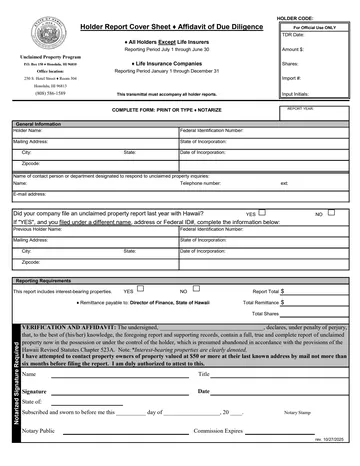
Due diligence is the holder's last try to reach the owner before the property goes to the state. In most states it is a letter, sometimes called an owner notice or a pre-escheat letter, sent to the owner's last known address in the holder's own records. The 2016 uniform act states the model rule: the holder sends notice by first-class mail “not more than 180 days nor less than 60 days before filing” the report, when its records hold a usable address and “the value of the property is $[50] or more” (Revised Uniform Unclaimed Property Act, section 501). The brackets mean each state picks its own number.
The letter matters for two reasons. First, it works: an owner who answers is paid or the account is reactivated, and the item comes off the report. Second, the states check it. Many ask the holder to state on the report that it complied, some want a sworn affidavit, and auditors ask for the mailing records. A letter mailed outside the window or below the required wording can count as no letter at all. The escheat process guide shows where the letter sits in the yearly cycle, and the due diligence letter template gives a starting text to adapt to each state's required wording.
The duty runs to the state of the owner's last known address, because that state gets the property. A vendor in Ohio and an employee in Florida get letters under two different rules, even from the same holder. The which state gets it guide explains the priority rules.
The mailing window
Most states set a window counted back from the day the report is filed: no earlier than one date, no later than another. The 2016 act's 60 to 180 days is now the rule in 10 jurisdictions: Colorado, District of Columbia, Idaho, Indiana, Kentucky, Maine, Tennessee, Utah, Vermont and Washington. The older uniform acts used 60 to 120 days, still the rule in 11: Delaware, Georgia, Kansas, Louisiana, Montana, Nevada, New Jersey, New Mexico, North Carolina, Pennsylvania and Wisconsin. Another 8 set only an outer limit of 120 days before filing and no minimum: Alaska, Minnesota, New Hampshire, North Dakota, Oklahoma, Rhode Island, South Carolina and Wyoming.
The windows that do not fit the pattern are the ones holders miss. Connecticut moved to a fixed calendar window in 2025: letters go out “Between July first and September thirtieth, inclusive, of the calendar year in which a presumption of abandonment is to take effect” (Conn. Gen. Stat. 3-65a). California counts from the date the property becomes reportable, not from the report, and wants the notice “not less than 6 nor more than 12 months before the time when the owner's property held by the business becomes reportable to the Controller” (Cal. Code Civ. Proc. 1520). Michigan allows a full year: “Not less than 60 days or more than 365 days before filing the report” (MCL 567.238), and Missouri wants the letter “within twelve months prior to turning the property over to the treasurer” (RSMo 447.503).
Some offices print a narrower window than their statute. Maine's statute says 60 to 180 days, and its 2026 Holder Reporting Manual agrees, but its older sample letter says “The letters must be sent no more than 120 days or less than 60 days before the report is filed.” Kentucky's 2026 Holder Book says “Owners must be notified not more than 120 days or less than 60 days before the report is filed.” against a statute that allows 180 (KRS 393A.270), and the District of Columbia's FAQ also says 120 days against a 180-day statute. The statute governs in each case. Mailing inside the narrower window satisfies both, so the safe course is the overlap. Several offices give calendar dates for a November 1 report: Arizona “by July 3rd for November reporting”, and Wisconsin says “Letters must be sent between July 1 and September 1.”
The dollar threshold
Below the threshold, most states require no letter, though the property is still reported, often in the aggregate. 39 of the 51 jurisdictions start at $50. The outliers matter for anyone who mails by a single company rule:
The first dollar amount each state names for the first letter, from the table below. New York has no floor for the first-class letter; North Carolina moves to $25 for all property on Dec. 1, 2026.
Several states count the threshold per owner, not per item. Iowa does not require a mailing to owners “whose property has an aggregate value of less than fifty dollars” (Iowa Code 556.11), and Maine's test is whether “The value of the property held for an owner in aggregate is $50 or more.” Some property needs a letter at any value. Delaware requires one for securities “regardless of the value of the property” (12 Del. C. 1148), and Kansas for stock and safe deposit boxes. Maryland's statute says $100, while its office FAQ says “Notices must be mailed to all owners with amounts of $50 or more.” The statute is the law; mailing at $50 meets both.
First-class, certified mail and email
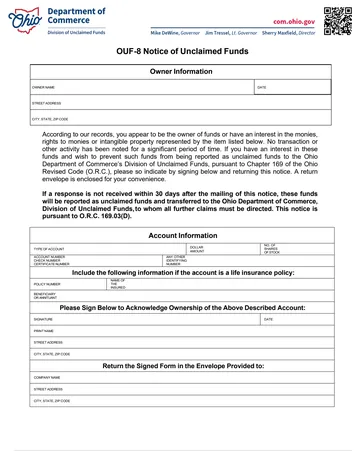
First-class mail is the default. Certified mail is the exception, and the states that require it do so for high values or securities. New Jersey is the strict one: its statute requires every letter to go “by certified mail, and with return receipt requested” (N.J.S.A. 46:30B-50). New York sends a first-class letter to every owner and, for property “whose value is in excess of one thousand dollars, send a second written notice to the owner by certified mail, return receipt requested” (N.Y. Aband. Prop. Law 1422). Ohio splits by value: first-class under $1,000 and certified “if the item of unclaimed funds has a value of one thousand dollars or more” (R.C. 169.03). Illinois, Maine and Nevada require certified mail for securities and similar property of $1,000 or more, and a signed return receipt then counts as the owner's indication of interest: in Illinois, “a signed return receipt in response to a notice sent pursuant to this Section by certified United States mail shall constitute a record communicated by the apparent owner to the holder” (765 ILCS 1026/15-501).
Email works two ways. Most 2016-act states add email: when the owner agreed to email, the holder sends the notice “both by first-class United States mail to the apparent owner’s last-known mailing address and by electronic mail” (section 501(b)). A few let email replace the letter: Colorado, Indiana and Montana, and Florida since 2026 (“by e-mail if the apparent owner has elected for e-mail delivery”). Connecticut goes furthest: email to a consenting owner “regardless of the value of the property”. Oregon's rule tells the holder to use its usual channel: “Holder must send the initial Notice to the Owner by the primary method it uses to communicate with the Owner, either email or standard mail.”
What the letter must say
The 2016-act states prescribe a heading. The model reads: “requires us to notify you that your property may be transferred to the custody of the” state's administrator “if you do not contact” the holder before a date 30 days after the notice (section 502). The letter must also identify the property and its value, say it will be turned over, say the owner must then claim from the state, warn that non-cash property may be sold, and tell the owner how to stop the transfer. 17 jurisdictions write a heading of this kind into their own law: California, Colorado, Delaware, District of Columbia, Florida, Idaho, Illinois, Indiana, Kentucky, Maine, Montana, North Dakota, Tennessee, Utah, Vermont, Washington and Wisconsin.
California's heading is in capitals and its own words: “THE STATE OF CALIFORNIA REQUIRES US TO NOTIFY YOU THAT YOUR UNCLAIMED PROPERTY MAY BE TRANSFERRED TO THE STATE IF YOU DO NOT CONTACT US”, with key facts “in boldface type or in a font a minimum of two points larger than the rest of the notice”. North Carolina asks for the date the holder will file and a statement that the property goes to the Treasurer “if satisfactory proof of claim is not presented by the owner to the holder within 30 days of that date”. Ohio requires a return envelope: “A self-addressed, stamped envelope shall be included”. Some offices say what to leave out. Wisconsin: “Do not include the department's contact information on due diligence letters”, and Florida's manual says “The due diligence letter must not contain any contact information” for the state.
Use each state's own sample where it publishes one; the table links 31 of them. A single national letter can work only if it carries the strictest heading and items, the right state name, and a reply date that fits every window it is mailed under.
Changes in 2025 to 2027
Florida, June 26, 2026. Florida rewrote chapter 717 (ch. 2026-174, “Approved by the Governor June 26, 2026.”). The first notice now goes out “At least 90 days, but not more than 180 days, before filing the report”, and “If the value of the property is greater than $1,000, the holder must send a second written notice by certified United States mail”, return receipt requested, at least 60 days before filing (Fla. Stat. 717.117). The Department's August 2025 manual still says “Not more than 120 days and not less than 60 days prior to filing the report”; the statute governs. For a report filed at the end of April 2027, that puts the first letters between early November 2026 and late January 2027.
Fla. Stat. 717.117 as amended by ch. 2026-174 (approved June 26, 2026). Florida's August 2025 manual still shows the old 60 to 120 day window.
North Carolina, Dec. 1, 2026. Session Law 2026-50 lowers the letter threshold to $25 for all property: “(Effective December 1, 2026) A holder of property that is presumed abandoned and is valued at twenty‑five dollars ($25.00) or more” must send written notice by first-class mail (S.L. 2026-50, section 5.3: “This section becomes effective December 1, 2026.”). Until then the rule is $50, or $25 for securities. The Treasurer's own step page still says “a notice to the owner is not required, though encouraged” below $50; for property presumed abandoned from Dec. 1, 2026, the $25 statute governs.
Georgia, July 1, 2026. Senate Bill 403 added certified mail: “For properties over $10,000.00, mailed letters shall be sent by certified mail.” The Department of Revenue page opens “Beginning July 1st, 2026, Holders must” and adds that “The cost of compliance may not be deducted from the remitted” property. The older FAQ still says “Letters do not have to be certified.”, which is out of date.
Connecticut, July 1, 2025. Public Act 25-81 “substantially revised Subsec. (a) including re timeframe and notification methods”: the July 1 to September 30 window, the $50 floor for mail and email to consenting owners. Washington, Jan. 1, 2026. Laws 2025 ch. 29 added email: “Sections 8 and 10 through 12 of this act take effect January 1, 2026.” Alabama, June 1, 2026 (Act 2026-285) and Louisiana, Jan. 1, 2027 added a liquidation warning for digital assets, and Montana's 2025 HB 164 let email replace the letter for consenting owners.
Due diligence rules in all 51 jurisdictions
Each row comes from the state's own statute, rule or holder manual, quoted and checked against the saved source; the source link opens the main one. Where a state publishes nothing on a point, the cell says Not listed. Rules as of November 2026 (last checked 2026-11-22); each state page has the detail and the links.
| State | Mailing window | Threshold | Mail, certified, email | What it must say | Proof | Source |
|---|---|---|---|---|---|---|
| Alabama | At least 60 days before filing | $50 or more | Written notice to the last known address | That the holder has the property; a liquidation warning for securities, digital assets and box contents (2026) | Signed report cover page certifies due diligence | alison.legislature.state.al.us |
| Alaska | No more than 120 days before filing | $100 or more | Written notice to the last known address | That the holder has the property | Report signed under penalty of unsworn falsification | akleg.gov |
| Arizona | Before the 120th day before filing (by July 3 for November) | $50 or more | Written notice; certified mail for digital assets | That the holder has the property (sample letter) | Form 650UP cover page affirms notice was sent | azleg.gov |
| Arkansas | 90 to 180 days before filing | $50 or more | First-class letter, return address requested; email allowed by rule | Property type, how to collect it, and that it will be reported (rule) (sample letter) | Affidavit with the report; keep proof 10 years | lexisnexis.com |
| California | 6 to 12 months before the property is reportable | $50 or more; securities and safe deposit boxes at any value | Mail, or electronic notice if the owner consented; certified for digital financial assets | A set heading in capitals and boldface items the statute lists (sample letter) | Not listed | leginfo.legislature.ca.gov |
| Colorado | 60 to 180 days before filing | $25 or more | First-class mail; email instead if the owner consented to email | A set heading with a 30-day date, plus the items the statute lists (sample letter) | Report states compliance | lexisnexis.com |
| Connecticut | July 1 to Sept. 30 of the year property is presumed abandoned (since July 1, 2025) | Mail at $50 or more per owner; email at any value with consent | First-class mail; email if the owner consented; certified mail not needed | That evidence of interest is needed or the property goes to the Treasurer (sample letter) | Not listed | cga.ct.gov |
| Delaware | 60 to 120 days before filing | $50 or more; securities at any value | First-class mail; no newspaper notice since 2017 | A set heading with a 30-day date, plus the items the statute lists (sample letter) | Report states compliance | delcode.delaware.gov |
| District of Columbia | 60 to 180 days before filing (office FAQ: 60 to 120) | $50 or more | First-class mail, and email too if the owner consented | A set heading with a 30-day date, plus the items the statute lists (sample letter) | Report states compliance | code.dccouncil.gov |
| Florida | 90 to 180 days before filing (since June 26, 2026) | $50 or more; a second, certified notice over $1,000 | First-class mail or email if elected; certified, return receipt, over $1,000 at least 60 days before | A set heading with a 30-day date, plus the items the statute lists | Report states compliance | leg.state.fl.us |
| Georgia | 60 to 120 days before the report (DOR: July 1 to Sept. 1, 2026) | $50 or more; certified mail over $10,000 | First-class mail, and email too if the owner agreed; certified over $10,000 (July 1, 2026) | No set wording; the DOR sample letter (sample letter) | Report checklist asks about certified letters | advance.lexis.com |
| Hawaii | Within 6 months before filing (cycle starts May 1) | $50 or more | Written notice; the affidavit says by mail | That the holder has the property | Notarized affidavit of due diligence with the report | capitol.hawaii.gov |
| Idaho | 60 to 180 days before filing | $50 or more | First-class mail, and email too if the owner consented; certified not required | A set heading with a 30-day date, the statute's items and holder contact (sample letter) | Report states compliance; keep signed returned notices | legislature.idaho.gov |
| Illinois | 60 days to 1 year before filing | $50 or more; certified at $1,000 for securities and virtual currency | First-class mail, and email too if consented; certified for securities and virtual currency of $1,000 or more | A set heading with a 30-day date, the statute's items and holder contact | Report states compliance | ilga.gov |
| Indiana | 60 to 180 days before filing | $50 or more | First-class mail, or email instead if the owner consented | A set heading with a 30-day date, plus the items the statute lists (sample letter) | Report states compliance | iga.in.gov |
| Iowa | Office: 60 to 120 days before Nov. 1 (mail July 1 to Aug. 31) | $50 or more per owner | Mail; banks may use electronic messaging | Sample wording from Iowa Code 556.2(5); include the business contact (sample letter) | Not listed | iowatreasurer.gov |
| Kansas | 60 to 120 days before filing | $100 or more; stock and safe deposit boxes at any value | Written notice | The property, the amount, and that it will be reported by Nov. 1 (sample letter) | Not listed | ksrevisor.gov |
| Kentucky | 60 to 180 days before filing (2026 Holder Book says 60 to 120; the statute governs) | $50 or more | First-class mail, and email too if the owner consented | A set heading with a 30-day date, plus the items the statute lists (sample letter) | Report states compliance | apps.legislature.ky.gov |
| Louisiana | 60 to 120 days before filing | $50 or more | Written notice | That the holder has the property; a liquidation warning for digital assets (2027) | Affidavit with the report | legis.la.gov |
| Maine | 60 to 180 days before filing (2026 manual agrees; the older sample letter says 120) | $50 or more per owner; certified at $1,000 for securities and virtual currency | First-class mail, and email too if consented; certified for securities of $1,000 or more | A set heading with a 30-day date, plus the items the statute lists (sample letter) | Report states compliance | legislature.maine.gov |
| Maryland | 30 to 120 days before the report | $100 or more (office pages say $50) | First-class mail (manual: two letters) | That the holder has the property and it is abandoned unless the owner answers in 30 days (sample letter) | Not listed | mgaleg.maryland.gov |
| Massachusetts | At least 60 days before the report (office: by Sept. 1) | $100 or more (rule: every owner) | First-class mail | Property description, the law, and the remittance date (rule) | Signed due diligence statement and a copy of the letter with the report | malegislature.gov |
| Michigan | 60 to 365 days before filing (office: by April 15) | $50 or more; $100 for holders reporting 25,000 items | Written notice to the last known address | The transfer warning and a deadline to contact the holder (manual) (sample letter) | Not listed | legislature.mi.gov |
| Minnesota | No more than 120 days before filing (2026: July 1 to Oct. 1) | $100 or more | Written notice to the last known address | That the holder has the property and the steps to prevent abandonment (sample letter) | Not listed | revisor.mn.gov |
| Mississippi | Before the report (statute sets no window; office suggests at least 60 days) | Office suggests $50 or more; the statute sets no amount | Mail to the last known address (Miss. Code 89-12-23(5)) | Not listed | Not listed | advance.lexis.com |
| Missouri | Within 12 months before reporting | $50 or more | First-class, marked Address Correction Requested; resend to a new address (rule 15 CSR 50-3.070 also takes a logged call) | The amount due and a request for confirmation (FAQ) | Not listed | revisor.mo.gov |
| Montana | 60 to 120 days before filing | $50 or more | First-class mail, or email if the owner consented (2025) | A set heading with a 30-day window, plus the items the statute lists | Affidavit with the report | mca.legmt.gov |
| Nebraska | Handbook: 60 to 120 days before the deadline | Handbook: above $25 | Letter to the last known address | Not listed | Not listed | nebraskalostcash.nebraska.gov |
| Nevada | 60 to 120 days before filing | $50 or more; certified at $1,000 for securities, retirement and virtual currency | Written notice, and email too if consented; certified for those types | Owner, property type, partial account number, amount, transfer statement (rule) (sample letter) | Affidavit with the report | leg.state.nv.us |
| New Hampshire | No more than 120 days before filing | $50 or more | Written notice to the last known address | The nature of the property and how to recover it (T-1 instructions) | Not listed | gc.nh.gov |
| New Jersey | 60 to 120 days before filing | $50 or more | Certified mail, return receipt requested | That the property goes to the State Treasurer unless claimed before the report | Holder keeps the evidence; nothing filed | pub.njleg.state.nj.us |
| New Mexico | 60 to 120 days before filing | $50 or more | Written notice | That the holder has the property | Affidavit with the report | nmonesource.com |
| New York | First-class 90+ days, certified 60+ days before (business: Dec. 10, Jan. 10) | Any item with an address; certified over $1,000 | First-class; second notice by certified mail, return receipt, over $1,000 | That it will be reported and remitted unless claimed by the remittance date | Not listed | nysenate.gov |
| North Carolina | 60 to 120 days before filing | $50 ($25 for securities); $25 for all property from Dec. 1, 2026 | First-class mail | Amount, holder contact, report date, 30-day claim window, earnings stay with the Treasurer (sample letter) | Electronic certification with the report | ncleg.gov |
| North Dakota | No more than 120 days before filing | $25 or more | First-class mail, and email too if the owner consented | A set heading with a 30-day date, the statute's items and holder contact (sample letter) | Not listed | ndlegis.gov |
| Ohio | Before the report, at least 30 days ahead of it | $50 or more | First-class under $1,000; certified, return receipt, at $1,000 or more | The property, number and amount, the 30-day warning, a stamped return envelope (sample letter) | Not listed | codes.ohio.gov |
| Oklahoma | No more than 120 days before filing | $50 or more (or a recurring payment) | Written notice, and email too if consented; first-class mail complies | That the holder has the property (sample letter) | Not listed | oklegislature.gov |
| Oregon | At least 60 days before filing | Over $100 per owner (rule) | The usual channel, email or standard mail | Property type, how to claim it, and that it will be reported (rule) (sample letter) | Keep compliance records 3 years | oregonlegislature.gov |
| Pennsylvania | 60 to 120 days before the report | $50 or more | First-class mail, unless the owner agreed to electronic notice | The property, its ownership, its value, and how to contact the holder | Affirmation of compliance in the report | palegis.us |
| Rhode Island | No more than 120 days before filing | $50 or more | Written notice to the last known address | That the holder has the property | Not listed | webserver.rilegislature.gov |
| South Carolina | No more than 120 days before filing | $50 or more | Written notice to the last known address | That the holder has the property (sample letter) | Not listed | scstatehouse.gov |
| South Dakota | Office: at least 60 days before the report | $50 or more (combined per owner) | That property is held and will escheat; a sale warning for securities and box contents (sample letter) | Not listed | southdakota.findyourunclaimedproperty.com | |
| Tennessee | 60 to 180 days before filing | $50 or more | First-class mail in a form the treasurer approves, and email too if consented | A set heading with a 30-day window, plus the items the statute lists (sample letter) | Report states compliance | advance.lexis.com |
| Texas | At least 60 days before delivery (portal: by May 1) | More than $250 | Mail or email | That the holder has it and may deliver it to the Comptroller by July 1 (sample letter) | Not listed | tcss.legis.texas.gov |
| Utah | 60 to 180 days before filing (rule: 60 days to 1 year) | $50 or more | First-class mail, and email too if consented; certified mail also complies (rule) | A set heading with a 30-day date, the statute's items and holder contact (sample letter) | Not listed | le.utah.gov |
| Vermont | 60 to 180 days before filing (office sample says 120) | $50 or more | First-class mail, and email too if the owner consented | A set heading with a 30-day date, plus the items the statute lists (sample letter) | Report states compliance; cover sheet counts letters | legislature.vermont.gov |
| Virginia | At least 60 days before the report (office: by Sept. 1) | $100 or more | First-class mail | Not listed | Not listed | law.lis.virginia.gov |
| Washington | 60 to 180 days before filing | $50 or more | First-class mail, and email too if the owner consented (2026) | A set heading with a 30-day date, plus the items the statute lists | Not listed | app.leg.wa.gov |
| West Virginia | Office: 60 to 120 days before filing | $50 or more, or in a safe deposit box | First-class mailing | How to claim or reactivate, that the State is custodian, a reply date 15 business days before remittance (sample letter) | Not listed | wvunclaimedproperty.gov |
| Wisconsin | 60 to 120 days before filing (office: July 1 to Sept. 1) | $50 or more | First-class mail, and email too if the owner consented | A set heading with a 30-day date, the statute's items; no Department contact (sample letter) | Keep a copy of the letter 10 years | docs.legis.wisconsin.gov |
| Wyoming | No more than 120 days before filing | $50 or more | Written notice to the last known address | That the holder has the property | Not listed | wyoleg.gov |
Proof, costs and penalties
What the holder files differs. 11 jurisdictions ask the report itself to state compliance, as the 2016 act does. Others want a sworn statement: Louisiana, Montana, Nevada and New Mexico require the holder to “file with the report an affidavit stating that the holder has complied”, and Hawaii's affidavit needs a notary. New Jersey files nothing but asks the holder to keep it: “No, the Holder must retain the evidence in their records.” Keep copies of every letter, the mailing list with dates, returned mail and certified receipts. Arkansas sets the period by rule, “A holder must maintain documentary evidence of all due diligence efforts for ten (10) years”, and Wisconsin says “You are required to keep a copy of the letter for 10 years”.
Costs are split. Illinois lets a holder that remits money “deduct from total amounts remitted, the actual costs of due diligence notices.” New York lets certified mail costs come off the item but says “First class mailing costs can’t be deducted as a service charge.” Georgia and Oregon bar any deduction, and Tennessee's guide says “You may NOT charge or deduct a fee from the owners account to perform the due diligence.”
Skipping the letter costs money in several states. Kansas: “shall pay a civil penalty not to exceed $5 for each failure to send written notice to an apparent owner” (K.S.A. 58-3967). Rhode Island charges “a civil penalty of ten dollars ($10.00) for each account”, and Virginia “a civil penalty not to exceed $50 for each account upon which due diligence was not performed” (Va. Code 55.1-2540). Missouri “may impose a penalty on such holder of up to twenty percent of the value of the property returned to the owner by the treasurer”, and Iowa charges “five dollars for each name and address account” when owners later claim a large share of a report. The penalties and interest guide covers the rest.
From the statutes in the table below: Fla. Stat. 717.117, N.Y. Aband. Prop. Law 1422, R.C. 169.03, O.C.G.A. 44-12-192, C.R.S. 38-13-501, K.S.A. 58-3967, R.I. Gen. Laws 33-21.1-34, Va. Code 55.1-2540.
Running the cycle
A holder that files in many states runs one cycle per report date. Group items by the state of the owner's last known address, find each state's window, and mail in the overlap. For a November 1 state with a 60 to 180 day window, that means letters between early May and early September; for a spring state such as Florida, Delaware or New York, letters go out over the winter.
The steps the statutes and holder manuals in the table below require; windows, thresholds and proof differ by state.
Treat returned and unanswered mail differently. Mail the post office returns is evidence the address is bad, and some states excuse a letter to an address known to be bad: Washington's guide says “the Post Office has deemed undeliverable” addresses need no letter. Silence is not contact. Michigan's manual: mail not returned “by the post office does not, by itself, qualify as contact with the” owner. An owner who does answer should be paid or reactivated before the report is filed; the dormancy clock restarts, and the item stays off the report. The uncashed checks guide covers reissuing a check after a reply.
Most failed letters trace back to the address on file. A vendor or employee record set up with a wrong name, TIN or address produces an uncashed check, then an undeliverable letter, then a report to the wrong state. Cleaning the address before the letter goes out is cheaper than an audit finding later.
Forms, line by line
Tools and templates for this topic
Due diligence letter
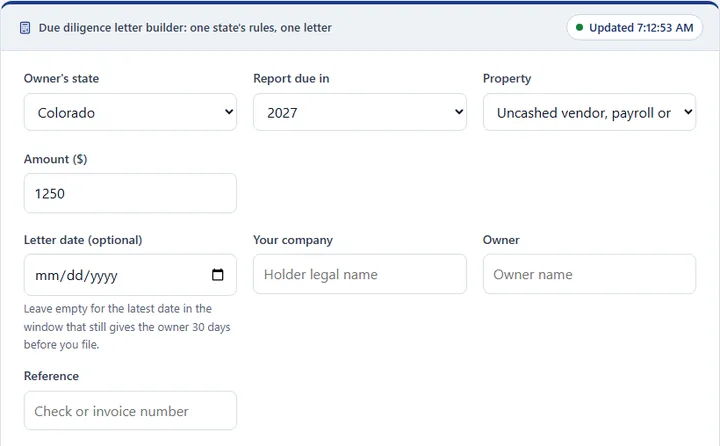
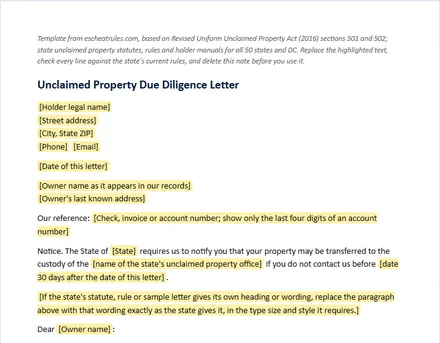
A fill-in owner notice with the heading, property details, reply date and claim steps the statutes require, plus a 51-state table of windows, thresholds and sample letters.
Questions holders ask
How far ahead of the report must I mail due diligence letters?
It depends on the state. The 2016 uniform act and 10 jurisdictions use 60 to 180 days before filing; 11 use 60 to 120 days; Florida uses 90 to 180 days since June 26, 2026; Connecticut mails July 1 to Sept. 30. Mail in the overlap of every window the letter has to meet.
Do due diligence letters have to go by certified mail?
Usually not. New Jersey requires certified mail, return receipt requested, for every letter. New York and Florida add a certified second notice over $1,000, Ohio uses certified mail at $1,000 or more, Georgia over $10,000, and Illinois, Maine and Nevada for securities and similar property of $1,000 or more.
Can I send due diligence notices by email?
Where the owner agreed to email, most 2016-act states want the email in addition to the first-class letter. Colorado, Indiana, Montana and Florida let email take the letter's place, and Connecticut requires email to consenting owners at any value.
What is the minimum amount for a due diligence letter?
$50 in 39 jurisdictions. Colorado and North Dakota use $25, North Carolina moves to $25 on Dec. 1, 2026, several states use $100, and Texas only requires a letter above $250. Some property, such as Delaware securities, needs a letter at any value.
Do I file copies of the letters with my report?
Most states only ask the report to state that you complied. Arkansas, Hawaii, Louisiana, Montana, Nevada and New Mexico want an affidavit, and Massachusetts asks for a signed statement with a copy of the letter. Keep the letters and mailing records either way; auditors ask for them.
Can I deduct the mailing cost from the property?
Only where the state allows it. Illinois and Utah allow the actual cost of envelopes, postage and stationery; New York allows certified mail costs per item but not first-class; Georgia, Oregon and Tennessee bar deductions.
Sources
- Revised Uniform Unclaimed Property Act (2016, as amended 2022), sections 501 and 502: Uniform Law Commission
- Fla. Stat. 717.117 as amended by Laws of Florida ch. 2026-174: flsenate.gov; ch. 2026-174
- N.C. Gen. Stat. 116B-59 and Session Law 2026-50: ncleg.gov; S.L. 2026-50
- O.C.G.A. 44-12-192 and 44-12-214 (2026): Georgia Code; Conn. Gen. Stat. 3-65a (2026 supplement): cga.ct.gov
- N.Y. Aband. Prop. Law 1422: nysenate.gov; N.J.S.A. 46:30B-50: New Jersey statutes; R.C. 169.03: codes.ohio.gov
- Every other row: the state's statute, rule or holder manual, linked in the table's Source column and listed on each state page