From the Revised Uniform Unclaimed Property Act (2016) sections 201, 403 and 404 and the report dates in each state's own statute or holder manual (the state table on the states page).
What escheat means
The word comes from English land law. In the old sense, when an owner died with no will and no heirs, the property passed to the sovereign. The Uniform Law Commission's 2016 act describes the old rule this way: “In an escheat the state succeeds to legal ownership of the property.” That sense survives in estate law: when someone dies without a will or heirs, “the property escheats to the state and the state takes title to the property as its owner”. That is an estate and probate question, handled under each state's inheritance laws, and it is not what this site covers.
What businesses mean by escheat, or escheatment, is the modern unclaimed property system. Here the state does not become the owner. It takes custody. In the uniform act's words, “The state merely holds possession of the property, indefinitely, as custodian for the benefit of the owner”, and the act itself says property the state receives “is held in custody for the benefit of the owner and is not owned by the state” (Revised Uniform Unclaimed Property Act, section 804). The two words are used interchangeably in practice: a state's form may say escheat, its statute unclaimed property, and both mean the same thing for the business that has to report.
The rules are state law. Each state and DC has its own act. Many follow one of the Uniform Law Commission's model acts (1981, 1995 or the 2016 revision), and others, including California, Delaware, New York and Texas, wrote their own. The escheat laws by state page lists the act each state follows.
Who the holder is and what it holds
The business that owes the money is the holder. The 2016 act defines a holder as “a person obligated to hold for the account of, or to deliver or pay to, the owner, property subject to this [act].” The owner is the person the money belongs to: a vendor, an employee, a customer, a shareholder.
The leading Supreme Court case on escheat is about an ordinary accounts payable and payroll file. In Texas v. New Jersey, Sun Oil owed small debts “to approximately 1,730 small creditors who have never appeared to collect them”, including “uncashed checks payable to suppliers for goods and services” and “uncashed checks payable to employees for wages” (379 U.S. 674). That is what most business holders hold today. The 2016 act's list of property starts the same way: “a credit balance, customer's overpayment, stored-value card, security deposit, refund, credit memorandum, unpaid wage”, and more.
The property types a business meets most each have their own guide: uncashed and stale-dated checks, unclaimed wages and payroll checks, customer credits and refunds, gift cards, and securities, dividends and retirement accounts. Some states exempt certain business-to-business credits or gift cards; others exempt nothing, which is why the state matters before the amount does.
The escheat cycle
For a holder, escheat is a yearly cycle with the same steps in every state. Only the periods and dates change.
The holder's steps under the Revised Uniform Unclaimed Property Act (2016) Articles 2, 4, 5 and 6; each state sets its own periods and dates.
The escheat process, step by step covers each step in detail, and the sections below give the rule behind each one.
When property is presumed abandoned
Property becomes reportable when the owner has shown no interest in it for a set time, the dormancy period. The 2016 act sets the period for a vendor check, which is a business's debt, at “a debt of a business association, three years after the obligation to pay arises” (section 201(4)), and for wages at “one year after the amount becomes payable” (section 201(11)). The periods have been getting shorter: “The 1981 Act shortened the general dormancy period from seven years to five years and the 1995 Act then shortened the general dormancy period from five years to three years.”
States do not all follow the model. North Dakota treats checks as abandoned when they “remain uncashed by the owner two years after becoming payable” (N.D.C.C. 47-30.2-04). Delaware's holder handbook says “In Delaware, most properties are considered abandoned after 5 years of dormancy”. Ohio counts wages only above a floor: “Any sum greater than fifty dollars payable as wages” (R.C. 169.02(N)). The dormancy periods by state table has each state's periods by property type.
RUUPA sections 201(4), 403(a), 404 and 501(a). Delaware waits 5 years and wants its report by March 1; North Dakota waits 2 years; check your state's page before you count.
Voiding a check or writing it back to income does not end the duty. The money is still owed to the payee. Illinois says so in its rules: a valid reason to void a check “does not include a policy of voiding outstanding checks, drafts, or similar instruments after a specified number of days”, and “a policy of automatically voiding would be tantamount to a private escheat law” (74 Ill. Adm. Code 760.780). The escheatment accounting guide shows how to keep the liability on the books until it is paid or reported.
Due diligence before the report
Before reporting, the holder must try to reach the owner. Under the 2016 act, the holder writes by first-class mail “not more than 180 days nor less than 60 days before filing” the report, when it has a valid address and the property is $50 or more (section 501(a)). A letter that brings the owner back ends the matter: the holder pays the owner, and nothing goes to the state.
The windows and thresholds differ, and they change. Florida rewrote its law in 2026: the notice now goes out “At least 90 days, but not more than 180 days, before filing the report”, and “If the value of the property is greater than $1,000, the holder must send a second written notice by certified United States mail” (Fla. Stat. 717.117). The due diligence letters by state page has every state's window, threshold and sample letter, and the due diligence letter template is ready to fill in.
Reporting and remitting
Each year the holder files a report with each state it owes, and pays or delivers the property with it. The most common date is the uniform act's: before November 1, for property that went dormant in the 12 months before July 1. Kansas, for example: “The report must be filed before November 1 of each year and cover the 12 months next preceding July 1 of that year” (K.S.A. 58-3950). In all, 42 states want the business holder report in the fall.
The rest report earlier in the year, and the spring states are the ones holders miss. 7 states want the report in spring: Connecticut, Delaware, Florida, Illinois, New York, Pennsylvania and Vermont. Delaware's report “must be filed by all holders and business associations other than banking organizations and insurance companies on or before March 1 of each year to cover the 12 months preceding January 1 of that year” (12 Del. C. 1142). New York wants the “Report, payment, and a Verification and Checklist to be received in our office by the close of business on March 10” (New York handbook for business reporters). In summer, Michigan and Texas take their reports: in Texas, “Each holder who on March 1 holds property to which this chapter applies shall file a report of that property on or before the following July 1” (Tex. Prop. Code 74.101). Insurers, banks and some other industries have their own dates in many states.
Almost every state takes the report as an electronic file in one standard layout. NAUPA, the state administrators' association, says “All 50 states have used the NAUPA standard electronic file format since 2004.” The NAUPA file format page explains the layout and the codes, and the unclaimed property reporting guide covers negative reports, aggregate amounts, extensions and each state's portal. NAUPA's state-by-state reporting list links every state's holder page; the state map on this site shows each state's report date.
Keep the records behind every report. The 2016 act says a holder “shall retain records for 10 years after the later of the date the report was filed” or was due (section 404). Those records are what an auditor asks for first.
Which state gets it
A business that operates in many states reports each item to one state only, and the Supreme Court decides which. In Texas v. New Jersey the Court held that each item “is subject to escheat only by the State of the last known address of the creditor, as shown by the debtor's books and records”. If the records show no address, or the address is in a state whose law does not reach the property, the holder's state of incorporation takes it, until the address state proves a better claim. The Court explained its choice simply: “It is fundamentally a question of ease of administration and of equity.”
A state cannot change the order by statute: “no State may supersede them by purporting to prescribe a different priority under state law” (Delaware v. New York, 507 U.S. 490). Money orders and traveler's checks follow a federal statute instead. Where the issuer's records show the state of purchase, “that State shall be entitled exclusively to escheat or take custody of the sum payable on such instrument” (12 U.S.C. 2503). In 2023 the Court applied that statute to MoneyGram's similar instruments, which “should generally escheat to the State of purchase” (Delaware v. Pennsylvania, 598 U.S. 115).
Texas v. New Jersey (1965), Delaware v. New York (1993), Delaware v. Pennsylvania (2023) and 12 U.S.C. 250112 U.S.C. 2501United States Code, Cornell LII to 2503.
So the address in the holder's own records decides where the property goes. An item with a bad or missing address goes to the state of incorporation, and a state that later proves the right address can ask for it. The which state gets it guide covers the rules in detail, including foreign addresses and entities other than corporations.
After the state takes custody
Once the holder has reported and paid, the state holds the property for the owner, and the owner claims it from the state, not from the holder. If the holder pays an owner after remitting, it can get the money back: under the 2016 act a holder “may file a claim for reimbursement from the administrator of the amount paid” when it paid in error or later paid the owner (section 605).
Retirement money adds a federal step. The IRS ruled that an IRA balance paid to a state unclaimed property fund “is subject to federal income tax withholding under § 3405” (Rev. Rul. 2018-17), and the Form 1099-R instructions say “Payments made from IRAs to state unclaimed property funds must be reported on Form” 1099-R. The securities and retirement guide covers both, and TIN Compliance's Form 1099-R guide covers the filing itself. The federal escheat rules page gathers the IRS, Treasury and Labor rules in one place.
Looking for money of your own? This site is for the businesses that hold unclaimed property. To search for yours, use your state's free search (every state's site is listed here) or MissingMoney.com, which says it “is the official Unclaimed Property website of the National Association of State Treasurers”.
Audits, penalties and voluntary disclosure
States enforce their laws by auditing holders, often many years back. In one Delaware case the state “audited plaintiff for deficiencies in reporting and escheating unclaimed property for the previous 22 year time period”, and the company had a problem: “Plaintiff had disposed of older records in compliance with its retention policy.” The federal court found the way the state estimated what was owed “shocks the conscience” (Temple-Inland, Inc. v. Cook, D. Del. 2016). Delaware changed its law in 2017 so that an examination may not reach “for any period more than 10 years prior to when property is presumed abandoned” (81 Del. Laws c. 1).
Interest and penalties are set state by state. Delaware charges “Interest at 0.5% per month” on late property, which “may not exceed 50% of the amount required to be paid”. Alabama sets, for a fraudulent report, “a civil penalty of one thousand dollars ($1,000) for each business day from the date a report under this article was due, up to a maximum of twenty-five thousand dollars ($25,000)” (Code of Ala. 35-12-92).
A business that has never reported does not have to wait for an audit. Most states run a voluntary disclosure or compliance program that limits the lookback and waives some or all penalties and interest. The unclaimed property VDA page lists each state's program.
The unclaimed property audits and penalties and interest guides go state by state.
Tools and templates for this topic
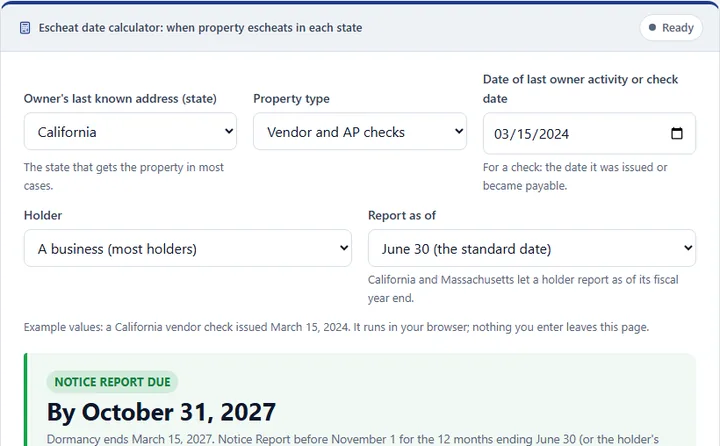
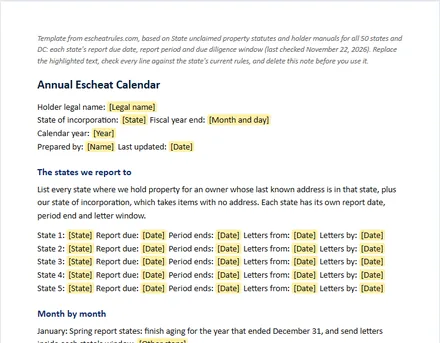
Annual escheat calendar
A printable calendar of the holder's year: period ends, due diligence letters, report and payment dates, with every state's date filled in to start from.
Questions holders ask
What is escheatment in simple terms?
A business that owes money it cannot deliver, such as an uncashed check, must report it and send it to a state after a set time. The state holds it until the owner claims it.
What is the difference between escheat and unclaimed property?
In the old sense of escheat the state becomes the owner, as when someone dies without a will or heirs. Under modern unclaimed property laws the state only takes custody and the owner can still claim. Businesses use the two words for the same process.
Does escheat mean the state keeps the money?
Not under unclaimed property laws. The 2016 uniform act says property the state receives is held in custody for the owner and is not owned by the state. The owner claims it from the state.
How long before an uncashed check escheats?
It depends on the state and the kind of check. The 2016 uniform act uses 3 years for a business debt such as a vendor check and 1 year for wages; North Dakota uses 2 years for checks and Delaware 5 years for most property.
Which state do I report unclaimed property to?
The state of the owner's last known address in your own records. If there is no address, or that state's law does not cover the property, report to your state of incorporation. Money orders and traveler's checks go to the state where they were bought.
When are unclaimed property reports due?
In 42 states the business holder report is due in the fall, most before November 1. Connecticut, Delaware, Florida, Illinois, New York, Pennsylvania and Vermont want it in spring, and Michigan and Texas in summer. Insurers and banks often have other dates.
Sources
- Texas v. New Jersey, 379 U.S. 674 (1965): Library of Congress, U.S. Reports
- Delaware v. New York, 507 U.S. 490 (1993): Library of Congress, U.S. Reports; Delaware v. Pennsylvania, 598 U.S. 115 (2023): supremecourt.gov
- 12 U.S.C. 250112 U.S.C. 2501United States Code, Cornell LII to 2503, Disposition of Abandoned Money Orders and Traveler's Checks: govinfo
- Revised Uniform Unclaimed Property Act (2016, as amended 2022), sections 102, 201, 404, 501, 605 and 804 and the prefatory note: Uniform Law Commission
- Temple-Inland, Inc. v. Cook, No. 14-654-GMS (D. Del. June 28, 2016): govinfo; Delaware Senate Bill 13, 81 Del. Laws c. 1 (2017): legis.delaware.gov
- IRS Rev. Rul. 2018-17 and the Instructions for Forms 1099-R and 5498 (2026): irs.gov
- State sources: K.S.A. 58-3950, 12 Del. C. 1142, Tex. Prop. Code 74.101, N.D.C.C. 47-30.2-04, R.C. 169.02, Fla. Stat. 717.117 (2026), 74 Ill. Adm. Code 760.780, Code of Ala. 35-12-92, and the New York and Delaware holder handbooks
- NAUPA, reporting software and file format: unclaimed.org