RUUPA (2016) sections 1204 to 1206; N.J.S.A. 46:30B-105 and 105.1; the state statutes in the table below.
How penalties and interest work
Unclaimed property penalties come in layers. Interest runs on the property from the day it should have been reported or paid. A civil penalty, often a daily amount with a cap, applies when the report, payment or delivery is late. A second, heavier tier applies when the failure is willful or the report is fraudulent, and in some states a willful refusal after a written demand is a crime. The penalty is on top of the property itself: the holder still reports and pays every item.
The states built these layers in different ways. Many follow the uniform acts. Others charge a percentage of the late property (Delaware, Maryland, Texas, Washington, Wisconsin), or, in the saved statutes, only interest (Connecticut and South Dakota), or a penalty only when the failure is willful (Arizona, Georgia, Kansas, Michigan and others). So the same late report can cost very different amounts in two states. Penalties are usually assessed after an audit or a late filing; the unclaimed property audits page covers how far back a state can look.
The uniform act's model
The 2016 Revised Uniform Unclaimed Property Act sets out the three tiers most new laws copy, with bracketed amounts each state chooses. A holder that fails to report, pay or deliver on time owes interest “from the date the property should have been reported, paid, or delivered to the administrator until the date reported, paid, or delivered”, at a rate the state sets (section 1204(a)). The administrator may add a civil penalty “of $[200] for each day the duty is not performed, up to a cumulative maximum amount of $[5,000]” (section 1204(b)). For evasion or willful failure, the penalty is “$[1,000] for each day the obligation is evaded or the duty is not performed, up to a cumulative maximum amount of $[25,000], plus [25] percent of the amount or value of property that should have been but was not reported, paid, or delivered”, and a fraudulent report draws the same (section 1205). The comment calls the first tier “moderate penalties and interest where failure to comply is non-willful and non-fraudulent” (RUUPA).
The states that adopted the 2016 act mostly kept those numbers: Colorado, DC, Idaho, Illinois, Indiana, Kentucky, North Dakota, Tennessee, Utah and Vermont all show $200 a day up to $5,000 for a late filing and $1,000 a day up to $25,000 plus 25 percent for willful failure. Several older acts (Arizona, Georgia, Kansas, Michigan, Nebraska and Oklahoma among them) charge $100 a day only for a willful failure to report, and 25 percent of the property for a willful failure to pay or deliver.
How high it goes
Maximum civil penalty before interest and before the percentage add-ons: Fla. Stat. 717.117(11); RUUPA (2016) sections 1204(b) and 1205; N.J.S.A. 46:30B-104, 105 and 105.1.
Florida sits at the low end for a late report: “$10 per day up to a maximum of $500 for the failure to timely report” (Fla. Stat. 717.117). New Jersey sits at the top: “a civil penalty of $200 for each day the report, payment, or delivery is withheld, or the duty is not performed, up to a maximum of $100,000”, and for willful failure “a penalty of $1,000 for each day the report, payment, or delivery is withheld, or the duty is not performed, up to a maximum of $250,000, plus 25% of the value of any property that should have been but was not reported.” (N.J.S.A. 46:30B-104 and 105). Percentage penalties can be larger still on a big remittance. Texas's statute says: “A penalty equal to five percent of the value of the property due shall be imposed on a holder who fails to pay or deliver property within the time prescribed by this chapter. If a holder fails to pay or deliver property before the 31st day after the date the property is due, an additional penalty equal to five percent of the value of the property due shall be imposed.” (Tex. Prop. Code 74.706).
Interest rates
Interest applies more widely than penalties: many states charge it on any late property, willful or not. Some rates are fixed in the statute: Connecticut's statute: “Any person who fails to report or deliver abandoned property within the time prescribed by this part shall pay interest to the Treasurer on such property or the value thereof at the rate of fifteen per cent per annum from the date such property should have been reported or delivered” (Conn. Gen. Stat. 3-65b); Arizona charges “interest at the rate of one and one-half per cent per month or fraction of a month on the property or value of the property from the date the property should have been paid or delivered” (A.R.S. 44-326(A)); Florida and Montana 12 percent a year; Nevada and New Hampshire 18 percent a year. Others float: New Jersey's is “interest at the annual rate of 10% above the annual rate of discount, in effect on the date the property should have been paid or delivered, for the most recent issue of 52-week United States Treasury bills” (N.J.S.A. 46:30B-103), and several states tie it to their tax interest rate or the prime rate. Delaware caps it: “Interest at 0.5% per month on outstanding unpaid amounts accrues from the date the amounts or property were due under this chapter until paid. Interest due in accordance with this subsection may not exceed 50% of the amount required to be paid.” (12 Del. C. 1183). Where the table says "Not listed", the saved statute and rules state no rate.
Willful failure, fraud and crimes
The heavier tier needs more than lateness: a holder that knew of the duty and did not perform it, or filed a report it knew was false. The 2016 act aims these at “willful or fraudulent conduct on the part of the holder”. Delaware adds a fraud penalty of “an amount equal to 75% of the portion of the deficiency in payment which is attributable to fraud” (12 Del. C. 1183(d)). Some states make willful failure a crime: in Texas “A holder commits an offense if the holder wilfully violates this chapter, including:” failing to report or pay, or “refusing to permit examination of records in accordance with this chapter.”, and “An offense under this section is a Class B misdemeanor.” (Tex. Prop. Code 74.710). Georgia, Michigan, Missouri, Nebraska, New Hampshire, Oklahoma, Rhode Island and South Carolina also treat a willful refusal, usually after a written demand, as a misdemeanor.
A fraudulent report also changes the lookback. In most states the limitation period does not run at all once a report is fraudulent, so the state can reach back without limit (see the audits table).
Penalties and interest by state
From each state's statute (an office page only where the statute was not available, noted in the cell). "Same penalty" means one statutory penalty covers a late report and a late payment. "Not listed" means the saved statute and rules state none. As of November 2026; last checked 2026-11-22.
| State | Late report | Late payment or delivery | Interest | Willful failure and fraud | Source |
|---|---|---|---|---|---|
| Alabama | $100 per business day, up to $5,000 (Code of Ala. 35-12-92(a)) | Same penalty covers late payment or delivery (35-12-92(a)) | Not listed | Willful: $500 per business day, up to $25,000; fraud: $1,000 per business day, up to $25,000 (35-12-92(b), (c)) | alison.legislature.state.al.us |
| Alaska | Tax code penalty may apply: 5% per 30 days, up to 25% (AS 34.45.470(b); AS 43.05.220(a)) | Same tax code penalty covers failure to pay or deliver (AS 34.45.470(b); AS 43.05.220(a)) | 12 percent a year from the date due (AS 34.45.470(a); AS 43.05.225(2)(B)) | Fraud: 50% or $500, whichever is greater (AS 43.05.220(c)); refusal after written demand: class A misdemeanor (34.45.470(c)) | akleg.gov |
| Arizona | Only if willful: $100 a day the report is withheld, up to $5,000 (A.R.S. 44-326(B)(1)) | Only if willful: 25% of the value of the property not paid or delivered (A.R.S. 44-326(B)(2)) | 1.5% per month or fraction of a month on the property's value from the date due (A.R.S. 44-326(A)) | No separate fraud penalty; willful penalties as above (44-326(B)); a fraudulent report tolls the limitation period (44-321(C)) | azleg.gov |
| Arkansas | $200 a day, up to $5,000, plus interest (Ark. Code 18-28-224(b)) | Same penalty covers late payment or delivery (18-28-224(b)) | Prime rate (Fed H.15) plus 2 points a year from the date due (18-28-224(a)) | Willful or fraudulent: $1,000 a day, up to $25,000, plus 25% of the unreported value (18-28-224(c), (d)) | lexisnexis.com |
| California | Only if willful (no reply to a certified-mail notice): $100 a day, up to $10,000 (Cal. Code Civ. Proc. 1576(a), (c)) | Willful refusal to pay or deliver: fine of $5,000 to $50,000 (CCP 1576(b)) | 12% a year from the date due unless reasonable cause; capped at $10,000 if paid on time but report deficient (CCP 1577) | Willful failure to report: $100 a day, up to $10,000; willful refusal to pay or deliver: $5,000 to $50,000 (CCP 1576) | leginfo.legislature.ca.gov |
| Colorado | $200 a day, up to $5,000, plus interest; waived for good faith without negligence (C.R.S. 38-13-1204(2), 1206) | Same penalty covers late payment or delivery (38-13-1204(2)) | Annual rate in C.R.S. 39-21-110.5, from the date due until reported, paid or delivered (38-13-1204(1)) | Evasion or willful: $1,000 a day, up to $25,000, plus 25%; fraud: same, from the report date until corrected (38-13-1205) | unclaimedproperty.colorado.gov |
| Connecticut | Not listed | Not listed | 15% a year from the date due on late reports or deliveries; may be waived for good faith (Conn. Gen. Stat. 3-65b(a)) | Not listed | cga.ct.gov |
| Delaware | Unless reasonable cause: lesser of 5% a month (up to 50%) or $100 a day (up to $5,000) (12 Del. C. 1183(b)) | Unless reasonable cause: 0.5% a month, up to 25% (12 Del. C. 1183(c)) | 0.5% per month from the date due until paid, up to 50% of the amount due (12 Del. C. 1183(a)) | Evasion or wilful: $1,000 a day, up to $25,000, plus 25%; fraud: 75% of the deficiency due to fraud (1184; 1183(d)) | delcode.delaware.gov |
| District of Columbia | $200 a day, up to $5,000, plus interest; waived for good faith without negligence (D.C. Code 41-162.04(b), 41-162.06) | Same penalty covers late payment or delivery (41-162.04(b)) | 10% a year from the date due (D.C. Code 41-162.04(a)) | Evasion or willful: $1,000 a day, up to $25,000, plus 25%; fraud: same, from the report date until corrected (41-162.05) | code.dccouncil.gov |
| Florida | $10 a day, up to $500, for a late or incomplete report (Fla. Stat. 717.117(11)) | Willful refusal to pay or deliver: $500 a day, up to $5,000, plus 25% of the value (Fla. Stat. 717.134(2)) | 12% a year from the date due; the department may waive it (Fla. Stat. 717.134(4)) | Willful failure to report: $500 a day, up to $5,000, plus 25% of unreported value; waived for good faith (717.134(1)) | leg.state.fl.us |
| Georgia | Only if willful: $100 a day, up to $5,000 (O.C.G.A. 44-12-227(a)) | Only if willful: 25% of the value of property not paid or delivered (O.C.G.A. 44-12-227(b)) | Not listed | Willful refusal after written demand: misdemeanor, fine up to $1,000 or up to 6 months in jail, or both (44-12-227(c)) | advance.lexis.com |
| Hawaii | $200 a day, up to $5,000, plus interest (HRS 523A-24(b)) | Same penalty covers late payment or delivery (523A-24(b)) | 52-week Treasury bill rate plus 2 points a year, from the date due (HRS 523A-24(a)) | Willful: $1,000 a day, up to $25,000, plus 25% of unreported value; fraud: same, from the due date (523A-24(c), (d)) | capitol.hawaii.gov |
| Idaho | $200 a day, up to $5,000, plus interest; may be waived (Idaho Code 14-5-1204(2), 14-5-1206) | Same penalty covers late payment or delivery (14-5-1204(2)) | 12% a year from the date due until reported, paid or delivered (Idaho Code 14-5-1204(1)) | Evasion or willful: $1,000 a day, up to $25,000, plus 25%; fraud: same, from the report date until corrected (14-5-1205) | legislature.idaho.gov |
| Illinois | $200 a day, up to $5,000, plus interest; waived for good faith without negligence (765 ILCS 1026/15-1204(b), 15-1206) | Same penalty covers late payment or delivery (15-1204(b)) | 1% per month from the date due (765 ILCS 1026/15-1204(a)) | Evasion or willful: $1,000 a day, up to $25,000, plus 25%; fraud: $1,000 a day from the report date (15-1205) | ilga.gov |
| Indiana | $200 a day, up to $5,000, plus interest; waived for good faith without negligence (IC 32-34-1.5-71(b), 73) | Same penalty covers late payment or delivery (IC 32-34-1.5-71(b)) | 1 year Treasury Bill rate plus 1 percentage point, reset each year (IC 32-34-1.5-71(a)) | Evasion or willful: $1,000 a day, up to $25,000, plus 25%; fraud: same, from the report date until corrected (32-34-1.5-72) | iga.in.gov |
| Iowa | Not listed | Only if willful: 25% of the value of the property not paid or delivered (Iowa Code 556.25(2)) | 10% a year from the date the property should have been paid or delivered (Iowa Code 556.25(1)) | Willful failure to pay or deliver: 25% of the value; may be waived for an explained mistake (556.25(2), (3)) | legis.iowa.gov |
| Kansas | Only if willful: $100 a day, up to $5,000 (K.S.A. 58-3967(a)) | Only if willful: 25% of the value of property not paid or delivered (K.S.A. 58-3967(c)) | 52-week Treasury bill rate plus 10 points a year, from the date due (K.S.A. 58-3967(d)) | No separate fraud penalty; willful penalties as above; a fraudulent report tolls the limitation period (58-3962(b)) | ksrevisor.gov |
| Kentucky | $200 a day, up to $5,000 (KRS 393A.730(2)) | Same penalty covers late payment or delivery (KRS 393A.730(2)) | Tax interest rate under KRS 131.183, from the date due (KRS 393A.730(1)) | Willful: $1,000 a day, up to $25,000, plus 25%; fraudulent or deficient report: same (KRS 393A.740) | apps.legislature.ky.gov |
| Louisiana | $200 a day, up to $5,000 (La. R.S. 9:176(B)) | Same penalty covers late payment or delivery (La. R.S. 9:176(B)) | Annual rate set under R.S. 13:4202, from the date due (La. R.S. 9:176(A)) | Willful: $1,000 a day, up to $25,000, plus 25%; fraudulent report: same (La. R.S. 9:176(C), (D)) | legis.la.gov |
| Maine | $200 a day, up to $5,000 (33 M.R.S. 2194(2)) | Same penalty covers late payment or delivery (33 M.R.S. 2194(2)) | 18% a year, or 10% above the 52-week Treasury bill discount rate (33 M.R.S. 2194(1)); the 2026 manual says 18% | Willful: $1,000 a day, up to $25,000, plus 25%; fraudulent report: same (33 M.R.S. 2195) | legislature.maine.gov |
| Maryland | Willful: $100 a day the report is withheld, up to $5,000 (Com. Law 17-323(b)) | 15% of the property's value (Com. Law 17-323(a)(1)) | Not listed | Willful refusal to pay or deliver: fine of $500 to $5,000, up to 6 months in prison, or both (17-323(c)) | mgaleg.maryland.gov |
| Massachusetts | Up to $500 if a court finds a reporting violation; good faith is a defense (M.G.L. c. 200A, 12(c)) | Not listed | 12% a year, or the adjusted rate under 26 U.S.C. 662126 U.S.C. 6621United States Code, Cornell LII, from the date due (M.G.L. c. 200A, 12(e)) | Not listed | malegislature.gov |
| Michigan | Willful: $100 a day, up to $5,000 (MCL 567.255(2)) | Willful: 25% of the property's value (MCL 567.255(3)) | Monthly rate of 1 point above the adjusted prime rate, from the date due (MCL 567.255(1)) | Willful refusal after demand: misdemeanor, fine of $500 to $25,000, up to 6 months, or both (MCL 567.255(4)) | legislature.mi.gov |
| Minnesota | Willful failure to report: misdemeanor (Minn. Stat. 345.55, subd. 1) | Willful refusal to pay or deliver: gross misdemeanor (Minn. Stat. 345.55, subd. 2) | 12% a year from the commissioner's written demand (Minn. Stat. 345.55, subd. 3) | Not listed | revisor.mn.gov |
| Mississippi | Willful failure, on conviction: fine of $5 a day the report is withheld, up to $100 (Miss. Code 89-12-47(1)) | Willful refusal, on conviction: fine of $5 to $100, jail up to 6 months, or both (Miss. Code 89-12-47(2)) | 1% per month from the date due; may be reduced or waived for mistake or good cause (Miss. Code 89-12-47(3)) | Not listed | advance.lexis.com |
| Missouri | Intentional: 5% of value a month, at least $100, up to 25% (RSMo 447.577.1) | Intentional refusal: at least $100 a day, up to $10,000; class A misdemeanor (RSMo 447.577.2) | 1.5% a month on assessments unpaid 45 days after the final decision (RSMo 447.539.8) | Intentional false statement: fine of $100 to $10,000; class B misdemeanor (RSMo 447.577.3) | revisor.mo.gov |
| Montana | $100 a day, up to $2,500 (MCA 70-9-824(2)) | Same penalty covers late payment or delivery (MCA 70-9-824(2)) | 12% a year from the date due (MCA 70-9-824(1)) | Willful: $1,000 a day, up to $25,000, plus 25%; fraudulent report: same (MCA 70-9-824(3), (4)) | mca.legmt.gov |
| Nebraska | Willful: $100 a day, up to $5,000 (Neb. Rev. Stat. 69-1324(b)) | Willful: 25% of the property's value; willful refusal is a Class II misdemeanor (69-1324(c), (e)) | Rate under section 45-103 in effect when the property was due (Neb. Rev. Stat. 69-1324(a)) | Not listed | nebraskalegislature.gov |
| Nevada | $200 a day, up to $5,000 (NRS 120A.730(2)) | Same penalty covers late payment or delivery (NRS 120A.730(2)) | 18% a year from the date due (NRS 120A.730(1)) | Willful: $1,000 a day, up to $25,000, plus 25%; fraudulent report: same (NRS 120A.730(3), (4)) | leg.state.nv.us |
| New Hampshire | Willful: $100 a day, up to $5,000 (RSA 471-C:38, II) | Willful: 25% of the property's value; refusal after demand is a misdemeanor (RSA 471-C:38, III, IV) | 18% a year from the date due, or $25 if greater (RSA 471-C:38, I) | Not listed | gc.nh.gov |
| New Jersey | $200 a day, up to $100,000 (N.J.S.A. 46:30B-104) | Same penalty covers late payment or delivery (N.J.S.A. 46:30B-104) | 10% above the 52-week Treasury bill discount rate, from the date due (N.J.S.A. 46:30B-103) | Willful: $1,000 a day, up to $250,000, plus 25%; fraudulent report: same (N.J.S.A. 46:30B-105, 105.1) | pub.njleg.state.nj.us |
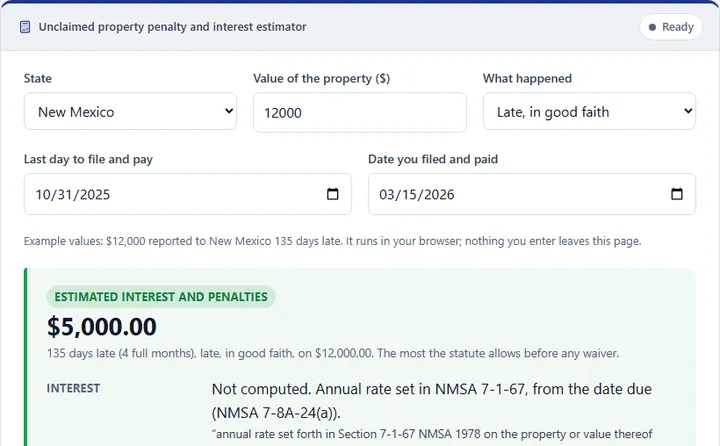
| New Mexico | $100 a day, up to $5,000 (NMSA 7-8A-24(b)) | Same penalty covers late payment or delivery (NMSA 7-8A-24(b)) | Annual rate set in NMSA 7-1-67, from the date due (NMSA 7-8A-24(a)) | Willful: $250 a day, up to $7,500, plus 25%; fraud: $500 a day, up to $12,500, plus 25% (7-8A-24(c), (d)) | nmonesource.com |
| New York | Willful: $100 a day; the Comptroller may waive it (Abandoned Property Law 1412(1)) | Not listed | 10% a year from the date due; the Comptroller may waive it (Abandoned Property Law 1412(2)) | Willful false oath in a report is perjury (Abandoned Property Law 1413) | nysenate.gov |
| North Carolina | Willful: $1,000 a day, up to $25,000, plus 25% (G.S. 116B-77(b)) | Same penalty covers willful failure to pay or deliver (G.S. 116B-77(b)) | Rate set by the Treasurer, 5% to 16% a year; rule uses the Revenue rate (G.S. 116B-77(a); 20 NCAC 08 .0112) | Fraudulent report: $1,000 a day, up to $25,000, plus 25% (G.S. 116B-77(c)) | ncleg.gov |
| North Dakota | $200 a day, up to $5,000 (N.D.C.C. 47-30.2-65(2)) | Same penalty covers late payment or delivery (47-30.2-65(2)) | As written: "an annual rate of one percent of the sum for each thirty-day period of delinquency or fraction of delinquency period". It mixes a yearly and a 30-day measure, so no rate is computed here (47-30.2-65(1)) | Willful: $1,000 a day, up to $25,000, plus 25%; fraud: same (47-30.2-66); commissioner may waive up to $25,000 (47-30.2-67) | ndlegis.gov |
| Ohio | Knowing failure: $100 a day; another $100 a day if not filed within 4 months of a request (R.C. 169.12(A), (B)) | Civil penalty of 1% a month of funds not reported or paid, up to 25 months (R.C. 169.12(C)) | Bank's best retail time deposit rate; non-banks, the best six-month Treasury bill rate (R.C. 169.12(C)) | Criminal: knowing violation fined up to $500, each day a separate offense (R.C. 169.99(A)); civil waiver for good cause (169.12) | codes.ohio.gov |
| Oklahoma | Willful failure: $100 a day, up to $5,000 (60 O.S. 680(B)) | Willful failure to pay or deliver: 25% of the value of the property (60 O.S. 680(C)) | 10% a year from the date the property should have been paid or delivered (60 O.S. 680(A)) | Willful refusal after written demand: misdemeanor, $500 to $5,000 fine or up to 6 months, or both (60 O.S. 680(D)) | oklegislature.gov |
| Oregon | Willful: up to $1,000 for individuals, $50,000 for corporations, after one reporting cycle and written instructions (ORS 98.992) | Same penalty covers willful failure to pay or deliver (ORS 98.992) | At the rate set by the Director of the Department of Revenue under ORS 305.220 (ORS 98.416(2)) | Not listed | oregonlegislature.gov |
| Pennsylvania | Up to $1,000 a day until a proper report is filed, waivable for good cause (72 P.S. 1301.24(c)) | Same penalty covers failure to pay and deliver (72 P.S. 1301.24(c)) | 12% a year from the time the report should have been filed (72 P.S. 1301.24(b)) | Criminal: $100 a day up to $10,000 for no report; refusal to pay a misdemeanor, $1,000 to $10,000 or up to 24 months (1301.25) | palegis.us |
| Rhode Island | Willful failure: $100 to $500 a day, up to $10,000 (R.I. Gen. Laws 33-21.1-34(b)) | Willful failure to pay or deliver: 25% of the value of the property (33-21.1-34(c)) | 12% a year above the 52-week Treasury bill discount rate (33-21.1-34(a)) | Willful refusal after written demand: misdemeanor, $100 to $500 fine or up to 6 months, or both (33-21.1-34(d)) | webserver.rilegislature.gov |
| South Carolina | May be required: $100 a day, up to $5,000 (S.C. Code 27-18-350(B)) | May be required: 25% of the value of the property (27-18-350(C)) | At the rate provided in Section 12-54-25 (27-18-350(A)) | Willful refusal after written demand: misdemeanor, fine up to $10,000 or up to 1 year, or both (27-18-350(D)) | scstatehouse.gov |
| South Dakota | Not listed | Not listed | Category A rate (4.5% a year) from the date due; may be waived on written request (SDCL 43-41B-35, -18; 54-3-16) | Not listed | sdlegislature.gov |
| Tennessee | $200 a day, up to $5,000 (T.C.A. 66-29-173) | Same penalty covers late payment or delivery (66-29-173) | Not listed | Willful: $1,000 a day, up to $25,000, plus 25%; fraud: same (66-29-174); treasurer may waive any penalty (66-29-175) | advance.lexis.com |
| Texas | Civil penalty up to $100 a day of violation, in an attorney general suit (Prop. Code 74.709(f)) | 5% of the value due; another 5% if not paid by the 31st day after the due date (Prop. Code 74.706(a)) | 10% a year from the date due until paid or delivered (Prop. Code 74.705) | Willful failure to report, pay or permit examination: Class B misdemeanor (Prop. Code 74.710) | tcss.legis.texas.gov |
| Utah | $200 a day, up to $5,000 (Utah Code 67-4a-1204(2)) | Same penalty covers late payment or delivery (67-4a-1204(2)) | Federal short-term rate (IRC 6621)IRC 6621Internal Revenue Code, Cornell LII plus four percentage points (67-4a-1204(1)) | Willful: $1,000 a day, up to $25,000, plus 25%; fraud: same (67-4a-1205); waiver in whole or in part (1206) | le.utah.gov |
| Vermont | $200 a day, up to $5,000; waived if good faith and without negligence (27 V.S.A. 1594(b), 1596) | Same penalty covers late payment or delivery (27 V.S.A. 1594(b)) | Higher of the Vermont Tax Department rate (32 V.S.A. 3108) or the Wall Street Journal prime rate (27 V.S.A. 1594(a)) | Willful: $1,000 a day, up to $25,000, plus 25%; fraud: same (27 V.S.A. 1595) | legislature.vermont.gov |
| Virginia | $100 a day, up to the lesser of $10,000 or 25% of the value (Va. Code 55.1-2540(C)) | Same penalty covers late payment or delivery (55.1-2540(C)) | Same annual rate as delinquent taxes under 58.1-1812 (55.1-2540(A)) | Willful or fraudulent: $1,000 a day, up to the lesser of $50,000 or 100% of the value (55.1-2540(D)); waiver for good cause (E) | law.lis.virginia.gov |
| Washington | 10% of the amount unpaid; willful failure: $100 a day, up to $5,000 (RCW 63.30.690(2), (7)) | 10% of the amount unpaid; 10% more on an audit assessment; 5% more if a determination is unpaid (RCW 63.30.690) | Rate computed under RCW 82.32.050(1)(c) (RCW 63.30.690(1)) | Fraud or willful evasion: $1,000 a day, up to $25,000, plus 25%; penalties are cumulative (RCW 63.30.690(5), (9), (10)) | app.leg.wa.gov |
| West Virginia | Civil penalty of $200 a day, up to $5,000 (Treasury summary of the Act) | Same penalty covers late payment or delivery (Treasury summary of the Act) | 12% a year of the property's value from the date due (Treasury summary of the Act) | Willful failure or fraudulent report: "even greater penalties" (Treasury summary; 36-8-24 not read) | wvunclaimedproperty.gov |
| Wisconsin | $150; then $100 a day after a written request (Wis. Stat. 177.1204(1)) | 15% of the value; then $100 a day after a written request (Wis. Stat. 177.1204(2)) | Not listed | False or fraudulent report: $1,000 a day or up to 6 months, capped at the lesser of $25,000 or 25% (177.1204(1)(c)) | docs.legis.wisconsin.gov |
| Wyoming | Willful failure: up to $100 a day (W.S. 34-24-135(a)(i)) | Willful failure to pay or deliver: 25% of the value of the property (W.S. 34-24-135(a)(ii)) | 10% a year above the 52-week Treasury bill discount rate, reset each year; may be waived (34-24-135(a)(iii), (c)) | Not listed | wyoleg.gov |
When the office's page says something else
Several state offices describe penalties differently from their own statutes, usually because the page was written for an older act. The statute is the law; the office's page tells you what the office says it does. Examples from the saved sources:
- Arizona's holder FAQ mentions a “100% penalty for the value of the property not reported”; the statute sets 25 percent for a willful failure to pay or deliver (A.R.S. 44-326(B)).
- Idaho's FAQ says late reports “could be charged an annual rate of 12% interest and 5% penalty”; the statute's penalty is $200 a day up to $5,000 (Idaho Code 14-5-1204).
- Indiana's holder pages say “The penalties for failing to file a report are $100 per day the report is late, up to $5,000.” Those figures match the repealed IC 32-34-1; the current act sets $200 a day (IC 32-34-1.5-71).
- Maryland's guidelines say “The penalty is 15% of the remitted report value” for late filings; the statute's 15 percent is for failing to pay or deliver, and a late report draws a daily penalty only when willful (Com. Law 17-323).
- Delaware's office says “The current administrative policy of the State Escheator is to waive, or not impose, interest and penalties on voluntarily” filed property, even if late. That is a policy, not a change in 12 Del. C. 1183.
When a state's page and its statute differ, plan on the statute and ask the office in writing how it will apply it.
Asking for a waiver
Most states can waive. The 2016 act says the administrator “may waive, in whole or in part” interest and penalties, and “shall waive a penalty under Section 1204(b) if the administrator determines that the holder acted in good faith and without negligence” (section 1206). Older statutes say much the same: Florida's “If the holder acted in good faith and without negligence, the department shall waive the penalty provided herein.” (Fla. Stat. 717.134), and Connecticut's “The Treasurer upon a showing of a good faith effort to comply with this part, may waive the interest prescribed in this section.”.
RUUPA (2016) sections 403(c) and 1206; Code of Ala. 35-12-76(g); Texas Form 53-206; the state statutes in the table below.
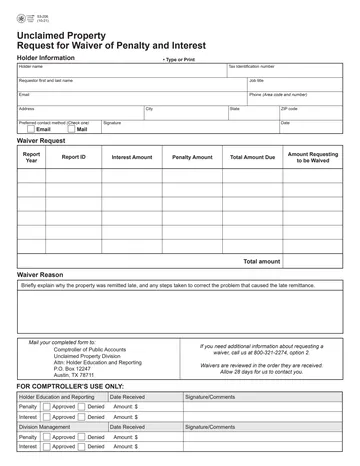
Ask in writing, and use the state's form where there is one. Texas has Form 53-206, Request for Waiver of Penalty and Interest, which asks the holder to “Briefly explain why the property was remitted late, and any steps taken to correct the problem that caused the late remittance.” and says “Allow 28 days for us to contact you.” (the Form 53-206 page goes line by line). West Virginia takes objections to an assessment on its Notice of Interest and Penalty Objection Form, and “Our office will provide a written decision within 90 days of receiving the objection.” Elsewhere, a letter to the office with the report ID, the amounts, the reason and the fix does the same job.
A good request shows good faith: the report was filed as soon as the problem was found, the cause was fixed, and the holder has a record of timely reports. A holder that never reported, and has not yet heard from the state, usually does better in a voluntary disclosure program, where the waiver is part of the deal.
Stopping the clock
Interest and daily penalties grow with time, so the fastest fix is to report and pay. Before the due date, ask for an extension (the reporting guide lists each state's process). The 2016 act lets a holder with an extension make a partial payment, which “terminates accrual of interest on the amount paid” (section 403(c)). Alabama's statute lets a holder with an extension make an interim payment, “which terminates the accrual of penalties, if any, on the amount paid” (Code of Ala. 35-12-76(g)).
After the due date, file and pay what you know, then correct the rest. If a state has already written to you, the failure to report notice page explains the letter and the clock it starts. A late report is better than none: in many states the limitation period starts only when a report is filed, and a fraudulent or missing report keeps every year open.
Forms, line by line
Tools for this topic
Questions holders ask
What is the penalty for filing an unclaimed property report late?
It depends on the state. The 2016 uniform act's model is interest plus up to $200 a day, capped at $5,000, and many states use it. Florida charges $10 a day up to $500, New Jersey $200 a day up to $100,000, and some states charge a penalty only when the failure is willful.
Do states charge interest on late unclaimed property?
Most do, from the date the property should have been reported or paid. Rates range from fixed rates such as 10, 12, 15 or 18 percent a year to rates tied to Treasury bills, the prime rate or the state's tax interest rate.
Can unclaimed property penalties be waived?
Usually yes. The 2016 act says the administrator shall waive the late-filing penalty for a holder that acted in good faith and without negligence, and most states may waive penalties and often interest on a written request. Texas uses Form 53-206.
Is failing to report unclaimed property a crime?
In some states a willful failure, or a refusal after the state's written demand, is a misdemeanor. Texas, Georgia, Michigan, Missouri, Oklahoma and others have such provisions. An ordinary late report is a civil matter.
Does a voluntary disclosure avoid penalties?
Usually. Most state VDA programs waive penalties and many waive interest too, but only for a holder that comes forward before an audit notice.
Do penalties apply if we never filed at all?
Yes, and the exposure is larger: interest runs from each original due date, and in many states the limitation period never starts without a report, so every year stays open.
Sources
- Revised Uniform Unclaimed Property Act (2016, as amended 2022), sections 403, 1204, 1205 and 1206: Uniform Law Commission
- State statutes: the source link in each row of the table, including Fla. Stat. 717.117 and 717.134, N.J.S.A. 46:30B-103 to 105.1, Tex. Prop. Code 74.705 to 74.710, Conn. Gen. Stat. 3-65b, A.R.S. 44-326, 12 Del. C. 1183 and 1184, Code of Ala. 35-12-76
- Texas Form 53-206: claimittexas.gov; West Virginia objection form: wvunclaimedproperty.gov
- Office pages quoted: Arizona holders FAQ, Idaho FAQ, Indiana holder pages, Maryland reporting guidelines, Delaware FAQ