- The liability stays on the books
- Why a void or write-off does not end it
- Journal entries from void to remittance
- Outstanding checks in the bank reconciliation
- Customer credits and AR credit balances
- Remittance, reimbursement and recoveries
- Records to keep
- Month-end and year-end controls
- Questions holders ask
- Sources
- Liability
- Stays on the books after a void or write-off
- Clears when
- The owner is paid or the state is paid
- Records
- 10 years after the report in most states
- Authority
- State law sets the steps; the entries are standard practice
The liability stays on the books
When a business writes a check, its books show the bill paid and the cash gone. If the check is never cashed, the business still owes the money: the vendor, employee or customer was never paid. Unclaimed property law turns that debt into a duty to the state after a set time. The 2016 uniform act treats the holder's own record as the starting point: “A record of a putative holder showing an unpaid debt or undischarged obligation is prima facie evidence of the debt or obligation.” (RUUPA section 1005(a)).
So the accounting job is to keep that obligation visible, usually in a separate unclaimed property (or escheat) liability account, from the day an item goes stale until it is paid to the owner or to a state. The statutes do not prescribe journal entries or account names. The entries on this page are standard accounting practice, and we say so plainly; what the law decides is when each step must happen (dormancy, due diligence, report and records) and what proof the holder needs. The escheat process guide covers those steps, and the dormancy periods table has each state's clock.
Why a void or write-off does not end it
A tempting shortcut is to void old checks and take the money back to income, or to write small customer credits off to miscellaneous income. That does not end the debt to the payee, and states say so. Illinois's rules say a valid reason to void a check “does not include a policy of voiding outstanding checks, drafts, or similar instruments after a specified number of days”, and that “a policy of automatically voiding would be tantamount to a private escheat law” (74 Ill. Adm. Code 760.780). The District of Columbia's holder FAQ answers the question directly: “Yes, past obligations that have been written off or taken to income are reportable.” “The Unclaimed Property Act prevents businesses from circumventing the unclaimed property process by making a private escheat.” (DC holder FAQ).
The standard property codes even have a line for it. The NAUPA codes the states publish include “CHECKS WRITTEN OFF TO INCOME” as a property type of its own (CK14 in Arizona's list), so a write-off is something holders report, not a way out. The uncashed checks guide covers the same rule from the AP side.
RUUPA (2016) section 1005(c); 74 Ill. Adm. Code 760.780; District of Columbia holder FAQ; North Carolina credit balance guide.
A void is fine when it reflects a real reason recorded at the time. The 2016 act lets a holder rebut its own record by showing a check was, among other things, “issued as an unaccepted offer in settlement”, “replaced with another instrument”, “paid, satisfied, or discharged”, “issued in error”, or voided “for a valid business reason set forth in a contemporaneous record” (section 1005(c)). The key word is contemporaneous: a note written years later, during an audit, is weaker proof.
Journal entries from void to remittance
The sequence below is the usual one for a vendor or payroll check. The account names are examples; use your own chart of accounts. The point is that the stale amount moves from cash (outstanding at the bank) to a liability, and leaves the liability only when someone is paid.
The legal steps come from the Revised Uniform Unclaimed Property Act (2016) sections 501, 604, 605 and 1005 and 74 Ill. Adm. Code 760.780; the entries are standard accounting practice.
| Event | Debit | Credit | The legal step behind it |
|---|---|---|---|
| Check issued to a vendor, employee or customer | Accounts payable (or wages payable, or the customer's account) | Cash | The debt to the payee arises; the dormancy clock starts when it is payable. |
| Check stale or voided under your policy | Cash (the void puts the money back in the bank balance) | Unclaimed property liability | A void does not end the debt (74 Ill. Adm. Code 760.780). |
| Customer credit balance aged past your review date | Accounts receivable (clears the credit on the customer's account) | Unclaimed property liability | A credit balance is property under the uniform acts; no write-off to income. |
| Owner answers the due diligence letter | Unclaimed property liability | Cash (reissue the payment) | Paying the owner ends the matter; nothing goes to the state. |
| Item proven not owed (issued in error, already paid) | Unclaimed property liability | The original account (expense, AP or AR) | A defense needs a record made at the time (RUUPA 1005(c)). |
| Report filed and payment sent to the state | Unclaimed property liability | Cash | The holder is relieved of liability for the property paid (RUUPA 604). |
| Holder pays an owner after remitting | Receivable from the state | Cash | The holder may claim reimbursement from the state (RUUPA 605). |
| State reimburses the holder | Cash | Receivable from the state | The claim is paid; no fee is charged under the 2016 act. |
Two choices are up to the business. First, when to void: some reclassify after 90 or 180 days, others at year-end; any date works as long as the item goes to the liability, not to income. Second, how to track items: one liability account with a subledger by owner, property type, state and dormancy date is enough for most holders, because the report needs each item's owner, last known address, amount and date. The NAUPA file format page lists the fields a report needs.
RUUPA (2016) sections 201(4), 403 and 501(a); Alaska Department of Revenue, Guidance for Holders Completing a Self-Review (2023). The entries are standard practice; the periods and dates come from each state's law.
Outstanding checks in the bank reconciliation
Until a check is voided, it sits on the bank reconciliation as an outstanding check: the bank balance is higher than the book balance by the checks not yet cashed. Old items on that list are the first place unclaimed property hides. Alaska's guidance for holders reviewing their own records says to “review quarterly outstanding lists and void reports” and to “Identify outstanding checks aged 90+ days on each report and voided checks aged 30+ days on each report.” It adds: “If your company has a policy to void checks after a certain date threshold, make sure these voided items are included in your self-review.” (Alaska self-review guidance).
Payments made through a payroll provider or payment processor need the same review. The Alaska guidance warns that “If your organization uses a third-party for payments, often your organization is still the” holder, so ask the provider for its list of unpaid items. A clean reconciliation, with stale items moved promptly to the liability account, is also the record an auditor will ask for.
Customer credits and AR credit balances
Credits are the other half of escheatment accounting: overpayments, duplicate payments, unapplied cash, credit memos and refunds due. The 2016 act's list of property names “a credit balance, customer's overpayment, stored-value card, security deposit, refund, credit memorandum”. These sit in accounts receivable as credit balances, and the same rule applies: they are owed to the customer until refunded or reported. North Carolina's guide says “there are no provisions under law that permit the write-off of small credit balances to income or other accounts” (North Carolina credit balance guide). Alaska's guidance tells holders that write off or reclassify aged balances to “make sure you review the associated adjustment report or write-off account for potential unclaimed property”.
Some states exempt credits between businesses, and that changes the entry: an exempt credit can be handled under the business's own policy. Others exempt nothing. The customer credits and refunds guide lists the business-to-business exemptions by state, and the gift cards guide covers stored value, where breakage accounting meets state escheat rules.
Remittance, reimbursement and recoveries
When the holder reports and pays, the liability for those items is cleared. The 2016 act says a holder that pays the state “in good faith and substantially complies with Sections 501 and 502 is relieved of liability” for the property (section 604), so nothing stays on the books for remitted items except the records behind them.
An owner may still come to the holder later. If the holder pays the owner, it can recover the money from the state: a holder “may file a claim for reimbursement from the administrator of the amount paid” when it paid the state in error or later paid someone it reasonably believed entitled to the money, and “A holder is not required to pay a fee” for the claim (section 605). Book the payment as a receivable from the state until the reimbursement arrives, and file the claim the way that state asks (the state pages link each office).
Retirement accounts and securities need more than one entry: an IRA paid to a state is a distribution for federal tax purposes. The securities and retirement guide covers the withholding and Form 1099-R rules.
Records to keep
Keep the subledger, the void and outstanding check reports, the due diligence letters and responses, and the reports filed. The 2016 act requires records “for 10 years after the later of the date the report was filed or the last date a timely report was due to be filed” (section 404), and most states use 10 years; the audits page has every state's period. Records of items you cleared without reporting matter as much as the report: they are the proof that an item was paid, reissued or never owed. Without them, an auditor can treat the item as owed, and where years of records are missing, estimate.
Month-end and year-end controls
- Monthly: age the outstanding check list and the AR credit balances; move items past your policy date to the unclaimed property liability, never to income.
- Monthly: record the reason for every void at the time you void it (reissued, issued in error, duplicate, paid another way).
- Before each state's report: pull the items that have reached dormancy, sort them by the owner's last known address, and send due diligence letters in each state's window.
- At filing: clear the liability for items remitted, keep the report and proof of payment, and book any items still within dormancy forward.
- Year-end: reconcile the liability subledger to the general ledger and to the reports filed, and check that write-off and suspense accounts hold no reportable items.
These controls also make a future audit or voluntary disclosure much cheaper, because the holder can show its own numbers instead of an estimate.
Templates
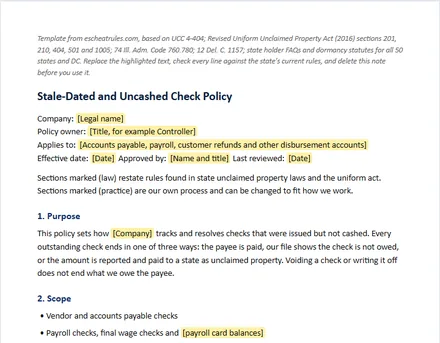
Stale-dated check policy
A policy for AP and payroll teams on uncashed checks: aging, outreach, voiding, write-offs, due diligence and reporting, with the law and the practice marked apart.
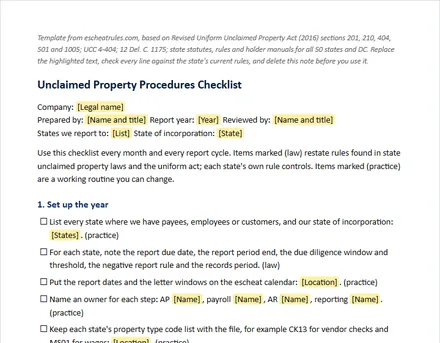
Procedures checklist
A month-by-month checklist for AP, payroll and AR: aging and outreach, voids, credits, wages, due diligence letters, the report and records, with each state's dates.
Questions holders ask
How do you account for an uncashed check that will escheat?
Void it into an unclaimed property liability account (debit cash, credit the liability), not into income or expense. When you pay the payee or remit to the state, debit the liability and credit cash.
Can we write off old uncashed checks to income?
No. The debt is still owed to the payee, and states treat written-off items as reportable. Illinois calls an automatic void policy a private escheat, and the DC holder FAQ says written-off obligations are reportable.
Is there an official journal entry for escheatment?
No. The statutes set when property must be reported and what records to keep, not the entries. The entries on this page are standard accounting practice.
How do outstanding checks affect the bank reconciliation?
Uncashed checks stay on the reconciliation as outstanding until voided. Aged items should be voided into the unclaimed property liability so the reconciliation stays clean and the amounts are tracked for reporting.
What if an owner asks for money we already sent to the state?
Pay the owner if the claim is good, book a receivable from the state, and file the state's holder reimbursement claim. Under the 2016 act the state reimburses without a fee.
How long do we keep escheat records?
Ten years after the report in most states, under the 2016 act and most state laws; some use less and Colorado now uses 6. Keep the records behind items you cleared without reporting too.
Sources
- Revised Uniform Unclaimed Property Act (2016, as amended 2022), sections 201, 404, 501, 604, 605 and 1005: Uniform Law Commission
- 74 Ill. Adm. Code 760.780 (Illinois Treasurer rules): Illinois
- District of Columbia unclaimed property holder FAQ: unclaimedproperty.dc.gov
- North Carolina, Guide to Unclaimed Property Credit Balances and Credit Memorandum (2025): nccash.gov
- Alaska Department of Revenue, Guidance for Holders Completing a Self-Review (June 2023): unclaimedproperty.alaska.gov
- Arizona NAUPA property codes: azdor.gov