Report seasons from each state's statute or holder manual (states_es); the window and the records rule from the Revised Uniform Unclaimed Property Act (2016) sections 404 and 501.
The process in one view
Every state and DC has its own unclaimed property law, and a business that operates in many states follows many of them at once. The good news is that the work has the same shape everywhere. Many states follow, in whole or in part, one of the Uniform Law Commission's model acts, and the 2016 version, the Revised Uniform Unclaimed Property Act (RUUPA), lays the steps out in order: when property is presumed abandoned (Article 2), the report (Article 4), the notice to the owner (Article 5) and what happens after the state takes custody (Article 6). The rest of this page walks through those steps from the holder's desk.
The holder's steps under the Revised Uniform Unclaimed Property Act (2016) Articles 2, 4, 5 and 6. Each state sets its own periods, windows and dates; the sections below give the rule behind each step.
The work is yearly because the report is yearly. Each state asks for one report a year from a business holder (insurers and banks often have their own dates), so most holders run the cycle on a calendar: a review a few months before each due date, letters in the state's window, then the report and payment. A business that reports to many states runs several cycles a year, because the states do not share a date.
Step 1: Find the property
Unclaimed property sits wherever the business owes money it has not paid out. Missouri's holder page lists the usual places, starting with “Stale outstanding checks - checks written represent an attempt to pay a valid obligation.” It goes on: “If a check does not clear the bank, the underlying liability is Unclaimed Property if it cannot be restored to the payee.” The list continues with liabilities written off to income, “Other stale liabilities in the general ledger - these are recorded obligations for which no check was issued”, and securities held by agents.
In practice the search covers the accounts payable and payroll outstanding check lists, voided check reports, customer credit balances and refunds, unapplied cash and suspense accounts, and anything a payroll or benefits provider holds for you. Alaska's self-review guidance gives a working test for the check accounts: “Identify outstanding checks aged 90+ days on each report and voided checks aged 30+ days on each report.” An outside service does not take the duty away. North Carolina's guide says “the company typically remains liable for reporting the unclaimed checks unless otherwise stated in the contract”.
The property types a business meets most each have their own guide: uncashed and stale-dated checks, unclaimed wages, customer credits and refunds, gift cards and securities and retirement accounts.
Step 2: Age it against the dormancy period
An item is not reportable just because it is old. It becomes reportable when it has been unclaimed for the period the state sets for that kind of property, the dormancy period. RUUPA puts it this way: property “is presumed abandoned if it is unclaimed by the apparent owner during the period specified below”, and then lists the periods (section 201). A vendor check, which is a business's debt, waits three years in the model act; wages wait one.
The clock restarts when the owner shows interest. Under RUUPA the period runs from “the latest indication of interest by the apparent owner in the property” (section 210(a)), such as a letter or recorded call from the owner about the account, or the owner cashing a check on it. Keep the record of that contact, because an auditor will ask for it.
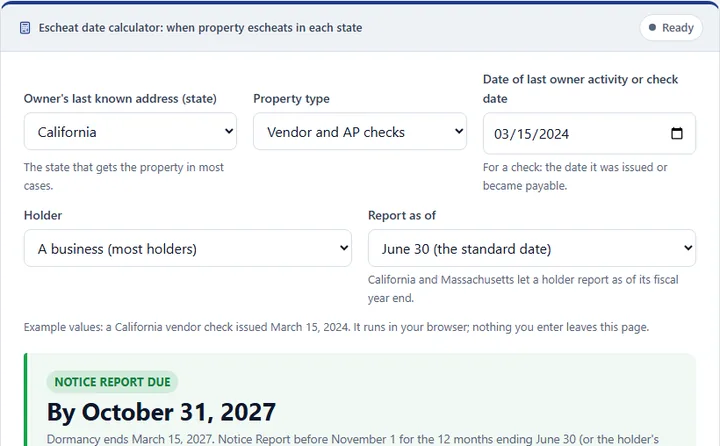
Then compare the dormancy date with the state's report cutoff. In a state that follows the model act, the report filed before November 1 covers “the 12 months preceding July 1 of that year” (section 403(a)), so an item that reaches its dormancy date by June 30 goes on that fall's report. States set their own periods by property type, from 1 year for wages in most states to 5 years for most property in Delaware: the dormancy periods by state table has all 51, and the escheat date calculator counts the dates for one item.
Step 3: Send due diligence letters
Before the report, the holder writes to each owner it has an address for. Under RUUPA the letter goes by first-class mail “not more than 180 days nor less than 60 days before filing the report” when the holder's address for the owner is not known to be bad and the property is $50 or more (section 501(a)). The letter must open with a set heading, starting “requires us to notify you that your property may be transferred to the custody of the” state's administrator, and tell the owner how to stop the transfer (section 502).
The states vary the window, the amount and the mail. Florida's 2026 law wants the letter “At least 90 days, but not more than 180 days, before filing the report” and, “If the value of the property is greater than $1,000, the holder must send a second written notice by certified United States mail” (Fla. Stat. 717.117). New York's law asks for “a written notice by first-class mail to each person appearing to be the owner” and, for property “whose value is in excess of one thousand dollars, send a second written notice to the owner by certified mail” (N.Y. Aband. Prop. Law 1422). Owners who answer and are paid come off the report; that is the point of the step. The due diligence letters by state page has every state's window, threshold and sample letter, and the due diligence letter template is ready to fill in.
Step 4: Build the report
The report lists each item and its owner. RUUPA's report must give the owner's name and last known address and the “Social Security number or taxpayer identification number, if known or readily ascertainable” for property of $50 or more, the date the dormancy clock started, and a statement that the holder sent the required notices (section 402(a)). Smaller items “may include in the aggregate items valued under $[50] each” (section 402(b)), and many states allow the same with their own floor.
The report is almost always a file in the NAUPA standard format, the state administrators' common layout, uploaded to the state's portal. RUUPA says the “administrator may not require a holder to file a paper report” (section 401(a)), and some states go further: in Alabama “The report shall be filed electronically and the monies remitted electronically.” (Code of Ala. 35-12-76). A holder may hire someone to prepare the report but stays answerable for it: the RUUPA comment says “the holder remains ultimately responsible for the timeliness and accuracy of the report”. The NAUPA file format page explains the layout and codes.
Whether a holder with nothing to report must file anyway depends on the state. Alabama's portal says “negative reports are NOT required.” Connecticut's instructions say the opposite for local businesses: all with a presence there “must submit a negative report if you have no unclaimed property”. The negative report finder and the unclaimed property reporting guide cover each state.
Step 5: File and remit on time
The model act's date is the most common one: “the report under Section 401 must be filed before November 1 of each year” (section 403(a)), with insurers before May 1. In all, 42 states want the business holder report in the fall. 7 take it in spring (Connecticut, Delaware, Florida, Illinois, New York, Pennsylvania and Vermont) and 2 in summer (Michigan and Texas). Delaware's report “must be filed by all holders and business associations other than banking organizations and insurance companies on or before March 1 of each year to cover the 12 months preceding January 1 of that year” (12 Del. C. 1142).
RUUPA sections 403(a), 404 and 501(a). Spring and summer states run the same steps on their own dates: check the state page before you count.
Payment usually goes with the report. California splits the two: a Notice Report in the fall and a Remit Report the next June, and the Controller's checklist says “Do not send funds or tangible property with the Notice Report. Property is due with the Remit Report” (see California's Notice and Remit Reports).
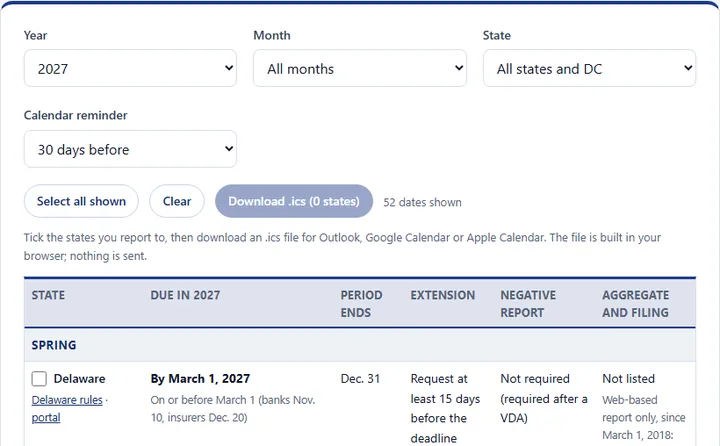
If the date cannot be met, ask before it passes. RUUPA lets the state grant an extension, and a holder that pays what it expects to owe in the meantime limits the cost: “The payment or partial payment terminates accrual of interest on the amount paid.” (section 403(c)). States set their own lead times; Alabama's rule says the request “must be in writing to the Treasurer's Office at least 15 days” before November 1 (Ala. Admin. Code 892-2-1-.03). The reporting calendar lists every state's dates.
Step 6: Keep the records
Keep what backs each report: the item, the owner, the dates, the letters sent and any owner contact. RUUPA says a holder “shall retain records for 10 years after the later of the date the report was filed or the last date a timely report was due to be filed” (section 404). Some states set less: Colorado's HB 25-1224 (2025) “shortens the period for which a holder required to file a report regarding property that is presumed abandoned must retain records from 10 to 6 years” (HB 25-1224). Records matter most when an auditor arrives: where a holder kept them, RUUPA limits estimates, and where it did not, the state may estimate what is owed.
Step 7: After the report
Once the property is paid to the state, the owner claims it from the state, and the holder is out of the line of fire. A holder that pays in good faith and gave the required notice “is relieved of liability arising thereafter with respect to payment or delivery of the property to the administrator” (section 604(a)), and the state defends it against later claims for that property (section 604(b)).
Owners still call the holder. If the holder pays an owner after remitting, or remitted something by mistake, it “may file a claim for reimbursement from the administrator of the amount paid” (section 605). The state pages link each state's holder reimbursement form where the state publishes one.
When steps were missed
A business that never reported, or skipped property types, is not alone, and the rules give it a way back before an audit finds it. RUUPA bars a state from starting an action or examination “more than 10 years after the duty arose” (section 610(c)), and Colorado cut its own limit to six years in the same 2025 law. Where records are gone, an audit can estimate.
Program terms differ by state: see the unclaimed property VDA and audits guides.
The unclaimed property VDA page lists each state's voluntary program, and the audits and penalties and interest guides go state by state. The procedures checklist turns the seven steps into a yearly routine.
Tools for this topic
Templates
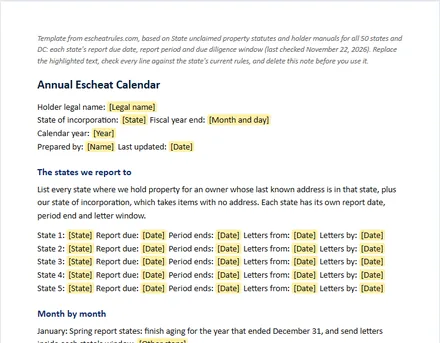
Annual escheat calendar
A printable calendar of the holder's year: period ends, due diligence letters, report and payment dates, with every state's date filled in to start from.
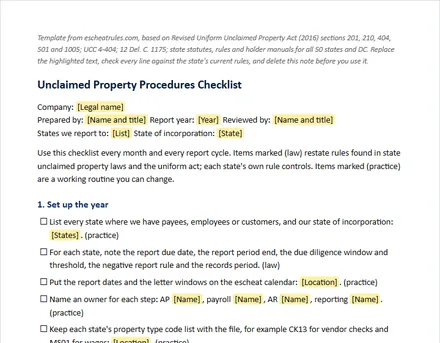
Procedures checklist
A month-by-month checklist for AP, payroll and AR: aging and outreach, voids, credits, wages, due diligence letters, the report and records, with each state's dates.
Questions holders ask
What is the escheatment process?
The yearly steps a business follows for money it owes but cannot deliver: find the items, check each against the state's dormancy period, send due diligence letters, report and pay what is left to the state, keep the records, and claim back anything later paid to an owner.
How long does the escheatment process take?
The dormancy period comes first: often 3 years for a vendor check and 1 year for wages, longer in some states. After that the work runs on the report calendar: letters 60 to 180 days before the report under the 2016 uniform act, then the report on the state's due date.
Do I report to every state?
You report each item to one state: the state of the owner's last known address in your records, or your state of incorporation when there is no address. A business with owners in many states files many reports, each on that state's date.
What if an owner contacts me after I have remitted?
Pay the owner if the claim is valid and ask the state to reimburse you; the 2016 uniform act lets a holder claim reimbursement after paying an owner. Or send the owner to the state's claim process.
Can I file a report with nothing on it?
Some states require a negative report from local businesses with nothing to report, such as Connecticut; others, such as Alabama, do not. Check the state page or the negative report finder.
Sources
- Revised Uniform Unclaimed Property Act (2016, as amended 2022), sections 201, 210, 401 to 404, 501, 502, 604, 605 and 610: Uniform Law Commission
- Report dates: each state's statute or holder manual, as listed in states_es and on the state pages; 12 Del. C. 1142: delcode.delaware.gov
- Code of Ala. 35-12-76 and Ala. Admin. Code 892-2-1: alison.legislature.state.al.us; Alabama holder FAQ: unclaimed.alabama.gov
- Florida Stat. 717.117 (as amended by ch. 2026-174): leg.state.fl.us; N.Y. Aband. Prop. Law 1422: nysenate.gov
- California Notice Report checklist: sco.ca.gov; Connecticut general reporting instructions: ctbiglist.gov
- Missouri, reporting unclaimed property: treasurer.mo.gov; Alaska, guidance for holders completing a self-review: unclaimedproperty.alaska.gov; North Carolina, guide to uncashed or unpresented checks: nccash.gov