- Who files
- Every holder filing a Hawaii report
- Due
- With the report, before November 1
- Filed with
- Unclaimed Property Program, Dept. of Budget and Finance
- Form revision
- rev. 10/27/2025
- Pages
- 1, notarized
At a glance
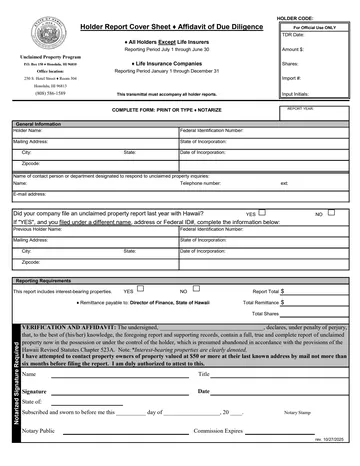
Hawaii's Holder Report Cover Sheet and Affidavit of Due Diligence is a one-page transmittal that goes on top of every unclaimed property report filed with the State of Hawaii. It identifies the holder, ties the report to last year's filing, totals the money and shares, and carries the notarized affidavit that the holder did its due diligence mailing. The form prints its purpose in one line: “This transmittal must accompany all holder reports.” The current revision is dated 10/27/2025 (as of November 2026). Download it from the program's holder information page or straight from the cover sheet PDF.
- Who files it. Every holder that files a Hawaii report: businesses, nonprofits, government entities and life insurers. Hawaii “does not require negative holder reporting”, so a holder with nothing to report files neither a report nor a cover sheet.
- When. With the report, before November 1 (HRS 523A-8(d)). The program's guidelines print the deadline as “Reporting Deadline is November 1”; the statute says before November 1, and the statute governs, so plan to deliver by October 31.
- With what. The guidelines list a complete report as the cover sheet with a summary list, the NAUPA electronic file and the remittance. “Electronic (NAUPA) files are REQUIRED for holder reports.”
- How. On paper, notarized, sent with the electronic file by mail, courier or email (see putting the report together). The program says it “does not host an upload website for submissions”.
Tap a box once for its note, again to jump to the line. Zoom in to read the small print.
Report year and the office box
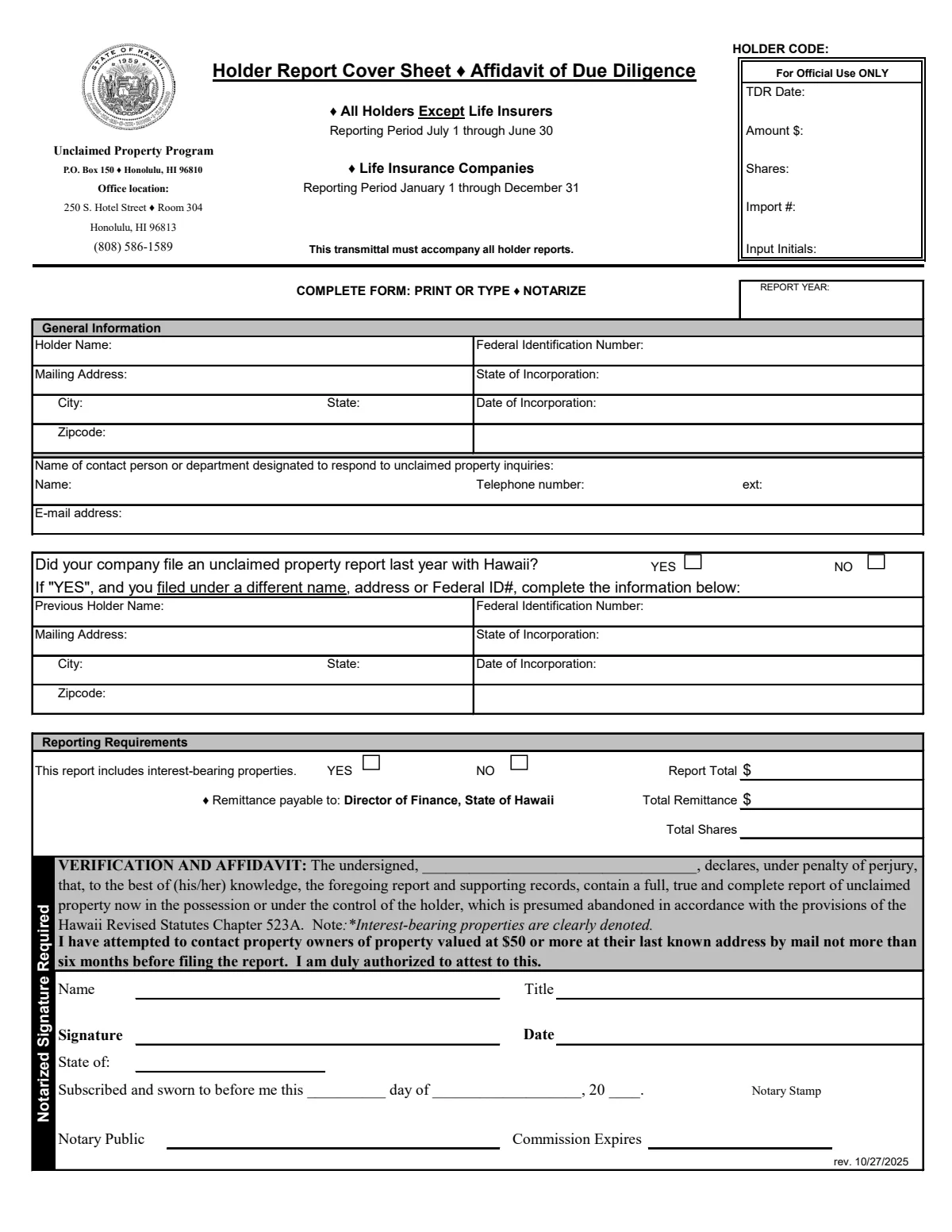
The top of the form names the program's addresses and the two report periods. Only the Report Year box is yours; the boxed column on the right is filled in by the program when the report arrives.
| Line | Label | What goes there |
|---|---|---|
| Office | HOLDER CODE; For Official Use ONLY (TDR Date, Amount $, Shares, Import #, Input Initials) | The boxed area at the top right is the program's own record of when the report arrived and what came with it. Leave it blank. Hawaii's holder guidelines, FAQ and holder pages do not say what goes in the Holder Code line (Not listed); if you are unsure, call the program at (808) 586-1589 before you write anything there. |
| Year | REPORT YEAR | The year of the report you are filing. The form prints the two report periods: for all holders except life insurers, “Reporting Period July 1 through June 30”; for life insurers, the calendar year. The statute says the report “shall be filed before November 1 of each year and cover the twelve months next preceding July 1 of that year” (HRS 523A-8(d)). So the report you file in October 2026 covers July 1, 2025 to June 30, 2026. |
General Information
This block identifies the holder. The program matches it to the holder record on the NAUPA file, so the name, FEIN and address must agree with the file.
| Line | Label | What goes there |
|---|---|---|
| Name | Holder Name | The legal name of the holder. Use the same name as on the NAUPA file that goes with the cover sheet, so the program can match them. The guidelines ask for “complete holder contact information: Name, Address, Email, and Phone Number” and warn that “Reports with discrepancies will be returned.” |
| FEIN | Federal Identification Number | The holder's federal employer identification number. If a parent files for its subsidiaries, the FEIN here should match the holder record on the electronic file. |
| Address | Mailing Address, City, State, Zipcode | The holder's mailing address for correspondence about the report. |
| Inc-state | State of Incorporation | The holder's state of incorporation or formation. It matters beyond this form: property with no owner address goes to the holder's state of incorporation, so a business incorporated outside Hawaii reports only property whose owners' last known addresses are in Hawaii. The guidelines put it this way: “If the owner's address is unknown, the property is reported to the state where the holder is incorporated.” See which state gets it. |
| Inc-date | Date of Incorporation | The date the holder was incorporated or formed. |
| Contact | Name of contact person or department designated to respond to unclaimed property inquiries; Name; Telephone number; ext | The person or department the program should call about this report, with a direct phone number. This is also who will hear from the program if an owner's claim needs more information. |
| E-mail address | The contact's email address. The program's own holder address is DBF.UP.Holders@hawaii.gov; that is where the guidelines send NAUPA files by email. |
Last year's report
The middle block links this year's report to last year's. Most holders check YES or NO and move on; it matters after a merger, a name change or a new FEIN.
| Line | Label | What goes there |
|---|---|---|
| Prior-year | Did your company file an unclaimed property report last year with Hawaii? YES / NO | Check one box. The next line on the form says what YES triggers: “If ‘YES’, and you filed under a different name, address or Federal ID#, complete the information below”. If the name, address and FEIN are the same as last year, leave the previous holder block blank. |
| Prev-holder | Previous Holder Name; Mailing Address; City; State; Zipcode | The name and address on last year's report. This is how the statute's successor rule works on paper: a holder that took over property from another holder, or changed its name while holding it, “shall file with the report its former names, if any, and the known names and addresses of all previous holders of the property” (HRS 523A-8(c)). If there was more than one previous holder, attach a list. |
| Prev-ids | Federal Identification Number; State of Incorporation; Date of Incorporation | The FEIN and incorporation details used on last year's report, if they changed (a merger, a conversion to another entity type, a new FEIN). |
Reporting Requirements
The totals block is where the cover sheet, the electronic file and the payment have to agree. A mismatch is the most common reason a report comes back.
| Line | Label | What goes there |
|---|---|---|
| Interest | This report includes interest-bearing properties. YES / NO | Check YES if any item on the report is an interest-bearing account, and mark those items. The guidelines say “Interest-bearing properties must be clearly identified in the holder report.” The statute asks the report to show “whether the property is an interest bearing account” (HRS 523A-8(b)(6)) because the state pays interest to the owner on deposits like these after it takes custody (HRS 523A-12). |
| Report-total | Report Total $ | The total value of all property on the report. It should equal the total of the NAUPA file and the summary list that go with the cover sheet. |
| Payee | Remittance payable to: Director of Finance, State of Hawaii | Not a blank: the form prints the payee. Make checks payable to the Director of Finance, State of Hawaii. The guidelines add that “Electronic Fund Transfer (EFT) options are available.” Email DBF.UP.Holders@hawaii.gov for the EFT details. |
| Remittance | Total Remittance $ | The amount you send with the report. “Remittance must reconcile to report total.” Safe deposit box contents are the exception: under HRS 523A-9(a), tangible property in a safe deposit box is delivered 120 days after the time for payment, not with the report. |
| Shares | Total Shares | The number of shares you report and deliver, if any. For shares the guidelines say: “Provide confirmation of escheated shares to the Director of Finance, State of Hawaii.” Leave it blank or write 0 if the report has no securities. |
Verification, affidavit and notary
The shaded block is the reason the form exists. Hawaii's statute requires two things that this block carries: a verified report (HRS 523A-8(b) says the report “shall be verified”) and an affidavit that the due diligence letters went out (HRS 523A-8(g)).
| Line | Label | What goes there |
|---|---|---|
| Affidavit | VERIFICATION AND AFFIDAVIT: The undersigned, ____, declares, under penalty of perjury ... | Write the signer's full name in the blank. By signing, that person swears two things. First, that the report and supporting records “contain a full, true and complete report of unclaimed property now in the possession or under the control of the holder”. Second, the due diligence statement: “I have attempted to contact property owners of property valued at $50 or more at their last known address by mail not more than six months before filing the report.” That is the affidavit the statute requires: the holder “shall file with the report an affidavit stating that the holder has complied with subsection (e)” (HRS 523A-8(g)). Do not sign until the letters have gone out. |
| Signer | Name; Title | The printed name and title of the person signing. The form's own words are “I am duly authorized to attest to this.” The statute does not name a required title (an officer, for example); use someone with authority to bind the holder and knowledge of the report. |
| Signature | Signature; Date | Signed and dated in front of the notary. The form says “COMPLETE FORM: PRINT OR TYPE” and NOTARIZE, and the side bar reads Notarized Signature Required. |
| Notary | State of; Subscribed and sworn to before me this __ day of __, 20__; Notary Public; Commission Expires; Notary Stamp | The notary's part: the state, the date the signer swore, the notary's signature, the commission expiry date and the stamp. The program's FAQ is plain about it: “A notarized holder report cover sheet and affidavit stating that written notice was sent to the apparent owner, must be included with a holder report.” |
HRS 523A-8(d), (e) and (g), 523A-21 and the Hawaii Guidelines for Reporting and Remitting Unclaimed Property (Rev. January 2026). Life insurers report the calendar year, also before November 1.
Putting the report together
The cover sheet is one of four pieces. The program's checklist in its Guidelines for Reporting and Remitting Unclaimed Property asks for a “Completed Holder Report Cover Sheet”, a “Summary Listing of properties reported”, the “NAUPA File (.HDE or .TXT)”, and the remittance or the share confirmation.
- The electronic file. The guidelines say the “NAUPA File (.HDE or .TXT format) can be submitted in CD, Flash Drive or email to: DBF.UP.Holders@hawaii.gov”. The program's older electronic files page still says “Holders must download the report to a CD for submission.” The January 2026 guidelines are the newer source and allow all three; the guidelines also say to “Contact our office prior to submitting NAUPA Files submitted via secured file server or dropbox.” The NAUPA file format page explains the layout.
- The summary list. A detailed property summary for the report: the guidelines ask holders to “provide a detailed property summary for the report”.
- The payment. A check payable to the Director of Finance, State of Hawaii, or an EFT arranged with the program, equal to the Total Remittance line.
- Where to send it. By USPS to State of Hawaii, Unclaimed Property Program, P.O. Box 150, Honolulu, HI 96810. By UPS or FedEx to 250 South Hotel Street, Room 304, Honolulu, HI 96813. Questions: (808) 586-1589 or DBF.UP.Holders@hawaii.gov.
Need more time? The statute lets a holder ask before the due date: the administrator “may grant the extension for good cause”, and the holder may make an interim payment, which “shall terminate the accrual of additional interest on the amount paid” (HRS 523A-8(f)). Hawaii publishes no extension form; the guidelines say “For extension request information, contact our office.”
Rules that trip holders up
- Mailing the letters too early. Hawaii's window is six months before filing, not before the due date. The statute says written notice goes out “not more than six months before filing the report” when the holder has an address its records do not show to be wrong, the claim is not time-barred, and “The value of the property is $50 or more.” (HRS 523A-8(e)). The guidelines start the cycle on May 1: “A cycle begins May 1, six months prior to the November 1 deadline.” A holder that files early in, say, August should count six months back from August, not from November. The due diligence letters guide and the letter template cover the content.
- Signing before the letters go out. The affidavit is sworn under penalty of perjury. Mail first, sign after.
- Forgetting the notary. An unnotarized cover sheet does not meet the program's own requirement in its FAQ.
- Totals that do not match. The Report Total, the NAUPA file total, the summary list and the check must agree.
- Reporting non-Hawaii owners. Report property “for owners with a last known address in Hawaii”; property with no address goes to the state of incorporation.
- Late or missing reports. A holder that misses the date owes interest at two points over the 52-week Treasury bill rate and “a civil penalty of $200 for each day the report, payment, or delivery is withheld, or the duty is not performed, up to a maximum of $5,000” (HRS 523A-24(b)); wilful failures cost $1,000 a day up to $25,000 plus 25 percent of the unreported value. The administrator “shall waive penalties if the holder acted in good faith and without negligence” (HRS 523A-24(e)). See penalties and interest.
- Throwing out the backup. Keep the records behind each report “for ten years after the holder files the report” (HRS 523A-21(a)), including copies of the due diligence letters.
How it connects
- The state's rules in one place: Hawaii unclaimed property.
- The affidavit's due diligence statement: due diligence letters by state, the due diligence letter builder and the letter template.
- The report and the file: unclaimed property reporting and the NAUPA file format.
- Which owners belong on a Hawaii report: which state gets it.
- Other state forms: New Mexico RPD-41201 (a cover report without a notary) and Ohio's OUF-8 notice.
Questions holders ask
Does the Hawaii cover sheet have to be notarized?
Yes. The form says to notarize it, the signature block reads Notarized Signature Required, and the program's FAQ says a notarized cover sheet and affidavit must be included with a holder report.
Do I file a cover sheet if I have nothing to report?
No. Hawaii does not require negative reports, and the cover sheet goes with a holder report. With no report, there is nothing to send.
When do I mail Hawaii due diligence letters?
Not more than six months before you file, to owners of property worth $50 or more whose address your records do not show to be wrong. For a report filed at the end of October, the guidelines start the cycle on May 1.
Can I email my Hawaii report?
The January 2026 guidelines allow the NAUPA file on a CD, a flash drive or by email to DBF.UP.Holders@hawaii.gov, and ask you to call first for a secure file server. The notarized cover sheet and the check still go by mail or courier unless the program arranges otherwise.
Who can sign the affidavit?
The form asks for someone who is duly authorized to attest. The statute does not name a title. Use an officer or manager with authority to bind the holder who knows how the report and the letters were prepared.
Is there an extension form?
No form is published. The statute lets the administrator extend the date for good cause if you ask before the due date, and an interim payment stops interest on the amount paid. Contact the program for the details.
Sources
- Holder Report Cover Sheet and Affidavit of Due Diligence, rev. 10/27/2025 (PDF)
- Guidelines for Reporting and Remitting Unclaimed Property, Rev. January 2026 (PDF)
- Holder Information and Holder FAQ, Hawaii Department of Budget and Finance
- Electronic Files Required
- Hawaii Revised Statutes chapter 523A, part I (sections 523A-8, 523A-9, 523A-12, 523A-21, 523A-24)