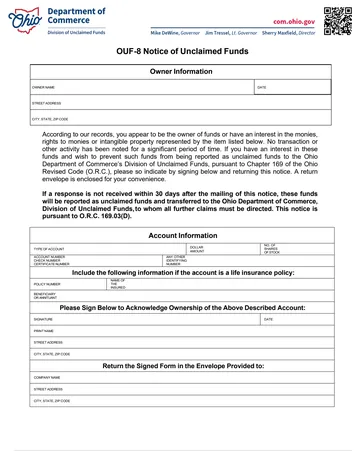
- Who sends it
- Every holder, for items of $50 or more
- When
- At least 30 days before you report
- Sent to
- The owner's last known address, not the state
- First-class; certified at $1,000 or more
- Pages
- 2 (instructions and notice)
At a glance
The OUF-8 Notice of Unclaimed Funds is the Ohio Department of Commerce, Division of Unclaimed Funds' model due diligence letter: the notice a holder mails to the owner of a dormant item before reporting it. The holder fills in the owner and account details; the owner signs and mails it back to keep the money from going to the state. It is a two-page PDF (instructions, then the notice), posted by the Division, current as of November 2026.
- Who sends it. Every holder reporting to Ohio, for each item of $50 or more with an owner address. The instructions say “Companies are required to send an OUF-8 Notice of Unclaimed Funds, or a similar notice that meets statutory requirements”.
- When. Before the report, and at least 30 days before it: “Allow a minimum of 30 days for the owner or beneficiary to respond to the notice prior to reporting the funds as unclaimed.” The report is due before November 1 for accounts dormant as of June 30 (R.C. 169.03(D)).
- How. First-class mail for $50 to $999.99, certified mail with return receipt for $1,000 or more, always with a self-addressed, stamped envelope (how to mail it).
- What it is not. It is not filed with the state. The Division sees it only if it asks: the signed notices are part of the records you keep, and the report's verification covers the mailing.
Tap a box once for its note, again to jump to the line. Zoom in to read the small print.
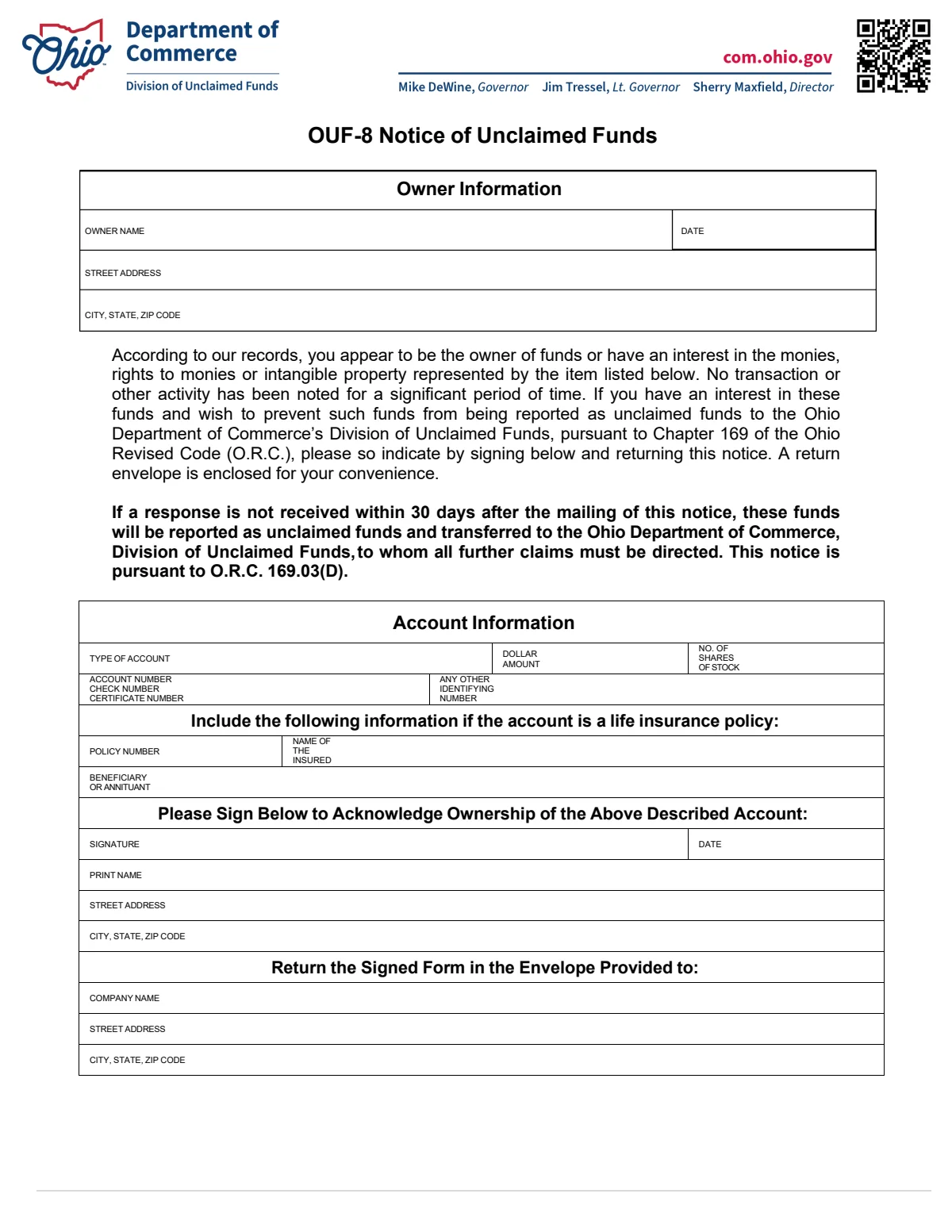
Owner Information
The top block is the owner's name and last known address, as your records show them, plus the date you mail the notice.
| Box | Label | What goes there |
|---|---|---|
| Owner-name | OWNER NAME | The owner's full name from your records: the payee on the check, the account holder, the shareholder. For a life insurance policy, the statute has the notice also go “to each beneficiary at the last known address of the beneficiary”, unless the beneficiary has the insured's surname and address. |
| Notice-date | DATE | The mailing date. It starts the clock: “The holder shall not report an item of unclaimed funds earlier than the thirtieth day after the mailing of notice required by this division.” Date the letter the day it goes in the mail. |
| Owner-street | STREET ADDRESS | The last known address “as shown by the records of the holder”. If a search of public records shows a newer address, the statute says to send the notice there as well. If you have no address at all, “the holder is relieved of any responsibility of sending notice”. |
| Owner-city | CITY, STATE, ZIP CODE | The rest of the address. The owner's state also decides where the property is reported: an Ohio address means Ohio; see which state gets it. |
The printed notice
The two paragraphs in the middle carry the words the statute requires: what the item is, that it will be reported in 30 days, and how the owner can stop that.
| Part | Printed text | What it does |
|---|---|---|
| Notice | According to our records, you appear to be the owner of funds ... | Printed; do not change it on the OUF-8. It tells the owner that no activity has been noted and asks the owner to “please so indicate by signing below and returning this notice”. It also promises that “A return envelope is enclosed for your convenience.” The statute makes the envelope mandatory: “A self-addressed, stamped envelope shall be included with the notice” (R.C. 169.03(E)). |
| 30-days | If a response is not received within 30 days after the mailing of this notice ... | Printed in bold: “If a response is not received within 30 days after the mailing of this notice, these funds will be reported as unclaimed funds” and later claims go to the Division of Unclaimed Funds. The form ends “This notice is pursuant to O.R.C. 169.03(D).” Since the 2021 amendments the notice rule sits in division (E) of R.C. 169.03 (division (D) is now the report date); the form's citation is out of date, and the duty is the same. |
Account Information
The statute says the notice “shall set forth the nature and identifying number, if any, or description of the funds and the amount appearing on the records of the holder to be due the owner or beneficiary”. These boxes are where that goes.
| Box | Label | What goes there |
|---|---|---|
| Type | TYPE OF ACCOUNT | Describe the property in words the owner understands: uncashed vendor check, payroll check, customer credit balance, dividend. A holder's own notice must “Describe the type of dormant account.” |
| Amount | DOLLAR AMOUNT | The amount due, from your records. A holder's own notice must “Identify the amount of the dormant account.” The amount also picks the mailing method (see how to mail it): under $50 no notice is needed, $50 to $999.99 first-class mail, $1,000 or more certified mail. |
| Shares | NO. OF SHARES OF STOCK | For shares only: how many. Leave blank for cash items. |
| Account-no | ACCOUNT NUMBER / CHECK NUMBER / CERTIFICATE NUMBER | The number that identifies the item. A holder's own notice must “Disclose the owner’s account number or other identifying number.” For a vendor check, the check number and date help the payee find it in their receivables. |
| Other-id | ANY OTHER IDENTIFYING NUMBER | Any other reference that helps the owner: an invoice number, a customer or vendor number, a claim number. |
Life insurance lines
| Box | Label | What goes there |
|---|---|---|
| Policy | POLICY NUMBER | Only when the account is a life insurance policy, as the form says: “Include the following information if the account is a life insurance policy”. |
| Insured | NAME OF THE INSURED | The insured's name, for a life insurance policy. |
| Beneficiary | BENEFICIARY OR ANNITUANT (as printed) | The beneficiary or annuitant, for a life insurance policy or annuity. Life insurers mail the notice to the beneficiary too, unless the beneficiary has the same surname and address as the insured. |
Owner's signature and return address
The bottom of the form is the owner's reply. The holder fills in only the return block.
| Box | Label | What goes there |
|---|---|---|
| Owner-signature | SIGNATURE | Left blank for the owner. The form's heading reads Please Sign Below to Acknowledge Ownership of the Above Described Account. A holder's own notice must work the same way: “The notice must require the owner to sign and return the form as acknowledgment of ownership, or reactivate the account, to prevent it from being reported as unclaimed funds.” |
| Owner-date | DATE | The owner dates the signature. |
| Print-name | PRINT NAME | The owner prints their name. |
| Owner-update | STREET ADDRESS; CITY, STATE, ZIP CODE | The owner's current address. If it differs from your records, update your records. The statute says that if the owner tells you of a continued interest before the report date, “the holder shall not report the funds to the director”. |
| Return-to | Return the Signed Form in the Envelope Provided to: COMPANY NAME; STREET ADDRESS; CITY, STATE, ZIP CODE | Your company's name and return address, matching the self-addressed, stamped envelope. Keep every signed form that comes back: an auditor can accept a “Signed returned notice of unclaimed funds form” to remove an item from its findings (Ohio Adm.Code 1301:10-3-04). |
How to mail it
The statute ties the mailing method to the item's value: the notice “shall be mailed by first class mail if the item of unclaimed funds has a value of fifty dollars or more but less than one thousand dollars and by certified mail, return receipt requested, if the item of unclaimed funds has a value of one thousand dollars or more”, unless the holder has verified that the address is wrong (R.C. 169.03(E)). The cost of certified mail can come out of the item: “A holder that sends a notice by certified mail, return receipt requested, may charge the item of unclaimed funds up to twenty dollars for providing that notice.”
R.C. 169.03(A)(2)(f) and (E); OUF-8 Notice of Unclaimed Funds Instructions.
To skip the certified mailing on an item of $1,000 or more, the holder must have documented at least two of three things: the owner “failed to respond to a first class mail notice sent to the last known address”; a first-class notice “was returned as undeliverable”; or a search of public records failed to confirm the address. The report must then include a statement that the holder verified the address was wrong, and “Any verifying documentation shall be maintained by the holder for five years from the date of the report” (R.C. 169.03(A)(2)(f)).
Items under $50 need no letter: “No mailing is required to owners of dormant accounts less than $50, however, applicable accounts would still be reportable unclaimed funds as an aggregate total.” Wages are different: the guide says “There is no minimum for non-wages. For wages, the minimum is $50.”, so a paycheck of $50 or less is not reportable at all in Ohio.
When to mail it
Ohio sets no earliest mailing date, only the 30-day minimum before the report. Most holders run the whole cycle once a year: list the accounts dormant as of June 30, mail the notices over the summer, give owners 30 days, then report before November 1. If you mail on September 15, the earliest you can report the unanswered items is October 15.
R.C. 169.03(D), (E) and (A)(2)(f); Ohio Unclaimed Funds Reporting Guide. Life insurers count from December 31 and report before May 1.
Need more time for the report itself? Ohio allows one extension a year, filed online by the report deadline for 30, 60, 90 or 120 days (file an extension online). The Ohio guide adds that early reporting is allowed “after the company complies with the due diligence mailing requirement and reporting requirements of the” Revised Code section 169.03.
Using your own notice
You do not have to use the OUF-8. The instructions say “Companies may devise their own notice of unclaimed funds.” A company notice must:
- “Disclose the owner’s account number or other identifying number.”
- “Describe the type of dormant account.”
- “Identify the amount of the dormant account.”
- Tell the owner that after 30 days the funds will be reported to the Ohio Department of Commerce, Division of Unclaimed Funds, and give the owner at least 30 days.
- Require the owner to sign and return it, or reactivate the account, to stop the report.
Add the self-addressed, stamped envelope the statute requires. The due diligence letter template starts from the content most states require; for Ohio, add the 30-day statement and the signature block above.
Rules that trip holders up
- Reporting too soon. An item reported before day 30 after mailing breaks R.C. 169.03(E).
- No envelope. The self-addressed, stamped envelope is required by statute, not a courtesy.
- First-class mail on a $1,000 item. Certified mail with return receipt, unless the address is verified as wrong and documented.
- Losing the signed replies. The guide lists, among the records to keep, “Signed due-diligence (OUF-8) mailings” and “Documentation of certified mailing to accounts with balances of $1,000 or more.” It says reports and their support “must be retained for five (5) years or until an examination is conducted, whichever comes first”.
- Who signs off. The report's verification covers the mailing too: “Verification of the report and of the mailing of notice, where required, shall be executed by an officer of the reporting holder.” (R.C. 169.03(F)).
- Skipping the letter. An auditor looks for “complaints of failure by holder to conduct due diligence” when deciding whether to examine a holder (Ohio Adm.Code 1301:10-3-04). A late or missing report can cost “a civil penalty of one hundred dollars per day” (R.C. 169.12(A)), plus interest and 1 percent a month of the unreported amount for up to 25 months (R.C. 169.12(C)); see penalties and interest.
How it connects
- The state's rules: Ohio unclaimed funds and the Ohio Unclaimed Funds report, how to file.
- Letters in every state: due diligence letters by state, the letter builder and the letter template.
- Where the check came from: uncashed and stale-dated checks and unclaimed wages.
- The report after the letters: unclaimed property reporting; Ohio files it on the Unclaimed Funds portal.
- Another state's due diligence affidavit: the Hawaii cover sheet.
Questions holders ask
Do I have to use the OUF-8 form?
No. The instructions allow a company's own notice if it gives the account or identifying number, the type of account, the amount, the 30-day warning, and asks the owner to sign and return it or reactivate the account. Include a self-addressed, stamped envelope either way.
When must Ohio due diligence letters be certified?
For items of $1,000 or more: certified mail, return receipt requested. You may charge the item up to $20 for it. The exception is an address you verified as wrong by documenting two of the three checks in R.C. 169.03(E).
How long do I wait after mailing the OUF-8?
At least 30 days. The statute says you may not report an item earlier than the thirtieth day after the notice was mailed.
Do I send letters for items under $50?
No. Items under $50 need no mailing but are still reported, as an aggregate total. Wages of $50 or less are not reportable in Ohio at all.
What if the owner signs and returns it?
Do not report the item. Pay the owner or reactivate the account, update the address in your records, and keep the signed notice with your records.
Do I file the OUF-8 with the state?
No. You keep it. The officer who verifies the report also verifies the mailing, and an auditor may ask for the signed notices and certified mail records.