From NAUPA's Standard Electronic File Format (NAUPA II, file dated Jan. 29, 2025) and its NAUPA III page (read Nov. 21, 2026).
What NAUPA format is
NAUPA, the National Association of Unclaimed Property Administrators, describes itself as “a Network of the National Association of State Treasurers”. It is the states' own association, not a law maker, but its file layout is what the states take: “All 50 states have used the NAUPA standard electronic file format since 2004. NAUPA II is the current version in production.” (NAUPA, reporting software and file format). A holder that reports in many states builds the same kind of file for each of them, which is the point.
The states make the format binding through their own law. Arkansas's 2025 rules say a holder “shall submit reports electronically using the most current National Association of Unclaimed Property Administrators' (NAUPA) standard electronic file format” (18 CAR 21-305), and Colorado's rule requires the report “through the current NAUPA Standard Electronic File Format”. Others say it in the holder manual. The unclaimed property reporting guide covers the rest of the filing: due dates, negative reports, aggregate limits and payment.
NAUPA publishes the layout as a free PDF, the NAUPA Standard Electronic File Format, with the full code tables. This page explains the layout and the codes in plain words; for the code lists themselves, use NAUPA's document and the state's own code list, because “Individual States may require different codes.”
How a NAUPA II file is laid out
A NAUPA II file is plain text in fixed-width records. In NAUPA's words, “The records are based upon a 625-byte record layout developed by NAUPA. The first byte of each record contains a” TR-CODE, a number that says what the record holds, and the other 624 bytes carry its fields. Each field sits at a set position, so a value that is too long, or a date in the wrong form, shifts everything after it and the state's system rejects the file.
NAUPA Standard Electronic File Format, Record Type Descriptions. Types 4, 7 and 8 are reserved.
A file for one report opens with one HOLDER record and closes with one SUMINFO record: “Only one HOLDER and one SUMINFO record exists in the file.” Between them, “There is one PROPERTY record for each piece of property.” An owner with three uncashed checks gets three property records. Extra owners or addresses for an item go in the PROPADD records right after it, and securities and safe deposit contents add their own records. The summary carries the counts and totals, and they must match the records above it.
Each field is marked mandatory, required or optional. Mandatory means exactly that: “information must be supplied in order to process the file correctly or the file will be rejected.” Required means “you must supply the information if you know it”, usually because the law asks for it. A few rules catch holders often:
- Amounts are whole numbers with two assumed decimals, zero-filled: in NAUPA's example, “$253.73 = 0000025373”.
- The reported amount is gross: “Enter the amount due the owner before any deductions, such as taxes, were subtracted.” Deductions such as tax withheld go in their own fields with a deduction code.
- Report the last known address “even if the” mail came back. The address decides which state gets the property, so it belongs on the report whatever its quality.
- An unknown owner is reported as UNKNOWN, and an aggregate line as AGGREGATE, with the count of items combined; each state sets its own aggregate limit (see the reporting guide).
- The owner's SSN or TIN goes on the record where known. NAUPA notes that “This number will not be released as public information”.
Property, relationship and other codes
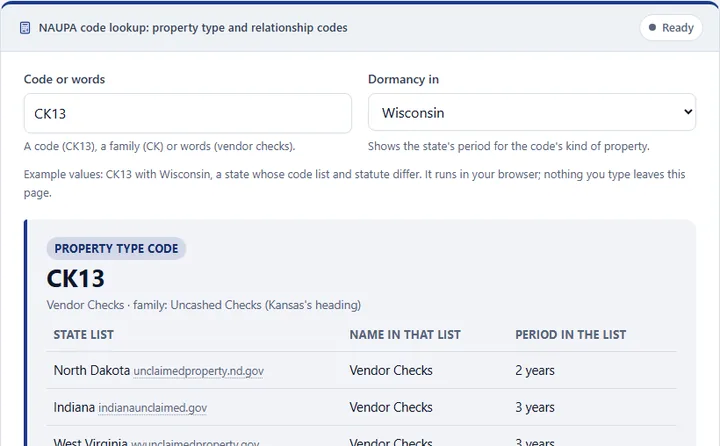
Codes carry most of the meaning in a NAUPA file. The property type code is four characters: two letters for the family and two digits for the type. Uncashed checks are the CK family, with vendor checks as “CK13 Vendor Checks”; payroll is in the miscellaneous family as “MS01 Wages, Payroll, Salary”; securities use SC. The code tells the state which dormancy period and which rules apply, so a vendor check coded as wages can be reported a year or two early or late. States also use aggregate codes ending in 99, such as Connecticut's “CK99 Aggregate Uncashed Checks”, and cash from sold fractional shares goes under a set securities code: Iowa tells holders to report it “using NAUPA code SC09”.
The relationship code on each property record says who must claim the property: an individual owner, joint owners, a custodian for a minor, a trustee, an estate's administrator and so on. NAUPA put it plainly: “The PROP-RELATIONSHIP-CODE indicates who must” claim the property. NAUPA's relationship and ownership codes were revised effective September 26, 2013. The owner type code separates individuals from businesses and aggregate lines (“PROP-OWNER-TYPE-CODE indicates the type of” owner). Deduction codes explain any amount taken off the gross: Michigan, for example, tells holders that withhold federal tax on an escheated IRA to “Use NAUPA Standard deduction code” TW for the tax. Other code tables cover security delivery methods, countries and industry (NAICS) codes.
Use NAUPA's document for the lists and the state's own code list where it has one: several states publish a code table with their dormancy period beside each code, and those tables are the authority for that state. The dormancy periods guide gives each state's periods by property type, from the statutes.
NAUPA III: the XML format
NAUPA III replaces the fixed-width text with XML. NAUPA says it “has moved from the fixed width format to Extensible Markup Language (XML).” The launch moved: “While we initially targeted a Fall 2026 start”, NAUPA chose two phases instead. Phase 1 is set for spring 2027 and keeps today's codes: “We will maintain the traditional NAUPA II property code elements with a few essential” changes to make room for new property codes. Phase 2 restructures the property codes later, with no date yet. NAUPA adds that NAUPA III “will co-exist with NAUPA II during transition to the new format”.
The current draft is NAUPA III File Format 1.6 (PDF, November 2026), with a changelog dated Nov. 12, 2026. It adds fields a holder will have to fill from its own records, among them a due diligence date (“Provide the dates that statutorily” required owner notice was performed), returned mail (“Provide information about mailings to” the owner that came back), sanctions (OFAC) status and cryptocurrency details. The changelog splits money orders into bank and non-bank codes and cites “the rule enacted by Congress in 12 U.S.C. Sections 2501 et seq.” The schema and validation tools are on NAUPA's NAUPA III page, which also links the schema on GitHub.
NAUPA Standard Electronic File Format, General Information, and NAUPA's NAUPA III File Format page (read Nov. 21, 2026).
Do not switch on NAUPA's date alone. NAUPA's own note: “Please verify with the specific state whether the NAUPA III format is currently accepted.” As of November 2026, Indiana is the one state in the table below that announces it, with “COMING IN 2027 --NEW NAUPA III FORMAT--MORE INFORMATION SOON”. Holders that will need to fill the new due diligence and returned mail fields should start keeping those dates per item now.
File types each state accepts
Every state takes a NAUPA file, but not every file. The common extensions are .txt, .hrs and .rpt; the older .HDE files that some software still writes are refused in most of the states that say so. A few states still take a disk or email, and most want an upload to their portal. The table lists what each state's own holder pages say about file types; states not listed take a NAUPA file without naming extensions (see the reporting table for each state's portal).
| State | File rules the state publishes | Source |
|---|---|---|
| Alaska | NAUPA file; no .HDE files since July 1, 2021 | unclaimedproperty.alaska.gov |
| Arizona | NAUPA file on CD-ROM, USB drive or by secure email; no Excel | azdor.gov |
| Arkansas | .txt, .hrs or .rpt, plain text, no encryption | auditor.ar.gov |
| California | NAUPA II | sco.ca.gov |
| Colorado | NAUPA file online; no .hde, paper, CD or email | unclaimedproperty.colorado.gov |
| Connecticut | .txt, .hrs or .rpt; no .HDE | ctbiglist.gov |
| Delaware | .rpt, .txt or .hrs, online only | unclaimedproperty.delaware.gov |
| Hawaii | .HDE or .TXT on CD, flash drive or email | budget.hawaii.gov |
| Indiana | NAUPA file; NAUPA III announced for 2027 | indianaunclaimed.gov |
| Kentucky | Plain .txt or encrypted .hde NAUPA file, through the portal | treasury.ky.gov |
| Maine | .HRS, .RPT and .TXT; no HDE | maineunclaimedproperty.gov |
| Michigan | .hrs or .txt; not .hde or NAUPA I | unclaimedproperty.michigan.gov |
| Minnesota | NAUPA .txt, .hrs or .rpt; no .HDE | mn.gov |
| Mississippi | txt, hrs or rpt; no Excel | treasury.ms.gov |
| Nebraska | NAUPA 2; no CD, email or paper | nebraskalostcash.nebraska.gov |
| Nevada | NAUPA file; no HDE | nvup.gov |
| New Jersey | .HRS, .RPT or .TXT; no HDE | nj.gov |
| New York | NAUPA only since 2025; the New York formats are retired | osc.ny.gov |
| North Dakota | .hrs or .txt | unclaimedproperty.nd.gov |
| Ohio | Unencrypted .TXT or .HRS | dam.assets.ohio.gov |
| South Carolina | NAUPA file; no .hde | southcarolina.findyourunclaimedproperty.com |
| South Dakota | .txt, .rpt or .hrs; no .HDE, PDF or Excel | southdakota.findyourunclaimedproperty.com |
| Texas | NAUPA Standard Electronic File, filed online; rejected files are resubmitted within 30 days | law.cornell.edu |
| Utah | NAUPA file; no HDE | mycash.utah.gov |
| Wisconsin | .TXT; no .HDE or .XLS | revenue.wi.gov |
| Wyoming | .txt only; no CDs, email or HDE | statetreasurer.wyo.gov |
NAUPA's own document still lists older media, such as floppy disks and tape, but marks email, FTP and tape “only where approved - contact the reporting state prior to sending for details.” The state's rule governs. Colorado, for example, “does not accept .hde files, paper, CDs, diskettes, or email submission of holder reports”.
NAUPA's file format and NAUPA III pages and the state file rules in the table on this page.
Building and checking the file
Most holders build the file with reporting software rather than by hand. NAUPA notes that “State unclaimed property programs accept the free reporting software HRS Pro (basic version), which produces a report in NAUPA standard electronic format.” Many state portals also offer a manual entry screen that writes the file for small reports, and some accept an Excel template converted to NAUPA.
Before upload, check the file against the state's rules: the right property codes for that state, owner detail for every item at or above the state's aggregate limit, no aggregate line where the state allows none, gross amounts with deduction codes, and totals in the summary that match. States return files that fail. Michigan: reports in the wrong format “cannot be processed, will be returned to the holder, and will not be considered timely filed”. A rejected file near the due date can make the report late, so leave time to fix and upload again.
One file per state, per report type. Holders with both tangible and intangible property often file two reports, and states such as Pennsylvania require it. The NAUPA code lookup will help match a property to its code, and the due diligence letters page covers the owner notice that comes before the file.
Tools for this topic
Questions holders ask
What is a NAUPA file?
The standard electronic file for unclaimed property holder reports. In NAUPA II it is a plain text file of 625-byte records: one holder record, one record per item of property, and a summary record with the totals.
What file extensions do states accept for NAUPA reports?
Most take .txt, .hrs or .rpt. Many no longer accept .HDE files; Wyoming takes .txt only, Wisconsin .TXT only, and Ohio unencrypted .TXT or .HRS. Hawaii still takes .HDE or .TXT by disk or email.
When does NAUPA III start?
NAUPA set phase 1 for spring 2027: an XML file that keeps the NAUPA II property codes with a few changes. NAUPA says to check with each state before using it; Indiana has announced it for 2027.
Where do I find the NAUPA property type codes?
In NAUPA's Standard Electronic File Format document, which NAUPA publishes free, and in each state's own code list, which wins where it differs. NAUPA notes that individual states may require different codes.
What is a relationship code?
The code on each property record that says who must claim the property, such as an individual owner, joint owners, a custodian or a trustee. NAUPA revised the relationship and ownership codes in 2013.
Do I need software to file a NAUPA report?
Not always. Most state portals have a manual entry screen for small reports, and NAUPA says the states accept a free basic reporting program that writes the NAUPA file.
Sources
- NAUPA Standard Electronic File Format (NAUPA II, file dated Jan. 29, 2025): unclaimed.org
- NAUPA III File Format page, draft 1.6 (Nov. 2026) and changelog (Nov. 12, 2026): unclaimed.org; draft 1.6; changelog
- NAUPA, reporting software and file format: unclaimed.org
- 18 CAR 21-305 (Arkansas, 2025): Arkansas rules; 8 CCR 1508-1 (Colorado, 2026): Colorado rules
- State holder manuals and pages for file types: linked in the table's Source column