Counted from the state table below (programs, lookbacks and eligibility from each state's statute, rule, form or program page) and 12 Del. C. 1173 as enacted by S.B. 13 (2017).
What an unclaimed property VDA is
A voluntary disclosure agreement (VDA) is a written deal between a holder and a state's unclaimed property office. The holder agrees to review its books for a set number of past years, report and pay everything it finds for that state, and stay compliant afterward. The state agrees to waive some or all of the penalties and interest its law would otherwise charge. States use different names: Voluntary Compliance Program in California, New Jersey, New York and Pennsylvania, Compliance Disclosure Agreement in Tennessee, Compliance Assistance Program in Oklahoma, and Voluntary Disclosure Agreement in most others.
Some states put the program in their statute. California's says “This section shall be known, and may be cited, as the ‘California Voluntary Compliance Program.’” (Cal. Code Civ. Proc. 1577.5), and Wisconsin's administrator “may enter into voluntary disclosure agreements with holders if the following conditions are met:” (Wis. Stat. 177.1505). Others run it by rule or simply by an agreement form on the office's website. Either way, the program is the state's offer, on the state's terms, and the agreement is what binds both sides.
Not a tax VDA
Searches for "voluntary disclosure agreement" mostly find state tax programs for sales, income or franchise tax. Those settle tax. Unclaimed property is a different law, usually run by a different office, and its VDA is a different agreement: it covers money the holder owes to owners, not tax the holder owes to the state. Even where the same department runs both, as the Department of Revenue does in Arizona, Georgia, Montana, Washington and Wisconsin, the unclaimed property program has its own form and terms. Wisconsin's, for example, is filed under the holders section of the department's online account: “Under the Holders section, select the Voluntary Disclosure Agreement Application link.” (Wisconsin VDA FAQ).
VDA or wait for the audit
The choice usually comes down to who sets the terms. In a VDA the holder does the review, picks its methods within the program's rules, and gets the waivers. In an audit the state or its contract auditor does the review, the lookback can be longer, missing years can be estimated, and penalties and interest apply (see unclaimed property audits and penalties and interest).
State program terms in the table below; 12 Del. C. 1172(a) and 1173(b) as enacted by S.B. 13 (2017); RUUPA (2016) sections 610, 1006 and 1204.
Timing matters because almost every program shuts once an audit begins. Alabama's agreement requires that “the Holder represents that it is presently not under audit”; Florida's program is not for holders under audit; Illinois, Nevada and North Carolina say the same in their own words. Delaware works the other way round: the State Escheator may not start a new examination “unless the person has first been notified in writing by the Secretary of State that the person may enter into an unclaimed property voluntary disclosure agreement” (12 Del. C. 1172(a)), and a holder that does not send its intent to enroll “within 90 days after the request to enter the voluntary disclosure agreement program was delivered” is referred for examination (1173(b); SB 13 first set “within 60 days” in 2017). See the Delaware VDA invitation letter.
What a VDA covers
Lookback. Ten report years is the most common review period. Some states add the dormancy period, so the review reaches back further in transactions: New York's handbook says “the reach back period relative to General Ledger type property is 10 years plus the dormancy period for the property.” (New York handbook), and Delaware's program page says “The look-back period is 10 report years (or 15 transaction years as Delaware has a 5 year dormancy period for most property types) from the date the Holder enrolls in the VDA.” (Delaware VDA FAQs). A few are shorter: Michigan asks for the current reporting year and the previous four (Form 4869), Oregon for at least the last six reporting years, and Wisconsin's statute says “The agreement shall apply to the 5 reporting periods im-mediately preceding the filing date of the holder's application.” (Wis. Stat. 177.1505(2)).
What is waived. Most programs waive penalties and interest. Not all waive both. New Jersey's says “Benefits of the VCP include the removal of all late penalties if the entity successfully completes the program. Simple interest is still assessed on the total liability due to the State.” (New Jersey VCP). California waives interest, and only if the holder finishes the program: “The Controller shall waive the interest payable under this section if the holder participates in and completes all of the requirements of the California Voluntary Compliance Program under Section 1577.5” (CCP 1577(d)). Texas waives for good faith: “Chapter 74.707 of the property code authorizes the Comptroller to waive the penalty or interest imposed on delinquent property if the holder has made a good faith effort to comply” (Texas holder pages).
Protection from audit. Some agreements close the covered years. Wisconsin's statute says “The administrator shall waive rights to an examination of records under s. 177.1001 with respect to the reporting periods in par. (f), and all earlier periods” (177.1505). Alabama's agreement says its right to audit the VDA period “will be limited to a period of 12 months following the date the Holder files its report” (Alabama VDA). Kansas's agreement, by contrast, says “Participation in this program does not protect your business from an audit.” (Kansas agreement). Read the agreement for the release it gives.
What does not change. A VDA does not excuse due diligence. Where the state's law requires letters to owners before reporting, the VDA report needs them too, and the holder must report every year after the agreement on the normal schedule. The due diligence letters page has each state's rule.
Delaware's Secretary of State program
Delaware's program matters to many holders, because Delaware takes property with no owner address from the many companies incorporated there. It is run by the Secretary of State, not the State Escheator who audits. The program page says “Established in 2012, The SOS VDA program” (vda.delaware.gov), and the statute gives the waiver: “The Secretary of State shall waive interest and penalty under §§ 1183 and 1184 of this title for holders that complete the voluntary disclosure in good faith.” (12 Del. C. 1173).
Delaware Secretary of State, Steps to VDA (vda.delaware.gov, read Nov. 21, 2026); 12 Del. C. 1173.
Enrollment starts with the form: “Holder submits a signed Form VDA-1. Form VDA-1 should be submitted electronically to sos.vda@delaware.gov” (Form VDA-1). At the end, the holder's chief financial officer or another officer signs a management representation letter on the records reviewed, the Secretary of State countersigns Form VDA-2 and issues a demand, and “The Holder will have 10 days to make payment of the amount due.” (Steps to VDA). The Delaware VDA invitation letter page covers the letter that starts it, and the Delaware audits and VDA page covers both programs.
VDA programs by state
Each state's program as its own statute, rule, agreement form or program page describes it, with a link where the holder applies. "Not listed" means the saved sources do not state it; ask the office. As of November 2026; last checked 2026-11-22.
| State | Program | What it waives | Lookback | How to apply | Source |
|---|---|---|---|---|---|
| Alabama | Yes: Alabama Voluntary Compliance Program, by Voluntary Disclosure Agreement (Ala. Admin. Code 892-2-1-.03(6)) | Civil penalties and interest on property properly reported and delivered | At least the 10 most recent reporting years | Sign the agreement and email or mail it to the Treasurer; not open to holders under audit Program page or form | unclaimed.alabama.gov |
| Alaska | Yes: First Time Filer or Voluntary Compliance process (informal; no agreement form found) | The state will often waive penalty and interest | Last 10 years at minimum; property presumed abandoned from Sept. 7, 1980 forward | File the report through the process; reporting questions to ucpholder@alaska.gov | unclaimedproperty.alaska.gov |
| Arizona | Yes: Voluntary Compliance Program (Voluntary Compliance Agreement) | Penalty and interest; ADOR also indemnifies the holder against claims on items reported | Last 10 report years | Sign the agreement and mail it to ADOR (the PDF says email it); not open if under audit or notified of one Program page or form | azdor.gov |
| Arkansas | Yes: Voluntary Compliance Program and Voluntary Disclosure Program (18 CAR 21-309) | Penalties: no penalties on property delivered under the agreement; interest not addressed in the forms | 10 years in the agreement forms; the rule says the 6 years before participation (18 CAR 21-309(c)) | Email a written request with the signed agreement to the Auditor; not open if under audit or sent an audit letter Program page or form | auditor.ar.gov |
| California | Yes: California Voluntary Compliance Program (Cal. Code Civ. Proc. 1577.5) | Interest, if the holder completes all program requirements (CCP 1577(d)) | At least the previous 10 years (CCP 1577.5(e)(2)) | Submit the VCP Application Form (SCO VCP 01); holders may apply at any time Program page or form | sco.ca.gov |
| Colorado | No: Treasury FAQ says Colorado does not offer Voluntary Disclosure Agreements | Not listed | Not listed | Not listed | unclaimedproperty.colorado.gov |
| Connecticut | No: the FAQ says there is no formal Voluntary Compliance process; first-time filers may ask for a waiver | Interest or penalties, on a written request (Treasurer may waive interest for good faith, 3-65b(a)) | 10 years recommended, same as the audit process | File the report with an officer's signed letter on letterhead, attached or emailed to CTHolderReport@ct.gov Program page or form | ctbiglist.gov |
| Delaware | Yes: Secretary of State Voluntary Disclosure Agreement Program (12 Del. C. 1173) | Interest and penalties for holders that complete it in good faith; also audit protection and indemnification | 10 report years (15 transaction years for 5 year property) from enrollment (12 Del. C. 1173(c)(2)) | Form VDA-1 signed by an officer, emailed to the Secretary of State; not open after a Notice of Examination Program page or form | vda.delaware.gov |
| District of Columbia | Yes: Voluntary Disclosure Program, only if the office has not already contacted the holder | Releases claims, interest, penalties and fines for the covered years and all preceding years (VDA form) | Not listed | Email the Unclaimed Property Unit to request a VDA; return the form by email or mail Program page or form | unclaimedproperty.dc.gov |
| Florida | Yes: Voluntary Disclosure Agreement (Fla. Admin. Code 69G-20.050); not for holders that filed or are under audit | Penalty and interest on the reported property (VDA agreement); the rule says penalties and fines | Prior 10 report years, reported within 3 months of the Final Order | Sign the Voluntary Disclosure Agreement form; it becomes a Final Order on approval by the Chief Financial Officer Program page or form | fltreasurehunt.gov |
| Georgia | Yes: Voluntary Disclosure Program; terms not published (email the program for details) | Not listed | Not listed | Email the Unclaimed Property Program's holder reporting address asking for program details | dor.georgia.gov |
| Hawaii | Yes: Voluntary Disclosure Agreement referenced; terms not published (contact the office) | Not listed | Not listed | Contact the Unclaimed Property Program, DBF.UP.Holders@hawaii.gov | budget.hawaii.gov |
| Idaho | Yes: informal Voluntary Disclosure Agreement, case by case (no formal program) | Penalty: approved holders are not subject to penalty; the packet says possible interest and penalties are avoided | Not listed | Email the Informal VDA Proposal and a letter of explanation to the Business Reporting Specialist Program page or form | yourmoney.idaho.gov |
| Illinois | Yes: Voluntary Disclosure Agreement (VDA) program, since June 2008 (74 Ill. Adm. Code 760.840) | Penalties and interest; all fees, penalties and interest for the examination period if full compliance is reached | Dormancy period plus the 10 years before it; Treasurer may examine 14 years to present | Send a signed VDA agreement to the Unclaimed Property Division; report online within 6 months; not open under exam Program page or form | icash.illinoistreasurer.gov |
| Indiana | Not listed | Not listed | Not listed | Not listed | indianaunclaimed.gov |
| Iowa | Yes by rule (Voluntary Compliance Self-Audit, 781 IAC 9.43), but the state is not accepting VDA applications now | Interest and penalties on an approved VCSA submission (781 IAC 9.43(3)) | Not listed | Not available now: the state is currently not accepting VDA applications | greatiowatreasurehunt.gov |
| Kansas | Yes: Kansas Voluntary Compliance Program Agreement | Penalties and interest, at the administrator's discretion (K.S.A. 58-3967); no protection from audit | 10 reporting years | Sign the agreement and return it to Unclaimed Property, Holder Services, Topeka; deliver within one year Program page or form | missingmoney.ks.gov |
| Kentucky | Not listed | Not listed | Not listed | Not listed | treasury.ky.gov |
| Louisiana | Unclear: portal lists a Voluntary Disclosure Agreement report type; no program terms published | Not listed | Not listed | Not listed | unclaimedproperty.la.gov |
| Maine | Yes: informal, case by case (no formal voluntary compliance program) | Not listed | Not listed | Email the business name, contact, reasons and scope of the request to up.holderinquiry@maine.gov Program page or form | maineunclaimedproperty.gov |
| Maryland | Yes: Voluntary Disclosure Agreement (VDA), only if the office has not contacted the holder | Release from all claims, interest, penalties and fines for the covered and preceding years (VDA form) | Set in each agreement (report years written on the form) | Send a signed VDA agreement to the Unclaimed Property Division Program page or form | claimitmd.gov |
| Massachusetts | Yes: Massachusetts Voluntary Disclosure Agreement, first time filers only | Interest and penalties | At least 9 years back, further if findings appear | Email the VDA form, a written narrative and NAUPA II findings together; pay only after acceptance Program page or form | findmassmoney.gov |
| Michigan | Yes: Unclaimed Property Voluntary Disclosure Agreement (Form 4869) | Penalties and interest on property remitted under the agreement | Current reporting year and the previous four reporting years | Email the signed Form 4869 to TreasUPDReporting@michigan.gov Program page or form | unclaimedproperty.michigan.gov |
| Minnesota | Not listed | Not listed | Not listed | Not listed | mn.gov |
| Mississippi | Not listed | Not listed | Not listed | Not listed | treasury.ms.gov |
| Missouri | Not listed | Not listed | Not listed | Not listed | treasurer.mo.gov |
| Montana | Yes: Voluntary Disclosure of Unclaimed Property Agreement, by request | Not listed | Not listed | Email the request to UnclaimedProperty@mt.gov or mail it to PO Box 5805, Helena Program page or form | revenue.mt.gov |
| Nebraska | Yes: statute recognizes a voluntary disclosure agreement from July 18, 2026; terms not published | Not listed | Not listed | Not listed | nebraskalegislature.gov |
| Nevada | Yes: Voluntary Disclosure Agreement (VDA) Program | Penalties and/or interest on the VDA properties | Not listed | Online VDA Request Form; holders must not have reported before or been picked for audit (NAC 120A.120) Program page or form | nvup.gov |
| New Hampshire | Unclear: portal lists a Voluntary Disclosure Agreement report type; no program found | Not listed | Not listed | Not listed | findnhmoney.gov |
| New Jersey | Yes: Voluntary Compliance Program (VCP), with a Voluntary Disclosure Agreement | All late penalties; simple interest is still charged | 10 report years | Email Form UP-11, Request for VCP Admission, to upa4compliance@treas.nj.gov Program page or form | nj.gov |
| New Mexico | Not listed | Not listed | Not listed | Not listed | tax.newmexico.gov |
| New York | Yes: Voluntary Compliance Program (since 1985) | Penalties and interest on the reported items | 10 years plus the dormancy period for general ledger property | Self-Directed Compliance Program, or a signed Voluntary Compliance Agreement; contact NYSVCU@osc.ny.gov Program page or form | osc.ny.gov |
| North Carolina | Yes: Voluntary Disclosure Program (VDP), for holders not under audit | Interest and penalties | Ten years plus the dormancy period | Email the VDP Request Form to VoluntaryDisclosureProgram@nctreasurer.gov Program page or form | nccash.gov |
| North Dakota | Yes: Voluntary Disclosure Agreement Program (N.D. Admin. Code 85-03-04-10) | Interest and penalties, in whole or in part (85-03-04-10(2)) | Not listed | Email unclaimed@nd.gov with company name, FEIN, address and contact; the Division may extend an invitation Program page or form | ndlegis.gov |
| Ohio | Yes: Voluntary Compliance Agreement (VCA) | Penalties and interest normally allowed under Ohio law | Last ten or more reporting cycles, including the current cycle | Sign the fillable VCA form and return it to the Division; self-exam findings due within 60 days Program page or form | com.ohio.gov |
| Oklahoma | Yes: Compliance Assistance Program (up to one year to comply); statute also allows amnesty programs (60 O.S. 680(E)) | Penalties and interest | Not listed | Download the Commitment form, sign and date it, return it to the Unclaimed Property Division Program page or form | oklahoma.gov |
| Oregon | Yes: Voluntary Disclosure Program (180 days to comply) | All applicable interest and penalty under ORS 98.416(2) and 98.992 for the property covered | At a minimum, the last six reporting years | Complete, sign and return the Voluntary Disclosure Agreement by email to up.audit@ost.state.or.us Program page or form | unclaimed.oregon.gov |
| Pennsylvania | Yes: Voluntary Compliance Program | All applicable penalties and interest (72 P.S. 1301.24, 1301.25) | Last ten years of books and records | Sign the agreement and email it to report@patreasury.gov; report within 90 days, only after Treasury's signed approval Program page or form | searchandclaimpa.gov |
| Rhode Island | Yes: one-time Voluntary Compliance Program | Interest and penalties | Not listed | Request on corporate letterhead, signed, with reasons, methods, subsidiaries and delivery date; questions to ups@treasury.ri.gov Program page or form | findrimoney.gov |
| South Carolina | Yes: Voluntary Disclosure Program (first-time participants) | Penalties (Treasurer FAQ: interest or penalties) | Not listed | Email unclaimed@sto.sc.gov with business name, federal tax ID, address and contact Program page or form | southcarolina.findyourunclaimedproperty.com |
| South Dakota | Yes: informal voluntary disclosure program (Form UCP-5) | All fees, penalties and interest for the examination period | The period required for the presumptive abandonment | Sign Form UCP-5 with a letter of explanation; report and payment due within 6 months of the Treasurer's signature Program page or form | southdakota.findyourunclaimedproperty.com |
| Tennessee | Yes: CDA (Compliance Disclosure Agreement) Program | Any possible penalties | Not listed | Complete the online CDA form; if approved, the Division signs the agreement Program page or form | treasury.tn.gov |
| Texas | Yes: Voluntary Disclosure Agreement (VDA) | Penalty or interest, for a good faith effort to comply (Prop. Code 74.707) | Not listed | Written request with company, FEIN, contact and estimated remittance to UP.VDA.requests@cpa.texas.gov or by mail Program page or form | claimittexas.gov |
| Utah | Yes: Voluntary Disclosure Agreement (first-time participants) | Civil penalties and statutory interest | Not listed | Sign and return the VDA form by email to Holders@upsupport.utah.gov; report within 90 days of the signed agreement Program page or form | mycash.utah.gov |
| Vermont | Yes: Voluntary Compliance Program (VCP) | Penalties and interest | 10 years of books and records; extrapolation and sampling for missing years | Request the Voluntary Compliance Agreement by postal mail, fax or email; six months to file once the Division signs Program page or form | vermonttreasurer.gov |
| Virginia | Yes: Voluntary Compliance Program (first-time participants) | Penalties and interest | The ten preceding report years | Email or mail the Compliance Participation Request Form; remit findings within six months; no anonymous requests Program page or form | vamoneysearch.gov |
| Washington | Yes: voluntary compliance agreement, typically only for first time filers | Penalty and interest, in many cases | Not listed | Email WAUCPHolders@dor.wa.gov to request a voluntary compliance agreement | ucp.dor.wa.gov |
| West Virginia | Yes: voluntary compliance program | Not listed | Not listed | Email UP-Compliance@wvsto.gov; the holder must not be under audit by West Virginia or any other state | wvunclaimedproperty.gov |
| Wisconsin | Yes: Voluntary Disclosure Agreement, by statute (Wis. Stat. 177.1505; permanent since 2023 Act 138) | Holder penalties (177.1204) if the agreement is executed within 180 days of the application | The 5 reporting periods before the application; earlier periods are not examined (177.1505(2)) | Apply online in My Tax Account (Voluntary Disclosure Agreement Application); one per legal entity Program page or form | revenue.wi.gov |
| Wyoming | Yes: informal voluntary disclosure | Penalty | Not listed | Contact the Unclaimed Property Division (upreports@wyo.gov) Program page or form | statetreasurer.wyo.gov |
States with no program or no published terms
A few states say plainly that they have no program. Colorado's holder FAQ says “Colorado does not offer Voluntary Disclosure Agreements.” (Colorado FAQ). Iowa has one in its rules, but its program page says “The State of Iowa is currently not accepting VDA applications.” (Iowa program page). Connecticut has no formal program, but a first-time filer can ask for a waiver of interest and penalties in a signed officer's letter with its report (Conn. Gen. Stat. 3-65b).
For Indiana, Kentucky, Minnesota, Mississippi, Missouri and New Mexico, the saved statutes, rules and holder pages do not describe a program, and for Louisiana and New Hampshire the only sign of one is a "Voluntary Disclosure Agreement" report type on the reporting portal. That does not mean the office will not talk to a holder that comes forward; it means there are no published terms. Contact the office first, in writing, and get any waiver in writing. Georgia and Hawaii have programs but publish no terms; ask the office for them.
Two states also run self-audit programs. Maryland's “allows Holders to voluntarily review their financial records and report any unclaimed property they may be holding”, under a Self-Audit Agreement, alongside its VDA (Maryland Self-Audit Program). Minnesota's self-audit page says “This self-audit will enable your company to identify any unclaimed property that is reportable in Minnesota.” (Minnesota Commerce).
How to apply
- Before you apply, check you are eligible: no audit notice from that state (West Virginia also bars holders under audit by any other state), and in some states no report filed before.
- Decide the scope: the legal entities, the property types and the years. The state's lookback sets the years; the entities and property types are yours to identify.
- Send the state's own form or request, linked in the table: an agreement to sign (Alabama, Kansas, Pennsylvania), an online form (Nevada, Tennessee), an email with the details the state lists (Texas, North Carolina, South Carolina), or Delaware's Form VDA-1.
- Do the review within the program's deadline, often 90 days to 6 months from the signed agreement, and send due diligence letters where the state requires them.
- Report and pay in the state's format, usually the NAUPA file through the state's portal, and keep the work papers with the agreement.
- Report on time every year after that. The agreement usually requires it.
Multistate holders often run several VDAs at once, one per state, because each state's program covers only property owed to that state. The which state gets it guide explains how to sort items by state, and the audit and VDA readiness checklist lists the records to gather.
Templates
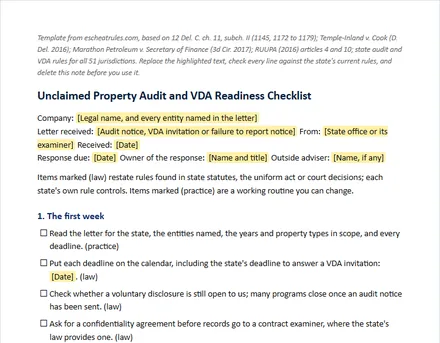
Audit and VDA readiness
What to gather and decide when an unclaimed property audit notice or a VDA invitation arrives, with each state's audit lookback, records rule and VDA program.
Questions holders ask
What is an unclaimed property VDA?
A voluntary disclosure agreement with a state's unclaimed property office: the holder reviews a set number of past years, reports and pays what it owes that state, and the state waives some or all penalties and interest. It is separate from a tax VDA.
Can I enter a VDA after an audit notice?
Usually not. Most programs are open only to holders that are not under audit and have not been notified of one. In Delaware the Secretary of State's VDA invitation comes first, and an audit follows if the holder does not send its intent to enroll within 90 days of delivery (12 Del. C. 1173(b)).
How many years does an unclaimed property VDA cover?
Ten report years is the most common, and some states add the dormancy period. Michigan uses the current year and four before it, Oregon at least six years, and Wisconsin the five reporting periods before the application.
Does a VDA waive interest as well as penalties?
In most states, yes. New Jersey waives penalties but still charges simple interest, and California waives interest only when the holder completes all program requirements.
Do I need a separate VDA for each state?
Yes. Each program covers only property owed to that state, so a holder with owners in many states may need several agreements, or a VDA in some states and ordinary late reports in others.
Do I still send due diligence letters in a VDA?
Yes, where the state's law requires them. A VDA changes the penalties and the lookback, not the duty to try to reach owners before reporting.
Sources
- State program pages, agreement forms, statutes and rules: the source link and the program link in each row of the table
- Delaware: 12 Del. C. 1172 and 1173 (81 Del. Laws c. 1, S.B. 13 (2017)); Secretary of State, Steps to VDA
- Maryland Self-Audit Program: claimitmd.gov
- Revised Uniform Unclaimed Property Act (2016): Uniform Law Commission