Counted from the states_es data record and the 51-row table below, which quote each state's statute, rule or holder manual.
The annual reporting cycle
A holder report lists every item of property that became presumed abandoned during the state's report period, owner by owner, and the holder pays the money or delivers the securities when it files. The 2016 uniform act states the usual date: the report “must be filed before November 1 of each year and cover the 12 months” preceding July 1 (section 403). The property goes with it, and the records behind it are kept for 10 years (section 404). The work starts months before the due date, because the due diligence letters must go out inside each state's window.
RUUPA sections 403, 404, 501 and 603 and the November 1 states in the table below; spring and summer states shift the whole cycle.
A holder with owners in many states files many reports, one per state, each to that state's rules and on that state's date. The owner's last known address decides which state gets each item (see which state gets it). Some states accept a few items owed to other states' residents on their own report, but only small amounts and only where the other state agrees: North Carolina takes “Ten or fewer properties, totaling $1,000 or less”, and adds that “Any property owed to owners with a last known address in California must be reported directly to California regardless of the value or number of items.”
Due dates and cutoffs
The due date and the cutoff travel together: the cutoff is the last day of the period the report covers, and the due date is when the report and the property are due. For 42 jurisdictions the cutoff is June 30 and the report is due in the fall, most before November 1. Maryland and Washington set October 31, and Oregon wants the report “after October 1, but not later than November 1”.
The spring states are the ones that catch holders out, because they report the calendar year: Delaware by March 1, New York by March 10, Connecticut by March 31, Pennsylvania by April 15, and Florida, Illinois and Vermont before May 1. Illinois splits by industry: most businesses report before May 1, while “must file a report before November 1 of each year that covers the 12 months preceding July 1 of that year” applies to financial organizations, governments and non-life insurers (74 Ill. Adm. Code 760.420). Michigan and Texas report in summer: Michigan on July 1 for the year ending March 31, and Texas on July 1 for property held on March 1. California runs two steps: the Notice Report with owner detail before November 1, and the Remit Report with the money “between June 1 and June 15”, and its checklist says “Do not send funds or tangible property with the Notice Report”.
Insurers often have their own date, usually May 1 for the prior calendar year; Delaware has separate dates for banks (November 10) and insurers (December 20), and New York has a date per industry. When a due date falls on a weekend, several offices move it to the next business day: in 2026, November 1 is a Sunday, and Wisconsin says “November 1, 2026, is a Sunday, so reports are due on the following” Monday. Check whether the state counts receipt or postmark. New Hampshire: “Reports postmarked but not received by the due date of the report are considered to be late.” Vermont says the opposite: “envelopes postmarked by this day are acceptable”. The reporting calendar lists every date.
Reporting rules in all 51 jurisdictions
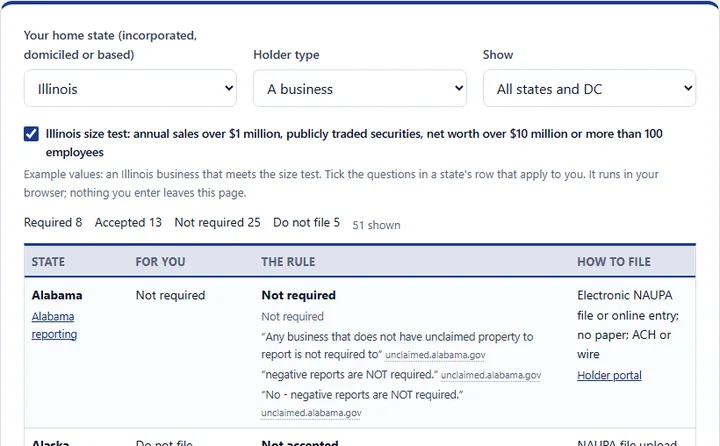
Each row comes from the state's own statute, rule or holder manual, quoted and checked against the saved source; the source link opens the one behind the due date, and the portal link opens the state's own holder reporting site. Where a state publishes nothing on a point, the cell says Not listed. Rules as of November 2026 (last checked 2026-11-22).
| State | Report due (cutoff) | Negative report | Aggregate | Extension | Filing and portal | Source |
|---|---|---|---|---|---|---|
| Alabama | Before Nov. 1 (June 30) | Not required | Under $50 (owner list still asked) | Written request at least 15 days before Nov. 1; 30, 60 or 90 days | Electronic NAUPA file or online entry; no paper; ACH or wire (portal) | alison.legislature.state.al.us |
| Alaska | Before Nov. 1 (June 30) | Not accepted | Under $100 | Written request; 60 or 90 days, approved before filing | NAUPA file upload or online entry; no paper (portal) | akleg.gov |
| Arizona | Before Nov. 1 (June 30) | Not required | Under $50 (office asks for detail) | Written request before Oct. 1; payment still due Nov. 1 | NAUPA file by CD, USB or secure email (over 10 items); Form 650UP with every report; check or wire | azleg.gov |
| Arkansas | Before Nov. 1 (received by the last business day of October) (June 30) | Not required; encouraged | Under $50 | Written request at least 1 day before the deadline | NAUPA file through the portal; pay online after the report (portal) | lexisnexis.com |
| California | Notice Report before Nov. 1; Remit Report and payment June 1 to 15 (June 30 or fiscal year end) | Only on written request | Under $25 | Request form at least 30 days before the due date; 30, 60 or 90 days | NAUPA II file or online entry; UFS-1 face sheet with every report; EFT at $2,000 (portal) | leginfo.legislature.ca.gov |
| Colorado | Before Nov. 1 (June 30) | Required | Under $25 | 30 days, asked for at least 30 days before the due date | NAUPA file upload or online entry only; no paper, CD or email (portal) | coloradosos.gov |
| Connecticut | March 31 (Dec. 31) | Required if present or based in Connecticut (office) | Not allowed since 2023 | On request: 10, 30, 45 or 60 days | NAUPA file upload, or online entry for 10 or fewer items; no paper (portal) | cga.ct.gov |
| Delaware | March 1 (banks Nov. 10; insurers Dec. 20) (Dec. 31) | Not required (required after a VDA) | Not listed | Request at least 15 days before the deadline | Web-based report only, since March 1, 2018: NAUPA II upload or online entry (portal) | delcode.delaware.gov |
| District of Columbia | Before Nov. 1 (office: Oct. 31) (June 30) | Required for DC-domiciled holders (office); the 1981 rule, 9 DCMR 3004.1, says every holder unless told otherwise | Owner detail required by law at $50; office wants every item | By email, case by case | NAUPA file through the portal; paper may not be required (portal) | unclaimedproperty.dc.gov |
| Florida | Before May 1 (Dec. 31) | Required every year once a holder has filed | Under $10 | Written request by April 30; up to 60 days | Holder Reporting Online System only; NAUPA file at 25 or more owners (portal) | laws.flrules.org |
| Georgia | Before Nov. 1 (insurers May 1) (June 30) | Required (DOR) | Under $50, not dividends | Email at least 30 days before; up to 90 days | NAUPA file through the portal at 25 or more properties; paper forms below (portal) | dor.georgia.gov |
| Hawaii | Before Nov. 1 (June 30) | Not required | Under $50 | For good cause; contact the office | NAUPA file by CD, flash drive or email; notarized cover sheet and affidavit | budget.hawaii.gov |
| Idaho | Before Nov. 1 (June 30) | Idaho-based holders only (manual) | Not allowed | Request by Nov. 1; 30, 60 or 90 days | Electronic only: NAUPA file upload or online entry (portal) | legislature.idaho.gov |
| Illinois | Before May 1 (most businesses); Nov. 1 for banks and non-life insurers (Dec. 31 (June 30 for Nov. 1 filers)) | Required for larger businesses | Under $5 | Written request 15 business days before; due diligence is not cause | NAUPA file over the internet (portal) | icash.illinoistreasurer.gov |
| Indiana | Before Nov. 1 (life insurers May 1) (June 30) | Not required; strongly encouraged | Under $50 | Form and letter, accepted up to 30 days before the deadline; 30, 60 or 90 days | Electronic only; NAUPA file upload or online entry (portal) | indianaunclaimed.gov |
| Iowa | Before Nov. 1 (June 30) | Not required | Under $50 (discouraged) | Up to 30 days, asked before Nov. 1 | NAUPA II file, or online entry for 10 or fewer items; no email (portal) | legis.iowa.gov |
| Kansas | Before Nov. 1 (life insurers May 1) (June 30) | Not required | Under $100 | Before the due date; 30, 60 or 90 days | NAUPA upload, online entry, or paper for 10 items or fewer (portal) | ksrevisor.gov |
| Kentucky | Before Nov. 1 (insurers May 1) (June 30) | Not required | Under $50 | Request before the due date; the form offers 30 or 60 days | Online portal only, NAUPA format (.txt or encrypted .hde); no paper (portal) | apps.legislature.ky.gov |
| Louisiana | Before Nov. 1 (office: Oct. 31) (June 30) | Not required | Under $10 | Before the due date, for good cause | NAUPA file for every report, uploaded; no removable media (portal) | legis.la.gov |
| Maine | Before Nov. 1 (life insurance May 1) (June 30) | Maine organizations only (Treasury) | Under $50, owner unknown | Extension and Exemption Request before the due date | Electronic by statute: online upload tool or manual entry (portal) | legislature.maine.gov |
| Maryland | Oct. 31 (insurers April 30) (June 30) | Banks, insurers and utilities by law; prior filers (office) | Under $100 by law (office says $50, with detail) | Email before the deadline; up to 90 days | NAUPA file, required at 10 or more properties (portal) | mgaleg.maryland.gov |
| Massachusetts | Nov. 1 (life insurers May 1) (June 30 or fiscal year end) | Required | Under $100 (discouraged) | Written request; up to 60 days | NAUPA II only, even for one item; EFT only, no checks (portal) | malegislature.gov |
| Michigan | July 1 (March 31) | Not required; encouraged | Under $50 (discouraged) | Up to 60 days on written request | NAUPA II file; paper Form 1223 for 10 or fewer items (portal) | legislature.mi.gov |
| Minnesota | Before Nov. 1 (life insurers Oct. 1) (June 30) | Minnesota entities holding nothing, or on request | Under $100 | Form 30 days before; 30, 60 or 90 days | NAUPA file only; no paper (portal) | revisor.mn.gov |
| Mississippi | Before Nov. 1; every third year by statute, any year per the Treasurer (June 30) | Not required (statute: on written request; rule: banks with none) | Under $100 by statute (office suggests $50) | On written request | Electronic NAUPA file (.txt, .hrs, .rpt); no paper or Excel (portal) | advance.lexis.com |
| Missouri | Before Nov. 1 (life insurers May 1) (June 30) | Not required (FAQ and 15 CSR 50-3.070) | Under $50 | 30-day periods on written request (statute); the rule says one, not over 30 days | NAUPA II upload; paper form under 50 owners (portal) | revisor.mo.gov |
| Montana | Before Nov. 1 (life insurers May 1) (June 30) | Not required | Under $50 per owner | Before the due date, for good cause | NAUPA text file or manual entry in TAP; paper UCH-1; no email (portal) | docs.legmt.gov |
| Nebraska | Before Nov. 1 (life insurers May 1) (June 30) | Not required; optional online | Not allowed | Written request; up to 90 days | NAUPA 2 file online only; no CD, email or paper (portal) | nebraskalegislature.gov |
| Nevada | Before Nov. 1 (insurers May 1) (June 30) | Required for Nevada holders | Not allowed | Online request form, for good cause | Portal filing and ACH debit payment required by statute; NAUPA format (portal) | leg.state.nv.us |
| New Hampshire | Before Nov. 1 (office: Oct. 31; insurers May 1) (June 30) | Not required; encouraged | Under $50 | Written request before the deadline; up to 120 days | NAUPA II file at 20 or more items; notarized Form T-1 on paper below (portal) | findnhmoney.gov |
| New Jersey | Before Nov. 1 (life insurers May 1) (June 30) | Not required; recommended, online only | Under $50, not dividends or interest | Automatic 30, 60 or 90 days by emailed form; payment not extended | Online only; NAUPA file or manual report; Fed Wire at $50,000 (portal) | pub.njleg.state.nj.us |
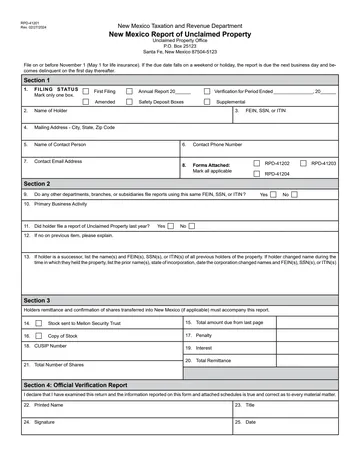
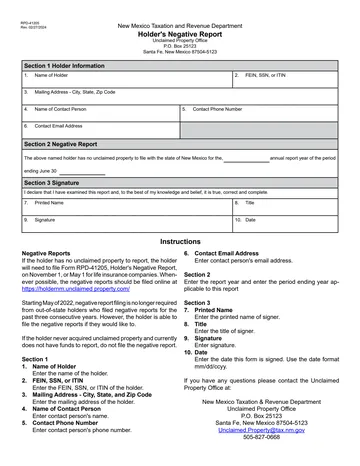
| New Mexico | Before Nov. 1 (life insurers May 1) (June 30) | Required, with exceptions since 2022 | Under $50 | Form RPD-41096; payment still due on time | Electronic NAUPA file above 25 properties; paper forms below (portal) | nmonesource.com |
| New York | March 10 (other dates by industry) (Dec. 31) | Not accepted | $20 or less | Report preparation only, asked 30 days ahead; pay 75% on time | NAUPA format only since 2025; paper Form AC2686 for 25 items or fewer (portal) | osc.ny.gov |
| North Carolina | Before Nov. 1 (life insurers May 1) (June 30) | Not required; a filed report starts the 5-year limit | Under $50; under $25 from Dec. 1, 2026 | Form before Oct. 1; 30, 60 or 90 days | Electronic only since July 1, 2021: NAUPA file or online entry (portal) | ncleg.gov |
| North Dakota | Before Nov. 1 (life insurers May 1) (June 30) | Optional | Under $25 | On request | Electronic NAUPA file (.hrs or .txt) or online entry (portal) | ndlegis.gov |
| Ohio | Before Nov. 1 (life insurers May 1) (June 30) | Required, certified | Under $50 | 30 to 120 days, one per year, filed by the deadline | NAUPA file (.txt or .hrs) or manual report; no paper; no wires (portal) | codes.ohio.gov |
| Oklahoma | Before Nov. 1 (life insurers May 1) (July 1 by statute (office counts to June 30)) | Not required; encouraged | Under $50, except recurring payments | On written request | Online NAUPA file at 15 or more items; notarized verification; check only (portal) | oklegislature.gov |
| Oregon | Oct. 1 to Nov. 1 (June 30) | Active holders and those audited in 5 years | None; $15 or less on request | On written request; first one up to 120 days | Electronic NAUPA file upload or removable media; no email (portal) | secure.sos.state.or.us |
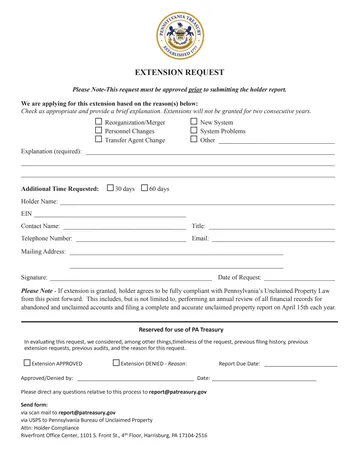
| Pennsylvania | April 15 (Dec. 31) | Not required; encouraged | Under $50 | 30 or 60 days, approved before filing; not two years running | NAUPA file upload or online entry (portal) | palegis.us |
| Rhode Island | Before Nov. 1 (June 30) | Required (office) | Under $50 | Written request 30 days before Nov. 1, case by case | NAUPA file online only; no paper (portal) | findrimoney.gov |
| South Carolina | Before Nov. 1 (June 30) | Required | Under $50 | Email before Nov. 1, case by case | NAUPA file upload or manual report; no paper; electronic payment (portal) | southcarolina.findyourunclaimedproperty.com |
| South Dakota | Before Nov. 1 (life insurers May 1) (June 30) | Not required | Under $10 | 30, 60 or 90 days, asked before the deadline | Electronic NAUPA II file with Form UCP-1 (portal) | southdakota.findyourunclaimedproperty.com |
| Tennessee | Before Nov. 1 (accepted through Nov. 2 in 2026) (June 30) | Not required | Under $25 | One-time 30 days | ReportItTN portal only; NAUPA file; electronic payment, no checks (portal) | treasury.tn.gov |
| Texas | July 1 (life insurers too, since 2021) (March 1) | Required for prior filers (Prop. Code 74.106); Pub. 96-478 asks every holder with nothing to file one | Under $25 | Not listed | NAUPA file through the secure portal, or online entry; electronic only (34 TAC 13.21) (portal) | tcss.legis.texas.gov |
| Utah | Before Nov. 1 (Nov. 3 in 2026) (June 30) | Not required | Under $50 by statute (rule: $5) | Written request 30 business days before; reasonable cause | Electronic only, on the website; no paper (portal) | le.utah.gov |
| Vermont | Before May 1 (Dec. 31) | Not required; encouraged | Under $25 | Written request 30 days before May 1 | NAUPA file over 10 items; notarized cover sheet with every report (portal) | legislature.vermont.gov |
| Virginia | Before Nov. 1 (insurers May 1) (June 30) | Not required | Under $100 | 30 or 60 days on written request | NAUPA file at 25 or more properties; no CDs or drives (portal) | law.lis.virginia.gov |
| Washington | Oct. 31 (insurers April 30) (June 30) | Only if requested | Under $5 (was $50 before 2026) | Email request before the due date | Online entry or NAUPA II upload; electronic payment (5% penalty for checks) (portal) | dor.wa.gov |
| West Virginia | Before Nov. 1 (life insurers May 1) (June 30) | Not required unless an extension was filed | Under $50 | Form 30 days before; 30 to 90 days | Electronic NAUPA II file, upload or online entry (portal) | wvunclaimedproperty.gov |
| Wisconsin | Nov. 1 (Nov. 2 in 2026) (June 30) | Banks, utilities and life insurers in Wisconsin | Under $5, owner unknown | 60 days, asked Sept. 1 to Oct. 31 | My Tax Account: NAUPA .TXT file or manual entry; no paper (portal) | revenue.wi.gov |
| Wyoming | By Nov. 1 (June 30) | Not accepted | Under $50 by law; office wants detail | Form before the due date; 30, 60 or 90 days | Online only, .txt NAUPA file; no CDs or email (portal) | statetreasurer.wyo.gov |
Negative reports
A negative report says the holder has nothing to report this year. The 2016 act leaves it to the state, and the states split three ways. 7 require one from every holder that has nothing: Colorado, Georgia, Massachusetts, New Mexico, Ohio, Rhode Island and South Carolina. Texas puts it in the statute: a holder that has filed once “shall file a property report in each successive year” (Tex. Prop. Code 74.106), and the Comptroller's Publication 96-478 goes further: “Holders that have determined that they are not holding abandoned property are required to file a negative report.” The statute governs; a first-time Texas holder with nothing to report loses little by filing one anyway. Another 14 require one only from some holders, such as in-state companies, larger businesses, banks and utilities, prior filers, holders recently audited, or holders the office asks: California, Connecticut, District of Columbia, Florida, Idaho, Illinois, Maine, Maryland, Minnesota, Nevada, Oregon, Texas, Washington and Wisconsin. And some refuse them: New York says “Preliminary and Negative reports are not required by New York State. Do not submit them.”, and Alaska warns “If a negative report is filed, it will be rejected.”
From the negative report column of the table below.
Where a negative report is optional, filing one can still help. North Carolina explains that the absence of a filed report “leaves a ‘hole’ in their filing history”, and without a report the five-year limitations period never starts for that year. Keep a record of the review either way; an auditor will ask how the holder knew it had nothing.
Aggregate amounts and small items
Most states let small items go on the report as one total per property type, without owner names. The 2016 act allows it for items under a dollar amount it leaves in brackets for each state to fill (section 402). The limits run from under $5 in Illinois, Washington and Wisconsin to under $100 in Alaska, Kansas, Massachusetts, Minnesota and Virginia. 5 jurisdictions allow no aggregate at all: Connecticut, Idaho, Nebraska, Nevada and Oregon. Many offices discourage it even where the law allows it, because an owner on an aggregate line cannot be found by a search. Aggregating does not mean skipping: the money is still reported and paid, and several states say there is no minimum. A few states do excuse a very small report. North Carolina excuses a holder whose property totals “two hundred fifty dollars ($250.00) or less in a single reporting year” from reporting that year, and Nebraska and Kansas have similar floors; the property is reported in a later year.
Extensions
Most states grant an extension on a request made before the due date, usually 30 to 90 days, and many publish a form. The catch is the money. The 2016-act states let a holder stop interest by paying an estimate: in Arizona's words, an interim payment “terminates the accrual of additional interest on the amount paid”. New Jersey gives no extra time to pay at all: “The UPA does NOT provide an extension to remit funds.” New York extends report preparation only, and to avoid penalty and interest “you must remit 75% of either the value of the” report or the prior year's amount. Due diligence is not a reason: Illinois says letters and other required holder actions “does not constitute reasonable cause”, and Connecticut will not extend “because due diligence was not completed in a timely manner”.
Filing the report
Almost every state takes the report as a file in the NAUPA standard format, uploaded to its holder portal, with a manual entry screen for small reports. The 2016 act bars paper: the “administrator may not require a holder to file a paper report.” Several states now refuse paper outright, and some still allow paper forms below a count, such as Georgia under 25 properties and New Hampshire under 20. Arizona and Hawaii have no upload site and take the file by email or on disk. The NAUPA format page explains the file and which states take which file types.
The steps the holder manuals in the table below describe; each state adds its own forms and payment rules.
Every report is verified. Online, that is usually a check box and the filer's name; some states add paper. Hawaii wants a notarized cover sheet and affidavit with every report, Oklahoma a notarized verification, Vermont a notarized cover sheet, and New Hampshire notarizes paper Form T-1 only. Montana tells electronic filers “no notary verification is required”. Separate reports are often required for tangible property, such as safe deposit box contents, and for different holder types.
Remitting cash, securities and safe deposit contents
Payment is due with the report. Illinois: “Reports and remittances are due at the same time.” Delaware treats a holder as delinquent when it fails to deliver payment and report “within seven (7) days of each other”. Payment rules vary widely. Massachusetts takes electronic transfers only: “Checks are not accepted.” Washington says “A 5% penalty applies for remitting by check.” Nevada charges a fee on payments outside its portal equal to the “greater of $50 or 2 percent of the amount of the” payment. California requires electronic transfer for “at least two thousand dollars ($2,000)”. New Jersey: “For Holders who are reporting $50,000 or more, a Fed Wire is required.” At the other end, Arizona says “Do not send payment via ACH.”, and Oklahoma takes checks only.
Securities are delivered, not sold, in most states, through DTC or ACATS to the state's custodian, often after an advance notice of two to ten business days. Massachusetts is typical: “All securities must be transferred prior to the November 1st reporting deadline.” Worthless and non-transferable shares stay off the report; Colorado “does not accept worthless securities (current market price is less than 1 cent per share)”. Safe deposit box contents usually come later, on the state's instructions. Kentucky: “Tangible property in a safe-deposit box shall not be delivered to the administrator” until 120 days after the report. The securities and retirement guide covers delivery and the IRS withholding rules for retirement accounts.
Late or missing reports draw interest and penalties in every state; the penalties and interest guide lists them, and a holder that has never filed can use a state's voluntary disclosure program.
Changes in 2025 to 2027
Washington, Jan. 1, 2026. The aggregate limit fell to under $5: “aggregate item threshold changes from $50 to $5 per item”. North Carolina, Dec. 1, 2026. Session Law 2026-50 lowers the aggregate limit from under $50 to under $25 (“amounts due an apparent owner less than twenty‑five dollars ($25.00) may be” reported in the aggregate) and requires owner detail for all securities property. Connecticut, July 1, 2025. Public Act 25-81 moved the report date to March 31 by changing “ninety days after” to March 31 following the calendar year. Illinois, Jan. 1, 2026. A holder now “holds the property in trust for the benefit of the administrator” (765 ILCS 1026/15-406). Maine, 2027. Public Law 2025 ch. 675 rewrites parts of the act, but the Treasury says it “will not effect the June 30, 2026 reporting that is due November 1, 2026”. New York, 2025. NAUPA files became the only format accepted. Indiana, 2027. The Attorney General announces NAUPA III. Nevada, 2026. A custodian change moved securities delivery to November, “with a deadline of November 30, 2026”, while reports stay due October 31.
Forms, line by line
Tools for this topic
Templates
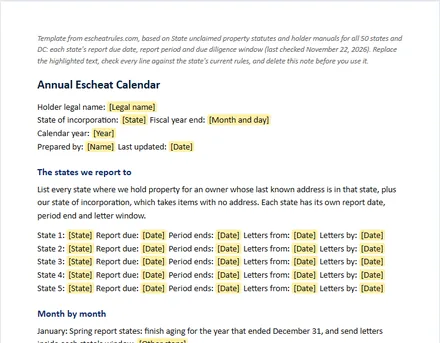
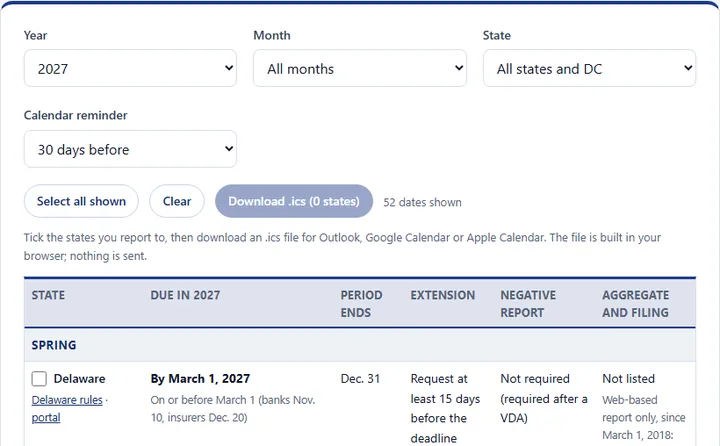
Annual escheat calendar
A printable calendar of the holder's year: period ends, due diligence letters, report and payment dates, with every state's date filled in to start from.
Questions holders ask
When are unclaimed property reports due?
In 42 jurisdictions the business holder report is due in the fall, most before November 1 for the year ending June 30. Connecticut, Delaware, Florida, Illinois, New York, Pennsylvania and Vermont want it in spring for the calendar year, and Michigan and Texas in summer. Insurers and banks often have other dates.
Do I have to file if I have nothing to report?
Only in some states. Colorado, Georgia, Massachusetts, New Mexico, Ohio, Rhode Island and South Carolina require a negative report from every holder with nothing to report; others require one only from in-state holders, larger businesses, prior filers or audited holders; New York, Alaska and Wyoming do not accept them.
What is the cutoff date for an unclaimed property report?
The last day of the period the report covers: June 30 for most November 1 states, December 31 for the spring states that report the calendar year, March 31 in Michigan, and March 1 in Texas.
Can I get an extension on my holder report?
Most states grant 30 to 90 days on a request made before the due date. Several do not extend the payment: pay an estimate by the original date to stop interest. New York extends report preparation only and wants 75 percent paid on time.
What is aggregate reporting?
Reporting small items as one total per property type without owner names. Limits run from under $5 in Illinois, Washington and Wisconsin to under $100 in several states, and some states allow no aggregate at all.
Do I pay when I file or later?
With the report in almost every state. California is the exception: the Notice Report is due before November 1 and the money comes with the Remit Report between June 1 and June 15.
Sources
- Revised Uniform Unclaimed Property Act (2016, as amended 2022), sections 401 to 404 and 603: Uniform Law Commission
- Due dates: the statute or holder manual behind each state's row (Source column), the same quotes the state map uses
- Tex. Prop. Code ch. 74: statutes.capitol.texas.gov; N.C. Gen. Stat. 116B-60: ncleg.gov; Cal. Code Civ. Proc. 1530 to 1532: leginfo.legislature.ca.gov
- State holder manuals and pages: New York Office of Unclaimed Funds, Illinois Treasurer, Washington Department of Revenue, Massachusetts Treasury and the others linked in the table