Texas v. New Jersey (1965), Pennsylvania v. New York (1972), Delaware v. New York (1993), Delaware v. Pennsylvania (2023) and 12 U.S.C. 250112 U.S.C. 2501United States Code, Cornell LII to 2503.
One item, one state
A business that owes money to people in many states does not report everything to its home state, and it does not report the same item twice. The Supreme Court explained why only one state can take each item: citing an earlier case, it noted that the Due Process Clause of the Fourteenth Amendment “prevents more than one State from” escheating a given item of property. Because the states could not settle the question among themselves, the Court wrote the rule, using its power to decide disputes between states. Those rules bind the states: “no State may supersede them by purporting to prescribe a different priority under state law” (Delaware v. New York, 507 U.S. 490).
The leading case is about an ordinary payables file. Sun Oil owed small sums “to approximately 1,730 small creditors who have never appeared to collect them”, including “uncashed checks payable to suppliers for goods and services”. Four states claimed them. The answer the Court gave in 1965 still decides where most vendor checks, wages and credits go.
The two priority rules
First: the owner's last known address in your records. The Court held that each item “is subject to escheat only by the State of the last known address of the creditor, as shown by the debtor's books and records”. Only the holder's own records count; the Court said “the address on the records of the debtor, which in most cases will be the only one available, should be the only relevant last-known address” (Texas v. New Jersey, 379 U.S. 674).
Second: the holder's state of incorporation. If the records show no address, or the address is in a state whose law does not provide for escheat of that property, the state of corporate domicile takes it. That state holds it only provisionally, “retaining the property for itself only until some other State comes forward with proof that it has a superior right to escheat”.
The Court looked at other tests and rejected them. A test of the most significant contacts “would serve only to leave in permanent turmoil” the question. The state of incorporation as the first rule “would too greatly exalt a minor factor”. And it chose simplicity on purpose: “It is fundamentally a question of ease of administration and of equity.”
U.S. Reports and the Supreme Court's 2023 opinion; 12 U.S.C. 250112 U.S.C. 2501United States Code, Cornell LII to 2503 (Pub. L. 93-495, 1974).
The four Supreme Court cases
Pennsylvania v. New York (1972). Western Union “does not regularly record the” addresses of its money order creditors, so under the 1965 rules almost all of its unclaimed money orders would go to New York, its state of incorporation. The Court refused to bend the rule for poor records, because varying it by the quality of a holder's records “would require this Court to do precisely what we said should be avoided”. It added that “nothing we say here prohibits the States from requiring Western Union to keep adequate address records” (407 U.S. 206). Congress answered two years later with the federal Disposition Act, below.
Delaware v. New York (1993). The case was about dividends and interest held by brokers and banks for owners they could not identify. The Court set out three steps, starting with this one: “First, we must determine the precise debtor-creditor relationship as defined by the law that creates the property at issue.” The second and third steps are the two priority rules. It found the intermediaries holding securities in their own name are the debtors, so their state of incorporation, not the issuers', took the unclaimed distributions. It refused to swap incorporation for a principal executive office test, which “needlessly complicates an inquiry made irreducibly simple by Texas' adoption of a test based on the State of incorporation”, and it required a state claiming under the first rule to prove addresses item by item, not by statistics. The securities and retirement page covers what that means for holders of securities.
Delaware v. Pennsylvania (2023). MoneyGram sold official checks and similar instruments through banks and kept few purchaser addresses, so Delaware, its state of incorporation, had been taking the unclaimed funds: by the defendant states' count “Delaware took $250 million between 2002 and 2017”. A unanimous Court held the federal Disposition Act covered those instruments, so they “should generally escheat to the State of purchase” (598 U.S. 115). What counts is the issuer's own practice: “it is the recordkeeping practices of the entity holding the funds that is relevant”. The Court left some products open: “We are not opining today as to whether the FDA applies to cashier's checks”, certified checks or other teller's checks. The case ended in 2024 when the parties stipulated to dismiss (Supreme Court docket No. 145, Orig.).
Money orders and traveler's checks
For these instruments Congress replaced the Court's rules in 1974. Its findings say the issuers' records “do not, as a matter of business practice, show the last known addresses of purchasers of such instruments”, and that “a substantial majority of such purchasers reside in the States where such instruments are purchased” (12 U.S.C. 2501)12 U.S.C. 2501United States Code, Cornell LII. The statute covers a “money order, traveler's check, or other similar written instrument (other than a third party bank check)” on which the issuer is directly liable, and sets three rules (12 U.S.C. 2503)12 U.S.C. 2503United States Code, Cornell LII:
- If the issuer's records show the state of purchase, “that State shall be entitled exclusively to escheat or take custody of the sum payable on such instrument”.
- If they do not, the state where the issuer “has its principal place of business” takes the sum, until another state proves by written evidence that it is the state of purchase. Note the switch: principal place of business here, not state of incorporation.
- If the state of purchase has no law for the property, the principal place of business state takes it, subject to the state of purchase's right to recover it later.
Most state acts defer to the federal statute. The 2016 uniform act lets the state take these sums only “to the extent permissible under” 12 U.S.C. 250112 U.S.C. 2501United States Code, Cornell LII to 2503 (section 306). A business that sells money orders or official checks should record the state of each sale; after 2023, that record decides the state for a wide range of prepaid instruments. The federal escheat rules page covers the federal layer in more detail.
What counts as the last known address
The Court spoke of an address on the debtor's books. The 2016 uniform act reads that broadly: the last-known address is “any description, code, or other indication of the location of the apparent owner which identifies the state, even if the description, code, or indication of location is not sufficient to direct the delivery of first-class United States mail” (section 301(1)). A ZIP code is enough: if it is for a post office in a state, that state is the last-known address state “unless other records associated with the apparent owner specifically identify the physical address of the apparent owner to be in another state” (section 301(2)). With several addresses on file, the act uses “the state of the most recently recorded address”, skipping a temporary one (section 303).
So the address field in your vendor, payroll and customer files decides where the money goes. An item with a wrong address goes to the wrong state, and the right state can later claim it. An item with no address goes to your state of incorporation, which is why states audit holders whose records show many items with none. The same address is where the due diligence letter goes before the report, so a bad address costs twice: the letter fails and the money goes to the wrong state.
A few states let a holder send small amounts for other states' owners through one report. Georgia allows it “only for insignificant property”, defined as “less than ten accounts totaling less than $1000”, and Illinois takes incidental property for states with which it has reciprocity on similar terms. Each state page lists its own practice.
Foreign addresses, LLCs and other edge cases
- LLCs and partnerships. The Supreme Court cases speak of corporations. The 2016 act defines domicile for other filed entities as “for a business association whose formation requires a filing with a state, other than a corporation, the state of its filing”. For any other holder it is the principal place of business.
- A holder that moved. If your domicile changed, the 2016 act looks to “the state where the holder was domiciled at the time the property was presumed abandoned” (section 304(c)).
- Foreign addresses. The uniform acts give property owed to owners abroad to the holder's state of domicile. The Supreme Court did not decide this; the 2016 act's comment calls it “a rational extension of that ruling”. Delaware changed its law in 2024 so that foreign-addressed property reportable to or exempted by a foreign country is not reportable to Delaware.
- A state that exempts the property. If the address state's law specifically exempts the item (a business-to-business credit, say), the 2016 act stops the domicile state from taking it (section 304(b)). Not every state has adopted that rule; the customer credits page has the 51-state B2B table.
The contested third priority
The uniform acts add a third rule: if the holder's state of domicile does not take the property and the owner's state cannot, the state where “the transaction out of which the property arose took place in this state” may (2016 act section 305). The courts have doubted it. The Third Circuit has said “the two states allowed to escheat under the priority rules of the Texas cases are the only states that can do so” and that “Any other state is preempted by federal common law from escheating the property.” (Marathon Petroleum Corp. v. Secretary of Finance of Delaware, 3d Cir. 2017). The 2016 act's own comment admits the dispute: “Some commentators contend that N.J. Retail Merchants stands as a bar to all” place of transaction rules. A holder that receives a claim based only on where a sale took place should ask the state for its authority.
Sorting a report by state
The holder's steps under the Supreme Court's priority rules and the 2016 uniform act's Article 3.
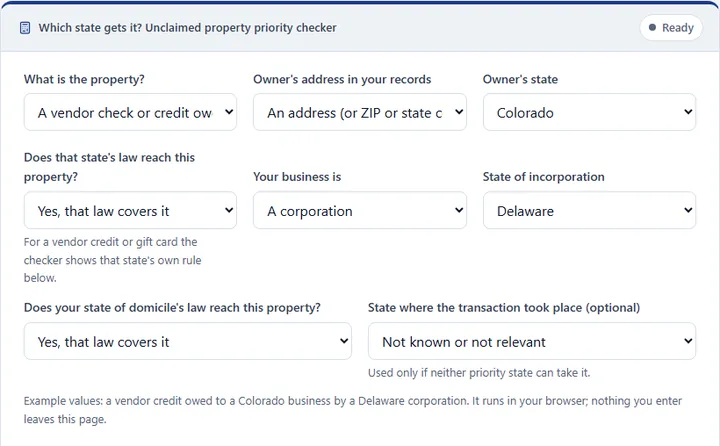
In practice a holder runs the rules once a year across its aged items: confirm which legal entity owes each item, read the owner's address from the master file, apply that state's dormancy period and exemptions, and send what is left to the state of incorporation. Each state then gets its own report on its own date; the unclaimed property reporting guide and the state map have the dates. The which state gets it checker walks one item through the rules.
Tools for this topic
Questions holders ask
Which state do I report unclaimed property to?
The state of the owner's last known address in your own books and records. If you have no address, or that state's law does not cover the property, report it to your state of incorporation. Money orders and traveler's checks go to the state where they were bought.
Is it the state where my company is headquartered?
No. The Supreme Court uses the state of incorporation as the second rule, not the principal place of business, and rejected head office tests. The one exception is the federal money order statute, which falls back on the principal place of business when the state of purchase is unknown.
What if the owner's address is outdated or wrong?
The rule uses the last address in your records, even if mail to it was returned. If the address is wrong, the property can go to the wrong state, and the right state can later claim it. Under the 2016 uniform act a state code or ZIP code is enough to set the state.
Where do items with no address go?
To the holder's state of incorporation, or for an LLC under the 2016 uniform act, the state where it was formed. That state holds the property only until a state with a better claim proves the owner's address was within its borders.
Can a state change the priority rules by statute?
No. The Supreme Court said in 1993 that no state may supersede the rules by prescribing a different priority under state law. Only Congress can reallocate, as it did for money orders and traveler's checks in 1974.
Does Delaware v. Pennsylvania apply to cashier's checks?
The Court did not decide that. It held MoneyGram's official checks and similar instruments fall under the federal Disposition Act, and said it was not ruling on cashier's checks, certified checks or other teller's checks.
Sources
- Texas v. New Jersey, 379 U.S. 674 (1965): Library of Congress, U.S. Reports
- Pennsylvania v. New York, 407 U.S. 206 (1972): Library of Congress, U.S. Reports
- Delaware v. New York, 507 U.S. 490 (1993): Library of Congress, U.S. Reports
- Delaware v. Pennsylvania, 598 U.S. 115 (2023): supremecourt.gov; docket No. 145, Orig.: supremecourt.gov
- 12 U.S.C. 250112 U.S.C. 2501United States Code, Cornell LII to 2503, Disposition of Abandoned Money Orders and Traveler's Checks: govinfo
- Marathon Petroleum Corp. v. Secretary of Finance of Delaware, 876 F.3d 481 (3d Cir. 2017): govinfo
- Revised Uniform Unclaimed Property Act (2016, as amended 2022), sections 102, 301 to 306 and comments: Uniform Law Commission
- Georgia holder FAQs (reciprocal reporting): dor.georgia.gov