From the Revised Uniform Unclaimed Property Act (2016) sections 610 and 1009, C.R.S. 38-13-404 and 38-13-609 as amended by HB 25-1224, Temple-Inland, Inc. v. Cook (D. Del. 2016) and the state statutes in the table below.
Who audits holders
The state's unclaimed property administrator audits. That is usually the state treasurer, sometimes the controller, the comptroller, the revenue department or another office (the escheat laws by state page names each one). The 2016 uniform act gives the administrator the power, “at reasonable times and on reasonable notice”, to examine a holder's records, and to issue “an administrative subpoena” when the holder does not produce them (RUUPA section 1002). Most states have the same power in their own words, and the statutes call the audit an examination.
Many audits are not done by state staff. States hire private firms. The uniform act's drafters described them as “composed of private firms organized to examine the records of holders looking for unreported unclaimed property”, and said the examinations are usually “performed on a contingency fee basis”, with the firm keeping an agreed share “between 10% and 15%” of what it recovers (RUUPA prefatory note). North Carolina's statute is typical of the authority: “The Treasurer may contract with any other person to conduct the examination on behalf of the Treasurer.” (G.S. 116B-71). This site does not name, rate or recommend any audit firm; the table below shows what each state's law says about the contract and the fee.
An audit letter can come from the auditor rather than the state. Check that the letter names the state and the statute, and if you are unsure, ask the state's office, whose contact details are on each state page. The audit notice page explains the letter itself.
How an audit runs
The steps are much the same everywhere, though each state's statute and rules set the details. The 2016 act is a fair outline.
Revised Uniform Unclaimed Property Act (2016) sections 1002, 1003, 1006, 1007, 1009(d), 1101, 1103 and 1104. Each state sets its own steps; check the state's statute in the table below.
Two rules in that outline help the holder. Before a contract auditor is assigned, the administrator must “demand in a record that the person to be examined submit a report and deliver property that is previously unreported”, at least 60 days ahead (section 1009(d)). At the end, the holder is entitled to “a complete and unredacted examination report”, including “the methodology of any estimation technique, extrapolation, or statistical sampling” (section 1007). If an examiner makes “an unreasonable or unauthorized request”, the holder can complain to the administrator (section 1008). Not every state has these rules; the states that adopted the 2016 act do, and the table shows each state's own.
What the auditor looks at is the holder's own ledger: outstanding check lists and void reports, accounts payable and payroll accounts, customer credit balances, write-off and suspense accounts, and the reports already filed. The escheatment accounting guide shows how to keep those accounts so the trail is clean.
How far back an audit reaches
The lookback is the most important number in an audit, and the states differ widely. The 2016 act has two limits: no action “more than five years after the holder filed a non-fraudulent report”, and “The administrator may not commence an action, proceeding, or examination with respect to a duty of a holder under this [act] more than 10 years after the duty arose.” (section 610). The drafters explained the history: “The 1981 Act provides an absolute 10 year statute of repose.” The 1995 act “takes the position that no statute of limitations on examinations begins to run until a report is filed”, and the 2016 act went back to the 1981 approach.
That split still shows in the table. In many states the clock runs only from a report. Alabama, for example, allows no action “more than 10 years after the holder specifically identified the property in a report filed with the Treasurer”, and adds: “In the absence of such a report or other express notice, the period of limitation is tolled. The period of limitation is also tolled by the filing of a report that is fraudulent.” (Code of Ala. 35-12-88(b)). Illinois, Hawaii, Minnesota, Montana, Nevada, New Jersey and New Mexico have the same tolling rule. A holder that never filed has no limit there. Other states cap the reach in years from the duty: Kentucky's statute says “The administrator shall not commence an action, proceeding, or examination with respect to a duty of a holder under this chapter more than ten (10) years after the duty arose.” (KRS 393A.390). A few go further: Pennsylvania counts 15 years after the report is filed, and Massachusetts has no limit for a holder that never filed (72 P.S. 1301.16; M.G.L. c. 200A, 12(f)). Colorado moved the other way: HB 25-1224 cut both the examination limit and the records period from 10 years to 6, effective June 4, 2025 (HB 25-1224).
Some states also reach back by office practice. New York's handbook says “For all VCAs entered into after January 1, 2017, or audits started after January 1, 2019, the reach back period relative to General Ledger type property is 10 years plus the dormancy period for the property.” (New York handbook). Since dormancy is added on top, a 10 year lookback for a 3 year property covers transactions 13 years old.
Records retention
An audit tests the holder's records, so the records period decides what the holder can prove. The 2016 act says a holder keeps the records behind its reports “for 10 years after the later of the date the report was filed or the last date a timely report was due to be filed”, unless a rule sets a shorter period (section 404). Most states use 10 years; some use less. Oregon's holder “shall maintain a record of the name and last-known address of the owner and such signature cards and other evidence that would assist in the identification of the owner for three years after the property has been remitted to the State Treasurer” (ORS 98.354); Iowa keeps 4 years after the report and California 7 years (Iowa Code 556.11; Cal. Code Regs., tit. 2, 1175).
A holder that reports to many states cannot pick one period. The state of the owner's last known address gets each item, so an auditor for any of those states can ask for the records behind it. The safe course is to keep records for the longest period among the states you report to, and longer for a property type with a long dormancy, since the records period starts only when the item is reported.
Throwing records away early is costly. When records are missing, the auditor estimates, and estimates rarely favor the holder. In Temple-Inland, the company “was only able to produce complete records back to 2003 for accounts payable and 2004 for payroll”. “Plaintiff had disposed of older records in compliance with its retention policy.” The state estimated the earlier years.
Estimation and its limits
When records for the audit years are gone, the state may estimate what the holder owed, usually by measuring the unclaimed property in years with records (base years) and applying the rate to years without them. The 2016 act allows it only when records were not kept: then “the administrator may determine the value of property due using a reasonable method of estimation based on all information available to the administrator, including extrapolation and use of statistical sampling when appropriate and necessary” (section 1006). If the holder filed its reports and kept its records, “The examination may not be based on an estimate unless the person expressly consents in a record to the use of an estimate.” (section 1003(c)).
RUUPA (2016) sections 1003(c) and 1006; 12 Del. C. 1172(f) as enacted by S.B. 13 (2017); KRS 393A.570; Temple-Inland, Inc. v. Cook (D. Del. 2016).
The states that adopted the 2016 act kept the consent rule. Kentucky's reads: “The examination shall not be based on an estimate unless the person expressly consents in a record to the use of an estimate” (KRS 393A.570). Wisconsin goes further for contract audits: no contract may allow the auditor “to use statistical sampling to estimate the other person's liability unless the other person consents to the use of an estimate.” (Wis. Stat. 177.1005). Virginia bars contingent fee auditors and estimation without consent for holders based in Virginia (Va. Code 55.1-2536(D)). Utah's act puts it bluntly: an estimated payment “is a penalty for failure to maintain the” records (Utah Code 67-4a-1006). States on older acts usually allow a reasonable estimate whenever records are insufficient; their rule is noted in the state pages.
What the courts said
Temple-Inland v. Cook (D. Del. 2016). In 2008 Delaware “audited plaintiff for deficiencies in reporting and escheating unclaimed property for the previous 22 year time period”. With records gone for the early years, the state estimated and found the company “owed the state $1,388,573.97 in unclaimed property”. The court found two faults in the method. It carried forward only what raised Delaware's claim: if base-year property showed an address in another state, that “has to be extrapolated into the reach back years. Defendants simply did not do that.” And when two states estimate from the same base-year property, “then a holder is being compelled to escheat the same estimated property to two states”. The court also noted that the state “never gave any notice that holders would need to retain records related to unclaimed property”, and called the whole process “a game of ‘gotcha’” that “shocks the conscience”. It granted the holder summary judgment on substantive due process (Temple-Inland, Inc. v. Cook, No. 14-654-GMS).
The decision did not outlaw estimates. The court wrote: “The court does not, however, agree with plaintiff that estimation could never meet this burden.” The 2016 act's comment cites the case as “the outer limits of the use of estimation techniques”.
Marathon Petroleum v. Secretary of Finance (3d Cir. 2017). The auditor in Delaware's examination of Marathon and Speedway had asked for 35 years of “voluminous detailed financial records”. The Third Circuit held that holders can sue: “we disagree with its conclusion that private parties cannot invoke federal common law to challenge a state's authority to escheat property”. It also held that a state may “conduct an appropriate examination to determine if there is fraud or another basis for determining that property may be escheated”, but warned that an audit's demands may become “so obviously pretextual or insatiable” that federal law stops it, and that Delaware could not use its rationale “as a pass for abusive auditing practices” (No. 16-4011, Dec. 4, 2017). The same year, in a case about a contingent fee auditor, the court held that a holder states a due process claim if “all Plains must show is that it was required to submit a dispute to a self-interested party” (Plains All American Pipeline v. Cook, 3d Cir. 2017).
Delaware's 2017 reform
Delaware, the state of incorporation for many large companies and so the state that takes property with no address, rewrote its audit rules in Senate Bill 13, “Approved February 2, 2017” (81 Del. Laws c. 1). The Third Circuit summed it up in Marathon: “the legislature decided to limit the look-back period of all audits to ten years and to impose a ten-year statute of limitations”. The main points:
- Lookback: no examination “for any period more than 10 years prior to when property is presumed abandoned”, counted from the year of the notice, except for fraud or wilful misrepresentation (12 Del. C. 1172(h)).
- Estimation: if the holder filed and kept records, “The examination may not be based upon an estimate unless the holder expressly consents in a record to the use of an estimate.” (1172(f)).
- Records: a holder “shall retain records for 10 years after the date the report was filed” (1145).
- VDA first: no new examination “unless the person has first been notified in writing by the Secretary of State that the person may enter into an unclaimed property voluntary disclosure agreement” (1172(a)). The VDA guide covers that program.
- Contract auditors: no firm may get “more than 50% of the number of all such compliance reviews and examinations” (1178).
- Appeal: the holder can go to the Court of Chancery, whose review includes “state or federal constitutional questions related to the examination” (1179).
The current code still holds those rules, with later changes; the Delaware row below quotes it. The Delaware audits and VDA page goes deeper.
Contract auditors and their fees
The 2016 act “This section expressly permits the use of contract auditors working on a contingent fee” basis, but limits them. In the act's bracketed model, “a contingent fee arrangement may not provide for a payment that exceeds [10] percent of the amount or value of property paid or delivered as a result of the examination”, and on request the holder gets “a complete and unredacted copy of the contract” (section 1009(e)). The drafters noted that “One state, North Carolina, has enacted legislation banning, as a general matter, the use of contingent fee auditors.” That changed in 2026: North Carolina's S.L. 2026-50 now allows contingent fees, and “contingent fee basis shall be limited to twelve percent (12%) of the final assessment.” (G.S. 116B-8).
The caps in the table vary. Colorado and Wisconsin use 12 percent (Wisconsin only for holders not domiciled there), Illinois and Utah 15 percent, and Kentucky, Indiana, DC, Vermont and Washington 10 percent (C.R.S. 38-13-1009; Utah Code 67-4a-1009; KRS 393A.630). Delaware pays hourly only for audits of Delaware-incorporated holders, apart from securities and life insurance accounts: its statute requires “Provide for payment exclusively on an hourly basis for all compliance reviews and examinations of holders incorporated in Delaware, except for compliance reviews and examinations of customer accounts or policies for securities accounts and life insurance policies.” (12 Del. C. 1178). Ohio uses fixed fees for its own audits. Many older acts let the state bill the holder for the cost of the examination, often a daily rate per examiner, capped at the value of the property found (Alaska, Arkansas, Hawaii, Louisiana, Montana, Nevada, New Mexico and Pennsylvania use $200 a day).
Audit rules by state
The lookback or limitation period, the records the holder must keep, and what the law says about contract auditors and examination cost, from each state's statute or rule (a manual or the office's page where noted). "Not listed" means the saved sources do not state it. As of November 2026; last checked 2026-11-22.
| State | Lookback and limitation | Records retention | Contract auditors and exam cost | Source |
|---|---|---|---|---|
| Alabama | 10 years after a report names the property; tolled if no report or a fraudulent one (Code of Ala. 35-12-88(b)) | 10 years after the report is filed, unless a rule sets less (Code of Ala. 35-12-90(a)) | Treasurer may contract examiners; exam cost may be charged, capped at the property found (35-12-89(b), (e)) | treasury.alabama.gov |
| Alaska | No limit found in AS 34.45; the office says an audit can cover all property types back to 1980 (Holder Reporting Handbook) | 10 years after the report is filed, unless a regulation sets less (AS 34.45.300(a)) | Department may contract examiners; cost $200 a day per examiner or more, capped at the property found (AS 34.45.290(b), (e)) | akleg.gov |
| Arizona | 4 years after a report names the property, 6 if over 25% omitted; tolled if no report or a fraudulent one (A.R.S. 44-321(C)) | 5 years after the report is filed (A.R.S. 44-323(A)) | Contingent fee auditors used, Department makes final decisions; cost $100 a day per examiner, capped (44-322(E), 44-340) | azleg.gov |
| Arkansas | 10 years after a report names the property; tolled if no report or a fraudulent one (Ark. Code 18-28-219(b)) | 10 years after the report is filed (Ark. Code 18-28-221(a)); rules say 10 years after remitting (18 CAR 21-306(b)) | Contract examiners may be paid fixed, hourly or contingent fees; cost $200 a day per examiner, capped (18-28-220; 18 CAR 21-602) | lexisnexis.com |
| California | No limit on the state found; expired limitation periods do not prevent escheat (Cal. Code Civ. Proc. 1570) | 7 years after the property is reported (Cal. Code Regs., tit. 2, 1175) | Contract auditors paid time and materials, a percentage of recoveries, or both; fee disclosed to the holder (2 CCR 1180.014) | leginfo.legislature.ca.gov |
| Colorado | 6 years after the duty arose (10 before June 4, 2025); 5 years after a nonfraudulent report (C.R.S. 38-13-609(2), (3)) | 6 years after the later of filing or the last timely due date (10 before June 4, 2025) (C.R.S. 38-13-404(1)) | Fixed, hourly or contingent fees; contingent fee capped at 12% of property recovered; holder may get the contract (38-13-1009(5)) | lexisnexis.com |
| Connecticut | No statutory limit found; the Treasurer's audit process uses a 10 year lookback (First Time Reporting Instructions) | At least 10 years after the report was filed or last due (Conn. Gen. Stat. 3-65a(d)(2), from July 1, 2025) | Not listed; the Treasurer's rule says the Unclaimed Property Division examines records, under oath if needed (RCSA 3-11-3(f)) | cga.ct.gov |
| Delaware | 10 years after the duty arose, counted from the exam or VDA notice; no limit for fraud or wilful misstatement (12 Del. C. 1172(h)) | 10 years after the report is filed; 10 years plus dormancy once under exam or VDA (12 Del. C. 1145) | Contractors capped at 50% of exams; hourly pay only for Delaware-incorporated holders, except securities and life policies (1178) | delcode.delaware.gov |
| District of Columbia | 10 years after the duty arose; 10 years after a non-fraudulent report (D.C. Code 41-156.10(b), (c)) | 10 years after the later of filing or the last timely due date (D.C. Code 41-154.04) | Fixed, hourly or contingent fees; contingent fee capped at 10% (except contracts in force Nov. 13, 2021) (41-160.09) | code.dccouncil.gov |
| Florida | 10 years after the duty arose; tolled by an audit notice or a written VDA election (Fla. Stat. 717.129(2)) | 10 years after the property becomes reportable (Fla. Stat. 717.1311(1)) | Contractors may deduct fees from property recovered; exam fee $100 per 8 hour day per examiner (717.1301(4); 69G-20.0024) | leg.state.fl.us |
| Georgia | 7 years from the date the property is presumed abandoned, except property held as a fiduciary (O.C.G.A. 44-12-231(a)) | 10 years after the property becomes reportable (O.C.G.A. 44-12-228(a)) | Commissioner may employ independent consultants, including to find unreported property; fee basis not stated (44-12-230) | advance.lexis.com |
| Hawaii | 10 years after a report names the property; tolled if no report or a fraudulent one (HRS 523A-19(b)) | 10 years after the report is filed, unless a rule sets less (HRS 523A-21(a)) | Administrator may contract examiners; cost $200 a day per examiner or more, capped at the property found (HRS 523A-20(b), (e)) | capitol.hawaii.gov |
| Idaho | 10 years after the duty arose; 5 years after a non-fraudulent report (Idaho Code 14-5-610(2), (3)) | 10 years after the later of filing or the last timely due date (Idaho Code 14-5-404) | Administrator may contract an agent to examine on its behalf; fee basis not stated (Idaho Code 14-5-102(2)) | legislature.idaho.gov |
| Illinois | 10 years after a report names the property; tolled if no report or a fraudulent one (765 ILCS 1026/15-610(b)) | 10 years after the later of filing or the last timely due date (765 ILCS 1026/15-404) | Contract auditors by RFP: fixed, hourly or contingent fees; contingent fee capped at 15% of property recovered (15-1009) | ilga.gov |
| Indiana | 10 years after the duty arose; 5 years after a nonfraudulent report (IC 32-34-1.5-36(b), (c)) | 10 years after the later of filing or the last timely due date (IC 32-34-1.5-21) | Fixed, hourly or contingent fees; contingent fee capped at 10%; holder may get the unredacted contract (IC 32-34-1.5-60(e)) | iga.in.gov |
| Iowa | No limit found; expired limitation periods do not stop property being presumed abandoned (Iowa Code 556.16) | 4 years after the report is filed (Iowa Code 556.11(8)(a)) | Treasurer may contract auditors; exam cost up to $100 a day per examiner, capped at the property found (556.23; 781 IAC 9.40) | legis.iowa.gov |
| Kansas | 5 years after the holder reports the property; tolled if no report or a fraudulent one (K.S.A. 58-3962(b)) | 10 years after the property becomes reportable (K.S.A. 58-3964(a)) | Exam cost at each examiner's actual hourly salary plus expenses, capped at the property found (K.S.A. 58-3963(d)) | ksrevisor.gov |
| Kentucky | 5 years after a non-fraudulent report; no exam more than 10 years after the duty arose (KRS 393A.390) | 10 years after the later of the report filing or its due date (KRS 393A.250) | Treasurer may contract examiners; contingent fee capped at 10% of property paid; holder may get the contract (KRS 393A.630) | apps.legislature.ky.gov |
| Louisiana | 10 years after a report names the property; tolled if no report; 6 years for insured banks (La. R.S. 9:171) | 10 years after the report is filed; 6 years for federally insured financial institutions (La. R.S. 9:173) | Treasurer may contract examiners; exam cost $200 a day per examiner, capped at the property found (La. R.S. 9:172) | legis.la.gov |
| Maine | 5 years after a nonfraudulent report; 10 years after the duty arose; an exam tolls the 10 years (33 M.R.S. 2120) | 10 years after the report was filed or due, whichever is later (33 M.R.S. 2094) | Treasurer may contract with a person to conduct an examination (33 M.R.S. 2169) | legislature.maine.gov |
| Maryland | 5 years after the report was filed, unless fraud or gross negligence (Com. Law 17-322(a)) | 8 years after the property becomes reportable, per the holder manual | Comptroller staff audit; contract auditors are also used (Comptroller FAQ) | mgaleg.maryland.gov |
| Massachusetts | 3-year dormancy plus 6 years; no time limit if the holder never filed (M.G.L. c. 200A, 12(f)) | 9 years from last activity for reported property, or 6 years from the report (960 CMR 4.07(2)) | Treasurer's agents may audit; court may order $150 a day per examiner as exam cost (960 CMR 4.02; c. 200A, 12(d)) | malegislature.gov |
| Michigan | 10 years after the duty arose; 5 years for B2B records; 4 years in a streamlined audit (MCL 567.250) | 10 years after the property becomes reportable; 5 years for B2B records (MCL 567.252(1)) | May contract examiners; no collection quotas; exam cost $50 a day per examiner, capped (MCL 567.251; R 567.2) | legislature.mi.gov |
| Minnesota | 10 years after a report names the property; tolled if no report or a fraudulent report (Minn. Stat. 345.46(b)) | Not listed | Exam cost $15 an hour per examiner, capped at the property found; percentage fees allowed for recovery (345.53, 345.485) | revisor.mn.gov |
| Mississippi | No limit found; expired limitation periods do not stop the presumption or the report duty (Miss. Code 89-12-35) | 7 years after the date of the holder's report (Miss. Admin. Code 38-4, Rule 5.1 B); the statute sets none | Treasurer may contract examiners (Rule 5.1); holder pays actual exam cost if unreported property is found (Miss. Code 89-12-45(2)) | advance.lexis.com |
| Missouri | 3 years after a report or notice of dispute; 6 years if fraudulent; any time if no report (RSMo 447.548) | At least 5 years after reporting the property (RSMo 447.539.9); the audit rule lists not keeping 8 years as a reason to examine (15 CSR 50-3.075) | Percentage fee contracts allowed for property held out of state, with the governor's approval (RSMo 447.584) | revisor.mo.gov |
| Montana | 10 years after a report names the property; tolled if no report or a fraudulent report (MCA 70-9-819) | 10 years after the holder files the report (MCA 70-9-821) | May contract examiners; exam cost $200 a day per examiner, capped at the property found (MCA 70-9-820) | mca.legmt.gov |
| Nebraska | 7 years after the report for the period; tolled by exam notice or VDA election (Neb. Rev. Stat. 69-1315) | 7 years after the property becomes reportable (Neb. Rev. Stat. 69-1322) | Exam cost may be charged to the holder, capped at the property found (Neb. Rev. Stat. 69-1322) | nebraskalegislature.gov |
| Nevada | 7 years after a report names the property; tolled if no report or a fraudulent report (NRS 120A.680) | 7 years after the holder files the report (NRS 120A.700) | May contract examiners; exam cost $200 a day per examiner, capped at the property found (NRS 120A.690) | leg.state.nv.us |
| New Hampshire | Not listed | 10 years after the property becomes reportable (RSA 471-C:35, I) | Exam cost at the RSA 383:11 rate per examiner, capped at the property found (RSA 471-C:34, IV) | gc.nh.gov |
| New Jersey | 10 years after a report names the property; tolled if no report or a fraudulent report (N.J.S.A. 46:30B-89) | 5 years after the holder files the report (N.J.S.A. 46:30B-95) | May contract examiners; exam cost $50 an hour per examiner, capped at the property found (N.J.S.A. 46:30B-91, 93) | pub.njleg.state.nj.us |
| New Mexico | 10 years after a report names the property; tolled if no report or a fraudulent report (NMSA 7-8A-19(b)) | 10 years after the holder files the report (NMSA 7-8A-21(a)) | May contract examiners; exam cost $200 a day per examiner, capped at the property found (NMSA 7-8A-20) | nmonesource.com |
| New York | Report presumed accurate after 5 years (APL 1412-a); audits reach back 10 years plus dormancy for general ledger items | 5 years after December 31 of the report year; brokers and dealers 10 years (APL 1412-a, 513-a) | Audits may be done by a third party acting on behalf of the Office of Unclaimed Funds (VCA form) | nysenate.gov |
| North Carolina | 5 years after a report; tolled if no report or a fraudulent report (G.S. 116B-71(b)) | 5 years after the holder files the report (G.S. 116B-73(a)) | May contract examiners; contingent fees capped at 12% of the final assessment (G.S. 116B-8, S.L. 2026-50) | ncleg.gov |
| North Dakota | 7 years after a nonfraudulent report; 10 years after the duty arose; tolled by exam or VDA notice (N.D.C.C. 47-30.2-39) | 10 years after the later of the report filing or the last timely due date (N.D.C.C. 47-30.2-24(1)) | Administrator may contract examiners; pay may be a fixed fee, hourly fee or contingent fee (N.D. Admin. Code 85-03-04-01) | ndlegis.gov |
| Ohio | Records review period: 5 years before the exam notice, plus the dormancy period (Ohio Adm. Code 1301:10-1-01(J)) | 5 years beyond the dormancy period, or until an audit is completed, whichever is first (R.C. 169.03(G)(2)) | Director may contract bonded auditors; in-state audits fixed fee, contingency only if Ohio joins another state (1301:10-3-04) | codes.ohio.gov |
| Oklahoma | 4 years after the holder files the report or 10 years after the duty arose, whichever is earlier (60 O.S. 666(B)) | 10 years after the property is reported (60 O.S. 679.1(A)); rule: 4 years after reporting or 10 after the due date | Treasurer may contract examiners; exam cost may be charged to the holder, never above the property found (60 O.S. 678(B), 679(B)) | oklegislature.gov |
| Oregon | Not listed | 3 years after the property has been remitted to the State Treasurer (ORS 98.354(1); OAR 170-145-0045) | Treasurer may use an Authorized Representative under contract to conduct the Examination (OAR 170-145-0000(30)) | oregonlegislature.gov |
| Pennsylvania | 15 years after the report is filed; if not required to report, 15 years after the property became escheatable (72 P.S. 1301.16) | No set period in the law; Treasury recommends at least 10 years after the report (Treasury holder handbook) | Treasurer may contract examiners; exam cost $200 a day per examiner, not above the property found (72 P.S. 1301.23(b), (e)) | palegis.us |
| Rhode Island | 10 years after the duty arose (R.I. Gen. Laws 33-21.1-29(b)) | Owner name and address 7 years after the property becomes reportable (R.I. Gen. Laws 33-21.1-31(a)) | Contract audit firms paid on value of property remitted; exam cost $100 a day per examiner, capped at value found (33-21.1-30(d)) | webserver.rilegislature.gov |
| South Carolina | 10 years after the duty arose (S.C. Code 27-18-300(B)) | Owner name and address 10 years after the property becomes reportable (S.C. Code 27-18-320(A)) | Administrator includes the Treasurer's agents or representatives; Treasury refers to its contracted auditors (27-18-20(1)) | scstatehouse.gov |
| South Dakota | 10 years after the duty arose (SDCL 43-41B-30(b)) | Owner name and address 10 years after the property becomes reportable (SDCL 43-41B-32(a)) | May contract with the Department of Revenue; exam cost $100 a day per examiner, capped at property found (SDCL 43-41B-31) | sdlegislature.gov |
| Tennessee | 10 years after the duty arose (T.C.A. 66-29-140(b)) | 10 years after the later of the report filing or the last timely due date (T.C.A. 66-29-126) | Treasurer may contract examiners after a 60-day demand to report; the contract is public (T.C.A. 66-29-164) | advance.lexis.com |
| Texas | No exam after the 7th anniversary of a report; no limit for false or fraudulent reports or unfiled periods (Prop. Code 74.7021) | 10 years from the later of the date reportable or the report filing date (Prop. Code 74.103(b)) | Comptroller, attorney general or an authorized agent of either may examine records (Prop. Code 74.702(a)) | tcss.legis.texas.gov |
| Utah | 5 years after a nonfraudulent report naming the property, tolled if none; 10 years after the duty arises (Utah Code 67-4a-610) | 5 years after the later of the report filing or the last timely due date (Utah Code 67-4a-404(1)) | Contract examiners may be paid a fixed, hourly or contingent fee; contingent fee capped at 15%; contract is public (67-4a-1009) | le.utah.gov |
| Vermont | 5 years after a non-fraudulent report; 10 years after the duty arose (27 V.S.A. 1520) | 10 years after the later of the report filing or the last timely due date (27 V.S.A. 1494) | Contingent fee capped at 10%; 60-day demand before a contractor; exam cost $200 a day, capped at value found (1569, 1567(b)) | legislature.vermont.gov |
| Virginia | Exam: 10 years before the exam's fiscal year end, non-filers to 1985; suits 5 years, 10 if no or false report (55.1-2536, -2528) | 5 years after the report is filed; 10 years after reportable if no report is filed (Va. Code 55.1-2537(A)) | Contract auditors allowed; for holders based in Virginia, no contingency fee and no estimation without consent (55.1-2536(D)) | law.lis.virginia.gov |
| Washington | 6 years after a filed report, absent fraud; 10 years after the duty arose (RCW 63.30.410(2), (3)) | 6 years after the later of the report filing or the last timely due date (RCW 63.30.250) | Department contracts third party auditors; contingent fee capped at 10% of property paid or delivered (RCW 63.30.650) | app.leg.wa.gov |
| West Virginia | 10 years after the property was first reported or placed in issue; exam tolls it; no protection if concealed (112 CSR 5-10) | All relevant records from the audit authorization letter until the final report (Treasury audit page) | Treasury contracts third-party auditors by authorization letter; audits held offsite virtually (112 CSR 5-11.1) | apps.sos.wv.gov |
| Wisconsin | 5 years after a nonfraudulent report; 7 years after the duty arose for unreported property; none for fraud (177.0610) | 10 years after the later of the report filing or the last timely due date (Wis. Stat. 177.0404(1)) | Contingent fee audits only for holders not domiciled in Wisconsin, capped at 12%; no sampling estimate without consent (177.1005) | docs.legis.wisconsin.gov |
| Wyoming | 10 years after the holder reported the property or gave notice of a dispute (W.S. 34-24-130(b)) | Owner name and address 5 years after the property becomes reportable (W.S. 34-24-132(a)) | Exam cost $100 a day per examiner, capped at the property found, business associations only (W.S. 34-24-131(a)) | wyoleg.gov |
Disputing the findings
An audit ends with findings the holder can contest. Under the 2016 act the holder can ask for an informal conference, then seek administrative review or go to court “Not later than 90 days after receiving notice of the administrator's determination” (sections 1101, 1103 and 1104). States set their own forms and deadlines: California, for example, takes a written request on its Unclaimed Property Informal Audit Review Conference Request, and the form warns that “SUPPORTING DOCUMENTATION MUST BE SUBMITTED WITH THIS REQUEST”. Delaware sends disputes to the Court of Chancery (12 Del. C. 1179). Deadlines are short, so read the findings letter for the date the day it arrives.
The strongest arguments are usually in the holder's own records: an item was paid, reissued, issued in error, or was never owed. The 2016 act lists the defenses a holder can prove for a check, including that it was “replaced with another instrument” or voided “for a valid business reason set forth in a contemporaneous record” (section 1005(c)). Those records have to exist before the audit, which is why the accounting side matters.
Preparing for an audit
A holder that has not reported, or has reported only some property, should look at a voluntary disclosure first: most states offer one, it usually waives penalties and interest, and it is closed once an audit notice arrives. The unclaimed property VDA page lists each state's program. Whether or not you take that route, these steps put a holder in a better position:
- List every legal entity, including acquired and merged companies, and the states where each has owners.
- Find the accounts where unclaimed property sits: outstanding check lists, void reports, payroll, accounts payable, customer credits, suspense and write-off accounts.
- Keep the records for the longest records period among your states, and keep the reports you filed with their due diligence proof.
- Document why items were voided, reversed or written off when you do it, not years later.
- File in every state you owe, including negative reports where a state requires them: in many states the limitation period starts only when a report is filed.
The audit and VDA readiness checklist turns these into a working list, and the penalties and interest page shows what an audit can add to the property itself.
Templates
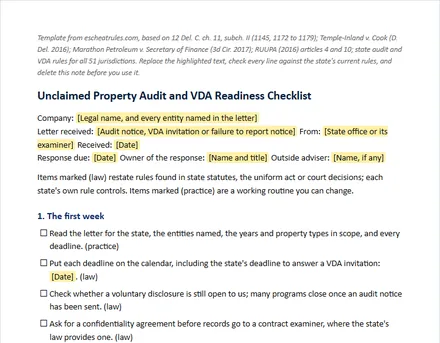
Audit and VDA readiness
What to gather and decide when an unclaimed property audit notice or a VDA invitation arrives, with each state's audit lookback, records rule and VDA program.
Questions holders ask
How far back can an unclaimed property audit go?
It depends on the state. The 2016 uniform act allows no examination more than 10 years after the duty arose, and Delaware limits audits to 10 years before the property was presumed abandoned. In many states on the 1995 act model the clock runs only from a filed report, so a holder that never filed has no limit.
Who conducts unclaimed property audits?
The state's unclaimed property administrator, with its own staff or a private contract auditor. Many contract auditors are paid a share of what they recover, and several states now cap that share at 10 to 15 percent.
Can the state estimate what we owe?
Only when records are missing, in most states, and under the 2016 act and Delaware's 2017 law not at all for a holder that filed reports and kept records, unless it consents in writing. A federal court struck down an estimate that ignored base-year property belonging to other states.
How long do we have to keep unclaimed property records?
Usually 10 years after the report is filed, under the 2016 act and most states. Some states use less (Oregon 3 years after remitting, Iowa 4, California 7) and Colorado now uses 6. Keep records for the longest period among the states you report to.
Can we still do a voluntary disclosure after an audit letter?
Usually not. Most state programs are closed to a holder that is under audit or has been notified of one. Delaware is the exception in order: the Secretary of State invites a holder to its VDA before an audit can start.
Do we have to pay the auditor?
Not directly in most states; the state pays the contract auditor. But many statutes let the state charge the holder the cost of the examination, often a daily rate per examiner, capped at the value of the property found.
Sources
- Revised Uniform Unclaimed Property Act (2016, as amended 2022), prefatory note and sections 404, 610, 1002, 1003, 1005 to 1009, 1101, 1103 and 1104: Uniform Law Commission
- Temple-Inland, Inc. v. Cook, No. 14-654-GMS (D. Del. June 28, 2016): govinfo
- Marathon Petroleum Corp. v. Secretary of Finance of Delaware, No. 16-4011 (3d Cir. Dec. 4, 2017): Third Circuit; Plains All American Pipeline v. Cook (3d Cir. 2017): Third Circuit
- Delaware Senate Bill 13, 81 Del. Laws c. 1 (2017): legis.delaware.gov
- State statutes, rules and manuals: the source link in each row of the table, including C.R.S. 38-13 as amended by HB 25-1224 (2025), G.S. 116B-8 as amended by S.L. 2026-50, 12 Del. C. ch. 11, KRS 393A, Wis. Stat. ch. 177, Utah Code 67-4a and Va. Code 55.1-2536; California Form AR-1